
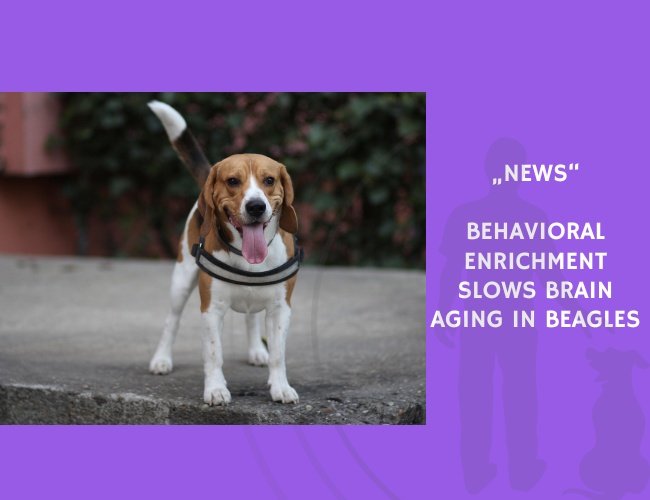
Aging dogs are increasingly recognized as preclinical models for Alzheimer’s disease (AD) due to their natural development of β-amyloid plaques, human-like metabolism, and comparable brain size for imaging studies. In this longitudinal investigation, Noche and colleagues (2024) explored how behavioral enrichment and pharmacological interventions influence structural brain changes in middle-aged beagles.
The study followed 43 beagles (36 females, 7 males) over several years, employing annual MRI scans to measure brain volume changes. While the team also tested tacrolimus, a calcineurin inhibitor, and Q134R, an NFAT-inhibiting compound, neither drug significantly affected brain volume outcomes. Instead, the most striking finding was linked to enrichment.
The results showed that the frontal lobe exhibited accelerated atrophy with age, while the caudate nucleus remained relatively stable. Remarkably, the hippocampus increased in volume across all dogs, suggesting that behavioral enrichment—through mental stimulation, social interaction, and physical activity—contributes to structural brain resilience. This hippocampal growth occurred despite the persistence of frontal lobe decline, highlighting region-specific effects of aging and enrichment.
These findings indicate that while some age-related brain changes may be unavoidable, behavioral enrichment can counteract hippocampal shrinkage and potentially delay cognitive decline. For both veterinary medicine and human Alzheimer’s research, the study underscores the importance of lifestyle interventions in promoting healthy brain aging.
Source: Noche, J. A., Radhakrishnan, H., Ubele, M. F., Boaz, K., Mefford, J. L., Jones, E. D., Rooyen, H. Y., Perpich, J. A., Mccarty, K. L., Meacham, B., Smiley, J., Bailey, S. A. B., Puskas, L. G., Powell, D. K., Sordo, L., Phelan, M. J., Norris, C. M., Head, E., & Stark, C. E. L. (2024). Age-Related Brain Atrophy and the Positive Effects of Behavioral Enrichment in Middle-Aged Beagles. Journal of Neuroscience, 44, published April 1, 2024.










