Introduction: Understanding Post-Meal Food Guarding
You’ve just filled your dog’s bowl, watched them enthusiastically devour every morsel, and walked away satisfied that their nutritional needs are met. Yet minutes later, when you approach to pick up the empty bowl, you’re met with a low growl, stiffened body, or even a warning snap. Your dog is full—physiologically satisfied—but the protective instinct remains fierce. Sound familiar?
This perplexing behavior, known as post-meal guarding, challenges everything we thought we knew about resource guarding. While most people understand that a hungry dog might protect their food, why would a dog who has just eaten continue to guard an empty bowl or feeding area? The answer lies deeper than simple hunger—it’s woven into the intricate tapestry of neural pathways, emotional memory, and learned survival patterns.
Post-meal guarding reveals a fascinating truth about our canine companions: their relationship with food extends far beyond the physical act of eating. Through understanding the neurobiological, emotional, and learned factors that maintain this behavior, we can develop more compassionate and effective approaches to help our dogs feel secure. This journey takes us through the brain’s reward circuits, the shadows of past experiences, and ultimately, toward a path of trust-based healing.
Let us guide you through this complex behavioral phenomenon, exploring not just the “what” but the profound “why” behind your dog’s continued vigilance. 🧡
The Neurobiological Foundation: What’s Happening in Your Dog’s Brain
Dopamine’s Lingering Dance
When your dog eats, their brain doesn’t simply flip a switch from “hungry” to “satisfied.” The neurochemical story is far more nuanced and, frankly, more interesting. Dopamine—often called the “seeking” neurotransmitter—plays a starring role in this drama.
Research reveals that dopamine circuits drive motivation and the anticipation of rewards far more than the reward itself. Think of dopamine as your dog’s internal scout, constantly scanning for opportunities and threats related to valued resources. During feeding, these pathways light up with activity, creating a state of heightened arousal and motivation. Here’s what makes post-meal guarding particularly fascinating: these neural pathways don’t immediately shut down when the food is gone.
The dopaminergic arousal associated with food consumption can outlast the actual eating, sustaining a protective motivation around the feeding area. Your dog’s brain remains in “seeking” mode, maintaining vigilance even though the primary biological drive—hunger—has been satisfied. This persistence of reward signaling creates a continued state of arousal, where the feeding area remains associated with high-value resources worthy of protection.
Key dopamine-driven behaviors you might observe:
- Hovering near the empty bowl long after finishing
- Stiffening or alerting when anyone approaches the feeding area
- Repeatedly checking or circling back to where food was consumed
- Maintaining “guarding posture” (lowered head, direct stare, tense body)
- Difficulty settling or relaxing in other areas of the home immediately after eating
Through functional neuroimaging studies, researchers have observed that dogs who exhibit post-meal guarding show prolonged dopamine pathway activity compared to non-guarding dogs. This neural echo, if you will, keeps the protective circuits engaged long after the last bite is swallowed.
The Amygdala’s Watchful Eye
Deep within your dog’s brain lies the amygdala, particularly the basolateral region, which serves as a critical hub for processing emotional significance and forming conditioned responses. This almond-shaped structure doesn’t just respond to current threats—it maintains vigilance based on learned associations and past experiences.
The amygdala plays a crucial role in retaining the value of rewards even when the physical reward is no longer present. In post-meal guarders, the amygdala continues to associate the feeding area with both past rewards and potential threats. This creates a powerful emotional cocktail: the space where food once was becomes permanently tagged as “high-value territory requiring defense.”
Research using temporary inactivation techniques has shown that when the amygdala’s influence is reduced, dogs demonstrate decreased guarding behaviors. This suggests that the amygdala maintains a persistent “vigilance state,” essentially telling the dog, “This is important, and someone might try to take it—stay alert.”
Even after your dog has eaten, their amygdala continues to process the feeding area as a site of both reward and potential conflict. This isn’t conscious decision-making; it’s an automatic neural response shaped by evolution and individual experience.
The Chemistry of Calm: Oxytocin and Serotonin
While dopamine drives seeking and arousal, other neurochemicals work to create feelings of safety, bonding, and relaxation. Oxytocin, often called the “love hormone,” and serotonin, which regulates mood and anxiety, are particularly important in understanding why some dogs can relax after eating while others remain on guard.
Dogs who exhibit post-meal guarding often show lower baseline levels of these calming neurotransmitters. This neurochemical imbalance creates a perfect storm: high dopamine-driven arousal combined with insufficient calming signals means the nervous system struggles to downregulate after feeding.
Signs your dog may have oxytocin/serotonin deficiency:
- Generally anxious or hypervigilant throughout the day (not just at feeding)
- Difficulty settling or relaxing, even in familiar environments
- Reactivity to minor environmental changes or stimuli
- Limited social engagement or trust behaviors with family members
- Slow recovery from stressful events
- Sleep disturbances or restless rest periods
Think of it this way: oxytocin and serotonin are like your dog’s internal “all clear” signal. They help transition the brain from vigilance to relaxation, from protection to trust. When these neurochemicals are deficient, your dog’s brain lacks the chemical messengers needed to say, “It’s safe now. You can let your guard down.”
Dogs with secure attachments to their humans typically show higher oxytocin levels, which correlates with decreased resource guarding behaviors. The trust built through consistent, positive interactions literally changes brain chemistry, making it easier for dogs to relax around valued resources. This is where the NeuroBond approach becomes particularly relevant—building emotional safety through connection creates the neurochemical foundation for trust-based relaxation. 🧠
Learning, Memory, and the Shadow of Scarcity
The Conditioning That Lingers
Your dog’s brain is an extraordinary learning machine, constantly recording patterns and adapting behavior based on consequences. Post-meal guarding isn’t just about current circumstances—it’s often rooted in learned associations that can span months or even years.
Dogs living in multi-dog households or environments where resources feel scarce learn powerful lessons about competition. Even a single incident where another dog approached their bowl and “stole” a morsel can encode a lasting memory: resources must be guarded, or they will disappear. This learning becomes so deeply ingrained that it persists even when the competitive context changes.
Consider a rescue dog who spent time in a shelter environment. In shelters, feeding time often involves competition, noise, and anxiety. Even after being adopted into a calm, single-dog household, that dog may continue exhibiting guarding behaviors because the neural pathways formed during those stressful times remain active. The behavior was adaptive once, and now it’s become a default response.
The reinforcement history matters profoundly. Each time guarding successfully prevents another animal or person from approaching, the behavior is strengthened. It becomes a self-reinforcing cycle: guard the food → others stay away → guarding “works” → repeat. This cycle can continue even after satiation because the learning isn’t about hunger—it’s about control and perceived safety.
Emotional Memory: When the Past Invades the Present
Food-related experiences create particularly strong emotional memories. This makes evolutionary sense—remembering where food was found and what threats accompanied it enhanced survival. But in our modern dogs, these powerful memories can create problems when they encode experiences of deprivation, theft, or anxiety.
Emotional memories associated with food insecurity trigger what researchers call “fear responses” around feeding. A dog who experienced periods of deprivation doesn’t simply remember being hungry intellectually; they carry a visceral, emotional memory that activates their stress response whenever food is present. These memories create hypervigilance that extends well beyond the meal itself.
Common experiences that create lasting food-related emotional memories:
- Being a stray with uncertain access to food
- Shelter or rescue environments with feeding competition
- Having food stolen by other pets in previous homes
- Punishment administered during or around feeding times
- Sudden dietary changes or periods of reduced rations
- Medical conditions causing chronic hunger (diabetes, parasites, malabsorption)
- Being fed irregularly as a puppy during critical development periods
Here’s what’s particularly challenging: emotional memories are stored differently than factual memories. They’re processed through the amygdala and become deeply wired into automatic responses. Your dog isn’t consciously thinking, “I remember being hungry once, so I should guard this bowl.” Instead, the feeding context automatically triggers a defensive state rooted in past emotional experiences.
Research reveals that dogs exposed to even brief periods of resource theft or mild deprivation show significantly increased post-meal guarding compared to dogs with consistently secure resource access. The emotional memory of “food might disappear” overrides the current reality of “I just ate a full meal.” This is where Soul Recall becomes relevant—those deep, intuitive emotional responses that arise from past experiences and shape present behavior.
The Power of Predictability
Imagine never knowing when your next meal would arrive. Sometimes it comes at 8 AM, sometimes noon, sometimes not until evening. How would you feel around food? Anxious, probably. Hypervigilant, certainly. This is the reality for dogs living with unpredictable feeding schedules.
Circadian rhythms and food-entrained oscillators in the brain create expectations around feeding times. When feeding is consistent and predictable, dogs develop a secure internal sense that “food will come again.” This predictability allows them to relax after eating because the anxiety about future scarcity is minimized.
In contrast, irregular feeding schedules prevent the establishment of this secure expectation. The dog’s brain remains in a chronic state of uncertainty: “I don’t know when food will appear again, so I need to guard everything food-related whenever I can.” This perpetuates guarding behavior even after satiation because the underlying anxiety about resource availability remains unresolved.
Studies comparing dogs with highly consistent feeding schedules to those with irregular patterns show dramatic differences. Dogs with predictable routines demonstrate faster arousal recovery after meals and significantly reduced guarding behaviors. The simple act of consistent timing helps the nervous system learn that resources are reliable, reducing the perceived need for vigilance.
Cognitive Patterns and Behavioral Regulation
When the Mind Can’t Shift Gears
Cognitive flexibility—the ability to adapt behavior to changing circumstances—is crucial for emotional regulation. Post-meal guarders often exhibit what researchers call “cognitive inflexibility,” essentially getting stuck in a defensive mindset even when the threat has passed.
Think of it like a mental gear that won’t shift. The feeding event activates protection mode, but once the food is consumed, some dogs struggle to disengage from this state. They remain locked in vigilance, unable to transition to relaxation even though the original trigger (food) is gone.
This cognitive rigidity isn’t stubbornness or willful disobedience—it’s a genuine neurological challenge. The brain circuits responsible for switching between behavioral states aren’t functioning optimally. What looks like a “choice” to continue guarding is actually an inability to cognitively disengage from previously activated threat cues.
Warning signs of cognitive inflexibility in post-meal guarders:
- Remaining fixated on the feeding area for extended periods (15+ minutes after eating)
- Difficulty transitioning to other activities or spaces after meals
- Repetitive checking behaviors (returning to bowl, sniffing area repeatedly)
- Intense reactions to minor changes in feeding routine
- Struggle learning new behaviors or cues in any context
- Persistent anxiety even in consistently safe environments
Cognitive tasks designed to assess flexibility reveal striking differences between guarders and non-guarders. Dogs who exhibit post-meal guarding typically perform more poorly on reversal learning tasks, where they must learn that a previously rewarded cue is no longer relevant. This suggests a broader difficulty with behavioral adaptation that extends beyond just food-related contexts.
The Arousal That Won’t Subside
Physiological arousal—the activation of your dog’s sympathetic nervous system—is appropriate and adaptive during feeding. Heart rate increases, muscles tense, senses sharpen. This arousal state prepares the body for action, whether that’s consuming food quickly or defending it from competitors.
In healthy regulation, this arousal should begin decreasing shortly after eating finishes. The parasympathetic nervous system, responsible for the “rest and digest” response, should gradually take over, lowering heart rate, relaxing muscles, and promoting calm. But in post-meal guarders, this transition is delayed or incomplete.
Chronic hyperarousal keeps the body in a state of readiness for threat, maintaining guarding behaviors despite physiological satiety. Monitoring heart rate variability, respiration patterns, and other physiological markers reveals that guarders show significantly slower arousal recovery compared to non-guarding dogs. Some remain in an elevated arousal state for 15-30 minutes or longer after finishing their meal.
This prolonged arousal creates a self-perpetuating problem. The longer a dog remains physiologically activated, the more likely they are to interpret neutral events (like a human walking past) as potential threats. The body’s signals tell the brain “there’s danger here,” which reinforces the guarding behavior, which maintains the arousal. Breaking this cycle requires interventions that address both the physical arousal and the underlying emotional perception of safety.
Impulse Control and the Guarding Response
Impulse control—the ability to inhibit an automatic response—varies significantly among individual dogs and can be shaped by early experiences, genetics, and training history. Dogs with poor impulse control struggle to override their immediate defensive reactions, even when those reactions are no longer necessary or appropriate.
Post-meal guarding often involves an impulse control challenge. The dog experiences an urge to guard (triggered by the feeding context and lingering arousal), but they lack the neural braking system to inhibit this urge once the actual need has passed. It’s not that they “want” to guard an empty bowl—they simply can’t stop themselves from responding to the ingrained pattern.
Training that strengthens impulse control can significantly impact guarding behaviors. Teaching dogs to “wait,” “settle,” or engage in incompatible behaviors during and after feeding builds the neural pathways needed for self-regulation. This isn’t about suppressing the guarding instinct through punishment; it’s about developing the cognitive capacity to choose a different response. 😄
The Human-Dog Relationship: Trust, Threat, and Transformation
How Your Actions Shape Their Perception
You might not realize it, but your behavior around your dog’s meal has profound implications for their sense of safety. Every approach to the feeding area, every reach toward the bowl, every verbal interaction during eating is processed through your dog’s threat-detection system.
Human intervention during or immediately after feeding—even well-intentioned actions—can significantly intensify guarding behavior. Approaching a dog while they eat, attempting to pet them during meals, or removing the bowl before they’ve naturally disengaged all send a clear message: “Resources are not safe when humans are near.”
Common human behaviors that can trigger or intensify post-meal guarding:
- Walking directly toward the dog while they’re eating or immediately after
- Reaching down toward the bowl or food area
- Making direct, sustained eye contact during or after feeding
- Hovering or standing over the dog in the feeding space
- Attempting to pet, touch, or handle the dog while they’re in “food mode”
- Removing the bowl while the dog is still near it or sniffing it
- Calling the dog away from the feeding area before they’re ready
- Having multiple people present or moving through the feeding space
This doesn’t mean you’ve done anything “wrong.” Many of us were taught to handle our dogs’ bowls during meals to “show dominance” or “prevent food aggression.” Unfortunately, this advice often backfires spectacularly, creating the very behavior it was meant to prevent. The dog learns that human proximity to food equals potential loss, which understandably triggers defensive responses.
Research comparing different human interaction patterns during feeding reveals that dogs whose humans maintain respectful distance during meals and use calm, predictable routines show significantly lower guarding intensity. The trust built through consistent, non-threatening behavior creates a foundation where the dog learns, “When my person is near food, nothing bad happens. I don’t need to defend.”
Reading Energy: The Invisible Leash of Emotion
Dogs are masters at reading human emotional states. Your tension, anxiety, frustration, or fear doesn’t go unnoticed—your dog perceives it through subtle changes in your body language, breathing patterns, vocal tone, and even chemical signals we’re not consciously aware of.
When you approach a guarding dog with anxiety (because you know they might growl), your tense body posture and hesitant movements can actually reactivate their defensive circuits. From the dog’s perspective, your stress signals danger: “Something is wrong. I need to be on alert.” This creates a feedback loop where your nervousness triggers their guardiness, which increases your anxiety, which intensifies their guarding.
Body language signals dogs read as stress or threat:
- Tense, rigid body posture or sudden movements
- Shallow, rapid breathing
- Direct, fixed eye contact or staring
- Frontal, head-on approach rather than sideways
- Reaching hands or leaning forward toward the dog
- Hesitant, jerky movements that signal uncertainty
- Raised shoulders or aggressive arm positioning
- Quick, nervous speech patterns or harsh vocal tones
This is where the concept of the Invisible Leash becomes particularly powerful. The emotional connection between you and your dog creates an invisible line of communication. When you’re calm, grounded, and confident, this emotional state transmits to your dog, helping their nervous system downregulate. Your calm becomes their permission to relax.
Handler emotional tone and body posture can either soothe or agitate the post-meal period. Experiments observing dogs’ physiological responses to different handler presentations show that dogs exposed to calm, relaxed handlers demonstrate faster heart rate recovery and reduced guarding behaviors compared to those whose handlers displayed tension or direct, confrontational postures.
The Ritual of Safety
Consistency might sound boring, but for dogs predisposed to anxiety around resources, it’s transformative. Feeding rituals—predictable sequences of behaviors that signal safety and routine—help the nervous system learn what to expect, reducing hypervigilance.
A strong feeding ritual might include: feeding at the same time daily, using the same location, following the same sequence of events (leash on, sit, release to eat, humans leave the area), and maintaining the same post-meal routine. This predictability allows your dog’s brain to categorize feeding as “safe, known, controlled” rather than “unpredictable, competitive, threatening.”
Elements of an effective feeding ritual:
- Consistent timing: Feed within the same 15-minute window daily
- Pre-feeding cue: Use a specific phrase or action that signals meal time
- Calm preparation: Prepare food calmly; don’t create excitement or frenzy
- Predictable placement: Always place bowl in the exact same location
- Release cue: Use a consistent word or gesture to signal “okay to eat”
- Respectful distance: Immediately leave the area, giving complete privacy
- Post-meal space: Wait for the dog to naturally disengage and leave the area
- Calm removal: Only remove bowl 10-15 minutes after dog has left the space
The calm disengagement part is crucial. Rather than hovering, watching, or approaching immediately after your dog finishes, giving them space to naturally disengage from the feeding context signals respect and safety. You’re essentially saying, “I trust you with your resources. I’m not a threat.” Over time, this builds the foundation for mutual trust.
Dogs experiencing consistent feeding rituals with calm human disengagement show measurably faster deactivation of guarding responses. Their arousal recovery time decreases, their stress behaviors diminish, and they begin to approach the feeding experience with less anxiety. The ritual becomes a neural pathway of safety. 🧡
Full. Guarded. Waiting.
Hunger ends, vigilance remains. Dopamine still hums where the bowl once sat, whispering that value lingers, that safety must stay defended.
The amygdala remembers reward. Territory marked by food becomes a promise and a threat—its emotional echo louder than logic.

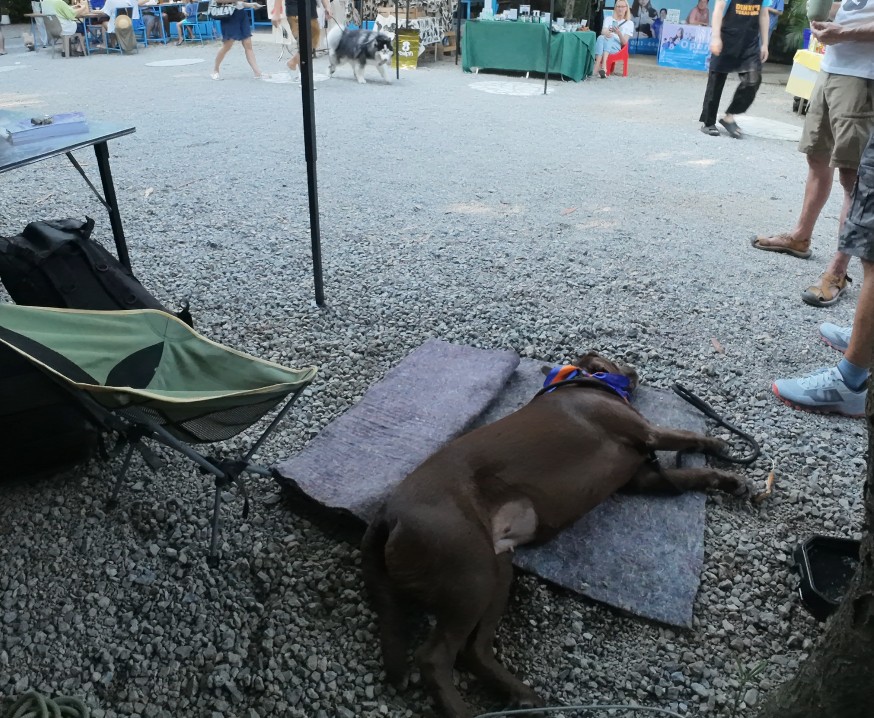
Security rewires survival. Predictable feeding, calm departure, gentle re-entry: these teach the brain that abundance returns and defense can rest.
Behavioral Therapy: Pathways to Peace
Desensitization and Counterconditioning Reimagined
Traditional desensitization and counterconditioning are powerful tools, but they require specific adaptation for post-meal guarding. The goal isn’t just to make your dog tolerate human presence near their bowl—it’s to fundamentally change their emotional response to the post-meal period.
Desensitization for post-meal guarding begins with identifying the threshold—the distance at which your dog notices your presence but doesn’t react defensively. This might be 10 feet, 20 feet, or even across the room. The key is starting below the threshold, where your dog can remain calm.
From this safe distance, you simply exist. You don’t approach, reach, or interact. You’re merely present while your dog finishes eating and naturally disengages. Over many repetitions, your presence becomes part of the normal, non-threatening feeding environment.
Counterconditioning layers positive associations onto this foundation. Once your dog can remain calm with you at threshold distance, you begin pairing your presence with good things happening—but crucially, these good things don’t involve approaching or interfering with the feeding area. Instead, you might toss a high-value treat in the opposite direction, or calmly drop a treat several feet away.
The message becomes: “When my person is in the room after I eat, wonderful things appear, but my food/bowl/space remains mine.” This is profoundly different from approaches that involve reaching toward the bowl or “trading” for it, which can inadvertently reinforce the perception that humans are indeed threats to resources.
Step-by-step desensitization protocol for post-meal guarding:
- Week 1-2: Establish threshold distance (where dog notices you but doesn’t react)
- Week 3: Simply be present at threshold distance while dog eats and after they finish
- Week 4: Sit or stand calmly at threshold, reading or using your phone (no dog focus)
- Week 5-6: Toss treats away from feeding area while at threshold distance
- Week 7-8: Gradually decrease distance by 1-2 feet per week if dog remains calm
- Week 9-10: Practice with different family members at various distances
- Week 11-12: Introduce gentle movement (walking past at safe distance)
- Week 13+: Continue gradual proximity increase, always honoring dog’s comfort
Successful protocols for post-meal guarding specifically focus on the empty bowl period. You’re not working with a dog who’s actively eating; you’re addressing the lingering vigilance after consumption. This requires patience—we’re rewiring deep neural pathways, not just teaching a new behavior.
🛡️ Post-Meal Guarding: When Full Dogs Still Protect Food 🧠
Understanding the neurobiological drive that keeps dogs vigilant even after satiation
🧬 The Neurobiological Foundation
Why Dogs Guard After Eating
Post-meal guarding isn’t about hunger—it’s driven by persistent dopamine arousal in the brain’s reward circuits. Even after eating, these neural pathways remain active, keeping your dog in “seeking” mode. The amygdala continues tagging the feeding area as high-value territory requiring defense, creating vigilance that outlasts physical satiation.
Key Neural Mechanisms
- • Dopamine Persistence: Reward circuits stay activated beyond consumption
- • Amygdala Vigilance: Fear center maintains “threat probability” around feeding area
- • Neurochemical Imbalance: Low oxytocin/serotonin prevents nervous system downregulation
- • Emotional Memory: Past scarcity or competition creates conditioned defensive responses
🔍 Recognizing Post-Meal Guarding Behaviors
What You’ll Observe
Your dog finishes their meal completely, yet minutes later they’re still hovering near the empty bowl. When you approach to pick it up, you’re met with stiffening, growling, or warning snaps. This vigilance can persist for 15-30 minutes or longer after satiation, revealing that the guarding isn’t about current hunger.
Common Warning Signs
- • Prolonged hovering: Remaining near empty bowl 10-30+ minutes after eating
- • Body stiffening: Tense muscles, lowered head, direct stare when approached
- • Repetitive checking: Circling back to feeding area repeatedly
- • Delayed settling: Difficulty relaxing or moving to other areas post-meal
- • Defensive responses: Growling, lip curling, or snapping at approach
✨ The NeuroBond Approach to Healing
Building Trust-Based Relaxation
Through the NeuroBond framework, we address post-meal guarding at its emotional core. This isn’t about forcing compliance—it’s about creating such profound safety that your dog’s nervous system can finally downregulate after eating. Predictable routines, respectful boundaries, and calm co-regulation literally rewire neural pathways from vigilance to peace.
Essential Protocol Steps
- • Create feeding rituals: Same time, same location, same sequence daily
- • Respect space: Leave the area immediately after placing food; no hovering
- • Practice co-regulation: Maintain calm presence at safe distance post-meal
- • Systematic desensitization: Gradually decrease distance over 12-16 weeks
- • Master your energy: Your nervous system state teaches theirs through the Invisible Leash
⚠️ Critical Safety & Medical Considerations
Rule Out Medical Causes First
Before implementing behavioral protocols, schedule a comprehensive veterinary examination. Gastrointestinal pain, dental disease, thyroid dysfunction, or chronic discomfort can intensify guarding behaviors. What appears as “aggression” may be a dog communicating genuine physical suffering that requires medical intervention, not training.
When to Seek Professional Help
- • Severe aggression: Biting, intense lunging, or attacks requiring safety management
- • No improvement: Behavior persists or worsens after 4-6 weeks of protocol
- • Multi-dog households: Competition creates complex dynamics needing expert guidance
- • Rescue trauma: Unknown history with suspected food-related trauma
- • Safety concerns: Children in home or high bite-risk situations
⚡ The Post-Meal Guarding Formula
Trust + Predictability – Threat Perception = Post-Meal Calm
Golden Rules: Medical check first, always • Feed same time daily (±15 min) • Leave area immediately after placing food • Start desensitization at 2x reactive distance • Your calm = their calm through emotional co-regulation • Decrease distance by 1-2 feet per week maximum • Recovery timeline: Mild = 4-8 weeks, Moderate = 12-16 weeks, Severe = 6+ months • Trust builds through consistency, not confrontation
🧡 The Zoeta Dogsoul Perspective
Post-meal guarding reveals a profound truth: behavior is the language of the nervous system. Through the NeuroBond approach, we recognize that lasting transformation requires addressing emotional safety, not just managing symptoms. When we create environments where trust flourishes and predictability reigns, we’re not training dogs—we’re partnering with their nervous systems to rewrite stories of scarcity into experiences of abundance.
The Invisible Leash reminds us that our emotional state becomes their permission slip. Your regulated breathing, grounded presence, and calm energy teach your dog’s amygdala that safety is real. This is co-regulation at its finest—where neuroscience meets soul, and control gives way to connection. Every moment of post-meal peace is a victory of trust over fear, partnership over force.
© Zoeta Dogsoul – Where neuroscience meets soul in dog training
Emotional Co-Regulation: The Power of Calm Presence
There’s something transformative about simply being present without agenda. Emotional co-regulation involves the human maintaining a calm, grounded state near the dog after feeding, without directly interacting with food, bowl, or the dog themselves. You’re offering your regulated nervous system as a model for theirs.
This approach draws on the understanding that nervous systems communicate. When you’re genuinely calm (not just pretending), your physiological state—your breathing, heart rate, muscle tension—sends signals that the environment is safe. Your dog’s mirror neurons and emotional attunement allow them to quite literally feel your calm.
For dogs stuck in post-meal vigilance, this consistent exposure to a calm human presence during what was previously an anxious period helps retrain neural pathways. The amygdala gradually learns that the post-meal context doesn’t require defensive activation. The autonomic nervous system learns to downregulate more quickly.
Structured emotional co-regulation protocol elements:
- Maintain physical distance initially (respecting the dog’s space)
- Focus on your own breathing and relaxation (4-count inhale, 6-count exhale)
- Avoid direct eye contact or body orientation toward the dog
- Stay present for a set duration (5-10 minutes initially)
- Use soft, peripheral vision rather than direct focus
- Ground yourself physically (feel feet on floor, relax shoulders)
- Gradually decrease distance over weeks as the dog’s arousal recovery improves
- Practice daily consistency for best neural pathway retraining
Research testing these protocols shows significant reductions in post-meal guarding and improved physiological recovery. Dogs demonstrate decreased heart rate variability, more relaxed body language, and shorter durations of vigilance. The human’s nervous system essentially teaches the dog’s nervous system a new response pattern.
The NeuroBond Framework: Building Trust from the Inside Out
Traditional behavior modification often focuses on changing external behaviors—”stop the growling, prevent the snap.” While managing the behavior is important for safety, lasting change requires addressing the internal emotional state driving those behaviors. This is where the NeuroBond framework offers a paradigm shift.
The NeuroBond approach recognizes that post-meal guarding isn’t primarily a training problem—it’s an emotional safety problem. The dog’s nervous system doesn’t feel secure enough to relax around valued resources. No amount of obedience training will resolve this if the underlying emotional foundation remains unchanged.
The framework emphasizes three core principles:
Emotional Safety First: Before attempting any behavior modification, we must establish an environment where the dog’s nervous system can begin to downregulate. This means eliminating threats around food, establishing predictability, and building secure attachment. Only from a foundation of safety can learning occur.
Predictable Routines as Neural Training: Consistency isn’t just convenient; it’s neurologically essential. Predictable feeding times, consistent rituals, and reliable human behavior teach the brain that the world is safe and manageable. This predictability allows the threat-detection system to relax, freeing energy for bonding and learning.
Trust-Based Relationship Building: The human-dog bond is the most powerful tool for behavioral change. When dogs trust their humans deeply—when oxytocin flows freely and the relationship feels secure—their entire threat-response system recalibrates. What once required vigilant protection becomes something that can be shared with a trusted partner.
A comprehensive NeuroBond-inspired intervention for post-meal guarding might include:
- Establishing absolutely consistent feeding times and locations
- Creating pre-feeding rituals that signal safety (calm energy, predictable sequence)
- Allowing complete privacy during and immediately after eating (no approaches, no interaction)
- Gradually introducing calm human presence at comfortable distances
- Building trust through positive experiences unrelated to food
- Teaching relaxation and impulse control through separate training sessions
- Addressing any underlying anxiety or insecurity through relationship building
- Slowly, over months, creating positive associations with human presence during the post-meal period
This isn’t a quick fix. Neural pathway retraining takes time, consistency, and patience. But the results can be transformative—not just reduced guarding, but a fundamental shift in how the dog experiences the world. They move from a state of chronic vigilance to trust-based relaxation, where resources don’t need defending because safety is assured.
That balance between science and soul—understanding the neurobiology while honoring the emotional experience—that’s the essence of Zoeta Dogsoul. 🧠
Special Considerations: Health, History, and Individual Differences
When Medical Issues Masquerade as Behavior
Before assuming post-meal guarding is purely behavioral, it’s essential to rule out medical contributions. Pain, digestive discomfort, and certain health conditions can intensify defensive behaviors around feeding.
Dogs experiencing gastrointestinal pain, nausea, or discomfort after eating may guard their feeding area because they associate that space with physical distress. The guarding isn’t about food protection; it’s about protecting themselves from anticipated pain or the perceived source of discomfort.
Dental issues, oral pain, or difficulty swallowing can also create anxiety around the feeding experience. A dog who experiences pain while eating may remain hypervigilant in the feeding area, anticipating future discomfort.
Certain neurological conditions affecting impulse control or emotional regulation can manifest as or intensify guarding behaviors. Hypothyroidism, for instance, has been linked to increased anxiety and defensive behaviors in some dogs.
Medical conditions to rule out before assuming purely behavioral causes:
- Gastrointestinal disorders (IBD, gastritis, pancreatitis)
- Dental disease or oral pain (broken teeth, gingivitis, abscesses)
- Hypothyroidism (affects mood, anxiety levels, and impulse control)
- Chronic pain conditions (arthritis, especially in neck/spine)
- Food allergies or sensitivities causing discomfort
- Parasitic infections affecting nutrient absorption
- Cognitive dysfunction syndrome in senior dogs
- Neurological conditions affecting behavioral regulation
Before beginning behavior modification, a thorough veterinary examination should assess:
- Gastrointestinal health and function
- Dental and oral condition
- Thyroid and endocrine function
- Neurological status
- Pain indicators
Addressing any underlying medical issues often dramatically improves behavioral responses, making subsequent training more effective.
The Rescue Dog Story: Trauma and Healing
Dogs with unknown or traumatic histories present unique challenges and opportunities. Rescue dogs may carry food-related trauma from their past—periods of starvation, competitive shelter environments, or punishment associated with eating. These experiences create powerful emotional memories that can persist for years.
Understanding this context helps us approach post-meal guarding with compassion rather than frustration. Your rescue dog isn’t being “difficult”—they’re operating from a nervous system shaped by past survival needs. The guarding behavior was once adaptive, perhaps even life-saving.
Healing from food-related trauma requires patience and a trauma-informed approach. This means:
- Never forcing or flooding (exposing the dog to overwhelming triggers)
- Moving at the dog’s pace, not the human’s timeline
- Celebrating small wins (even just finishing a meal with slightly less tension is progress)
- Building trust through consistent, positive experiences across all contexts, not just feeding
- Recognizing that setbacks are normal and don’t represent failure
Many rescue dogs show remarkable improvement once they’ve been in a stable, predictable environment for several months. The nervous system gradually learns that resources are reliable, threat is absent, and trust is possible. But this timeline varies dramatically among individuals—some dogs heal within weeks, others require years.
Individual Differences: Genetics, Personality, and Breed Considerations
Not all dogs respond to the same triggers or interventions in the same way. Individual variation in temperament, genetic predisposition, and breed-specific traits all influence the development and persistence of post-meal guarding.
Some breeds were historically bred for resource guarding or protective behaviors. While any dog can develop post-meal guarding, dogs from guardian breeds or those with strong prey drive may exhibit more intense or persistent guarding patterns. This isn’t deterministic—individual variation within breeds often exceeds variation between breeds—but it’s worth considering.
Personality traits like baseline anxiety level, boldness, and frustration tolerance impact how a dog responds to perceived resource threats. A naturally anxious dog may develop guarding more readily and require more extensive intervention than a confident, easy-going individual.
Previous training experiences also matter. Dogs who’ve been trained using punishment-based methods may show heightened defensive behaviors, as they’ve learned that human interaction can be unpredictable or threatening. Conversely, dogs trained with positive reinforcement often demonstrate greater flexibility and faster response to behavior modification.
Tailoring your approach to your individual dog’s history, temperament, and learning style maximizes success. What works beautifully for one dog may be ineffective or even counterproductive for another.
Environmental Management: Creating a Context for Success
The Safe Feeding Space
Physical environment profoundly impacts behavior. Creating a feeding space that supports relaxation and security helps prevent and reduce post-meal guarding.
Ideal feeding environments are:
- Quiet and low-traffic (not in the middle of a busy kitchen or hallway)
- Separated from other pets (preventing real or perceived competition)
- Consistent (always the same location)
- Protected (the dog can see their surroundings but feels some enclosure or backing)
- Low-stimulation (away from windows with exciting outdoor views or noisy appliances)
Some dogs benefit from feeding in a crate or confined area where they feel protected on multiple sides. This isn’t about punishment or isolation—it’s about creating a den-like space that feels inherently safe. After eating, the dog can then choose to leave this space when they’re ready.
For multi-dog households, separate feeding locations are essential, even if the dogs seem fine eating near each other. The subtle tension of monitoring another dog’s proximity, even without overt conflict, maintains a background stress level that can fuel post-meal guarding.
Reducing Overall Household Stress
Post-meal guarding rarely exists in isolation from the dog’s overall stress level. A dog living in a chaotic, unpredictable, high-stress environment carries chronic arousal that intensifies all defensive behaviors, including guarding.
Addressing household stress involves:
- Maintaining consistent daily routines (not just for feeding, but for all activities)
- Providing adequate physical exercise appropriate to the dog’s breed and age
- Offering mental enrichment that’s engaging but not overstimulating
- Ensuring the dog has adequate rest (adult dogs need 12-14 hours of sleep daily)
- Managing interactions with other pets or family members to prevent conflict
- Creating quiet retreat spaces where the dog can decompress
When overall stress decreases, the nervous system has more capacity for regulation. This makes post-meal arousal recovery faster and reduces the intensity of guarding behaviors. You’re essentially lowering the baseline “threat level” that the dog operates from.
The Role of Enrichment and Routine Balance
Mental enrichment is valuable, but timing and intensity matter. Highly stimulating activities immediately before or after feeding can maintain arousal levels that interfere with post-meal relaxation.
Consider structuring your dog’s day to allow for calm periods around feeding times. Intense play, training sessions, or exciting activities are best scheduled at least an hour before or after meals. This gives the nervous system time to settle before eating and ensures that post-meal arousal isn’t compounded by other stimulating experiences.
Enrichment feeding toys (like Kongs or puzzle feeders) can be helpful for some dogs with post-meal guarding, but require careful implementation. For some individuals, working for food actually increases arousal and guarding. For others, the extended feeding time and mental engagement help with overall regulation. Pay attention to your specific dog’s response. 😄
Moving Forward: Your Action Plan
Assessment: Where Are You Starting?
Before implementing any intervention, honestly assess your current situation. This baseline understanding helps you track progress and adjust approaches as needed.
Consider these questions:
- How intense is the guarding? (stiffening, growling, snapping, biting)
- How long does the guarding persist after eating? (minutes, hours)
- What triggers increase or decrease the behavior?
- How does your dog behave around food in general?
- What is their overall anxiety level outside of feeding contexts?
- How predictable is their current feeding routine?
- What is your relationship like in non-food contexts?
- Are there any medical concerns that should be evaluated?
Document specific observations for a week or two before beginning behavior modification. This gives you objective data to reference later when evaluating progress.
Building Your Support Team
Post-meal guarding, especially if intense, benefits from professional guidance. Consider assembling a support team that might include:
- A veterinarian to rule out medical issues
- A certified professional dog trainer (CPDT-KA) or certified behavior consultant (CBCC-KA)
- A veterinary behaviorist for severe cases or those not responding to standard intervention
Working with professionals experienced in force-free, relationship-based approaches yields the best outcomes. Avoid trainers who recommend confrontational methods, “alpha rolls,” or punishment-based techniques for guarding—these approaches typically worsen the behavior and damage trust.
Implementation: Patience and Progress
Implementing a behavior modification plan for post-meal guarding requires commitment and realistic expectations. This isn’t typically a behavior that resolves in days or even weeks—neural pathway retraining takes time.
Your implementation might follow this general timeline:
Weeks 1-2: Foundation Building
- Establish completely consistent feeding routine
- Create safe feeding space
- Begin calm presence work (far distance)
- Address any medical concerns
- Build trust through positive interactions unrelated to food
Weeks 3-6: Gradual Desensitization
- Slowly decrease distance during post-meal presence
- Continue consistency and routine
- Introduce counterconditioning elements
- Monitor arousal recovery time
- Celebrate small improvements
Weeks 7-12: Integration and Practice
- Practice various scenarios (different family members present, different times)
- Gradually increase “normal” household activity during post-meal period
- Continue monitoring stress signals
- Adjust approach based on progress
Months 4-6+: Maintenance and Refinement
- Continue supporting the dog’s sense of safety
- Maintain core routines while allowing some flexibility
- Address any setbacks with patience
- Recognize that this may be an ongoing management need
Remember that progress isn’t always linear. Your dog may have great weeks followed by a setback. This doesn’t mean failure—it means the nervous system is still learning.
Recognizing Success
Success in addressing post-meal guarding isn’t just about the absence of growling or snapping. Look for these indicators of genuine progress:
Behavioral indicators of healing:
- Faster physiological recovery (heart rate, breathing) after eating
- More relaxed body language in the feeding area (soft eyes, loose muscles)
- Decreased duration of vigilance (returning to normal activity sooner)
- Willingness to leave the feeding area voluntarily and sooner
- Reduced startle responses to movement near the feeding area
- Generally decreased anxiety around food contexts
- Increased trust behaviors toward humans in other contexts (eye contact, approaching freely)
- Improved sleep quality and ability to settle after meals
- Reduced checking or circling behaviors around the empty bowl
- Softer body language when humans are present during post-meal period
These changes reflect genuine internal shifts, not just suppression of outward behavior. This is the healing we’re seeking—transformation from the inside out. 🧡
Conclusion: From Vigilance to Peace
Post-meal guarding in dogs reveals a profound truth about behavior: what we see on the surface rarely tells the whole story. A growl over an empty bowl isn’t about stubbornness or dominance—it’s a window into a nervous system still processing threat, a brain where reward circuits haven’t fully downregulated, and emotional memories that cast long shadows over present moments.
Understanding the neurobiological foundations—the persistent dopamine arousal, the amygdala’s watchful processing, the deficit of calming neurochemicals—helps us approach these behaviors with compassion rather than frustration. Our dogs aren’t choosing to make things difficult; they’re responding from neural pathways shaped by evolution, experience, and individual variation.
The learning history matters. Competition, scarcity, theft, and unpredictability create powerful conditioning that can persist long after circumstances change. Food becomes more than nutrition; it becomes a symbol of security, control, and survival. Breaking these associations requires patience, consistency, and approaches that address emotional learning, not just outward behavior.
The human-dog relationship stands at the center of transformation. Your dog doesn’t just need training—they need trust. They need to learn, through hundreds of small interactions, that resources are safe, that you respect their boundaries, that the world is predictable and generous rather than threatening and scarce. Through the NeuroBond framework of emotional safety, predictable routines, and trust-based connection, we can help dogs transition from resource protection to genuine relaxation.
Behavioral therapy—desensitization, counterconditioning, emotional co-regulation—provides the practical tools for change. But these techniques work best when embedded in a broader philosophy that prioritizes the dog’s emotional experience and respects their pace of healing. We’re not forcing compliance; we’re facilitating safety.
Your journey with a dog who exhibits post-meal guarding may be challenging, but it’s also an opportunity for profound connection. As you work through this behavior together, you’re not just addressing a problem—you’re building a relationship based on mutual understanding and trust. You’re learning to read subtle signals, to regulate your own emotional state, to honor your dog’s needs while gently expanding their comfort zone.
This is the work of the Invisible Leash—that space where control gives way to connection, where rigid rules dissolve into responsive awareness. When your dog can finally relax in their feeding space, when they can meet your eyes after eating without tension, when they choose to walk away from their bowl knowing it will be there tomorrow—that’s not just behavioral success. That’s trust made visible.
The science gives us understanding. The techniques give us tools. But ultimately, transformation happens in the quiet moments of mutual presence, in the consistent choices that build safety, in the patient accumulation of experiences that gradually rewrite the story. From vigilance to peace, from protection to trust, from anxiety to calm—this is the journey we take together with our dogs.
You’re not alone in this work. Thousands of dogs and their devoted humans have walked this path before you, and thousands more will follow. Each small step forward matters. Each moment of maintained calm is a victory. Each day that builds upon the last creates neural pathways of safety that grow stronger with time.
May your journey be filled with patience, understanding, and the growing trust that transforms both dog and human. That, truly, is the essence of Zoeta Dogsoul.
For more resources on building trust-based relationships with your dog and understanding the neuroscience of behavior, continue exploring the concepts of NeuroBond, the Invisible Leash, and Soul Recall in your daily interactions. Every moment is an opportunity for connection.