Introduction: When Sound Becomes the Enemy
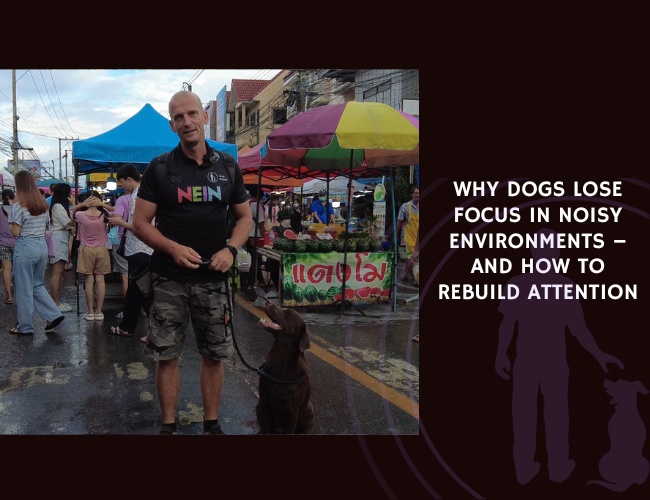
Picture this: You’re at the park with your usually attentive Border Collie, practicing recall exercises that she masters perfectly in your backyard. But today, with children playing nearby, traffic humming, and other dogs barking, she seems like a completely different animal. Her eyes dart everywhere except toward you, her body tenses at every new sound, and that reliable recall? Completely forgotten. You might wonder if she’s being stubborn, but what’s really happening runs much deeper – her brain is experiencing a neurological traffic jam that makes focus nearly impossible.
The relationship between noise and canine attention isn’t just about temporary distraction. When we understand how auditory overstimulation hijacks our dogs’ neural pathways, we can see that what looks like disobedience is actually a brain overwhelmed by competing signals, stress hormones flooding the system, and survival instincts overriding learned behaviors. This invisible struggle affects millions of dogs daily, from anxious pets hiding during thunderstorms to working dogs whose performance falters in chaotic environments.
Let us guide you through the fascinating neuroscience behind why your furry friend loses focus in noisy settings, and more importantly, how you can rebuild their attention using evidence-based techniques that respect their emotional and cognitive needs. Because understanding the ‘why’ behind the behavior is the first step toward creating lasting change. 🧠
The Neuroscience of Noise: Understanding Your Dog’s Brain Under Stress
How the Prefrontal Cortex Struggles with Sound Overload
Your dog’s prefrontal cortex (PFC) acts as the brain’s executive control center, managing everything from impulse control to sustained attention. Think of it as the conductor of an orchestra – when all instruments play in harmony, beautiful music emerges. But when noise creates chaos, this conductor becomes overwhelmed, unable to direct the performance effectively.
In quiet environments, the PFC maintains a delicate balance between excitatory neurotransmitters like glutamate-glutamine (Glx) and inhibitory ones like GABA. This balance allows your dog to filter relevant information from background noise, focus on your voice, and execute learned behaviors. However, auditory overstimulation disrupts this neurochemical harmony. The brain’s resources, instead of processing your “sit” command, become consumed by analyzing every car horn, barking dog, and rustling leaf as a potential threat.
Research in mammalian neuroscience shows that damage or disruption to the lateral prefrontal cortex severely impairs attentional mechanisms. While your dog’s PFC isn’t damaged, the flooding of sensory input creates a temporary functional impairment – like trying to have a phone conversation while ten other people shout in your ear. The result? Your normally responsive companion simply cannot access the neural pathways needed for focused attention.
The Amygdala’s Survival Override: When Fear Takes the Wheel
Deep within your dog’s brain sits the amygdala – an ancient structure that hasn’t changed much since their wolf ancestors roamed the wilderness. This almond-shaped cluster of neurons serves as the brain’s alarm system, and it takes its job very seriously. When loud, unpredictable sounds occur, the amygdala doesn’t pause to analyze whether that boom was thunder or a truck backfiring. It immediately triggers a cascade of survival responses.
This activation initiates two major stress pathways: the sympathetico-adreno-medullary (SAM) axis floods the body with adrenaline and noradrenaline, while the hypothalamo-pituitary-adrenal (HPA) axis releases cortisol. Within seconds, your dog’s entire physiology shifts from “learning mode” to “survival mode.” Their pupils dilate, muscles tense, heart rate accelerates – all preparing for fight, flight, or freeze.
Here’s what makes this particularly challenging: the amygdala’s response happens faster than conscious thought. Before your dog’s thinking brain can evaluate whether that loud noise is actually dangerous, their body has already launched into emergency protocols. This biological reality means that no amount of training can completely eliminate this initial fear response – but understanding it helps us work with, rather than against, our dogs’ natural wiring.
The Neurotransmitter Disruption: Chemical Chaos in the Canine Brain
Imagine neurotransmitters as text messages between brain cells. Under normal conditions, dopamine sends “pay attention” messages while norepinephrine delivers “stay alert” updates. These chemical messengers work together to maintain your dog’s ability to focus, learn, and respond appropriately to cues. But noise doesn’t just add more messages – it scrambles the entire communication system.
When stress hormones flood the brain during noise exposure, they interfere with normal neurotransmitter function. Dopamine signaling becomes erratic, making it difficult for your dog to experience the reward sensation from following commands. Norepinephrine levels spike too high, creating a state of hypervigilance where everything seems equally important and threatening. The normally precise chemical ballet becomes a chaotic mosh pit.
This neurochemical disruption explains why even well-trained dogs can seem to “forget” everything they know in noisy environments. It’s not forgetfulness – it’s a temporary inability to access those neural pathways while the brain deals with what it perceives as an emergency. Understanding this helps us approach training with patience rather than frustration, recognizing that our dogs aren’t being stubborn; their brains are simply overwhelmed.
Behavioral Responses: Reading Your Dog’s Stress Signals
The Observable Signs of Attentional Breakdown
When noise overwhelms your dog’s cognitive capacity, their body becomes a billboard advertising their internal struggle. Learning to read these signs transforms you from a frustrated handler into an empathetic partner who can provide support when your dog needs it most.
Early Warning Signs to Watch For:
- Scanning behavior – rapid head movements trying to locate every sound source, eyes darting constantly, inability to maintain eye contact even briefly
- Tension indicators – tightened facial muscles, furrowed brow, ears pinned back or rotating constantly like radar dishes
- Breathing changes – shallow, rapid panting even without physical exertion, holding breath between sounds
- Body stiffness – muscles visibly tensed, tail held rigidly (either high or tucked), trembling or shaking
Escalation Behaviors Indicating Overload:
- Freezing responses – becoming statue-still as the brain shuts down non-essential functions, appearing “zoned out” or dissociated
- Displacement behaviors – excessive lip-licking when not thirsty, yawning when not tired, sudden intense scratching, “wet dog shakes” despite being dry
- Avoidance attempts – trying to hide behind you, pulling toward exits, attempting to climb into your lap (even large dogs)
- Stress vocalizations – whining, excessive barking at nothing specific, unusual quietness in normally vocal dogs, growling at neutral stimuli
These behaviors serve as pressure valves, releasing tension when the cognitive load becomes unbearable. Recognizing them early allows intervention before complete breakdown occurs.
Breed-Specific Vulnerabilities: Why Some Dogs Struggle More
While every dog can experience noise-related attention loss, certain breeds face unique challenges based on their genetic heritage and sensory capabilities. Understanding your dog’s breed-specific tendencies helps tailor support strategies to their particular needs.
Herding breeds like Border Collies, Australian Shepherds, and German Shepherds were selectively bred for hypervigilance and environmental awareness. These same traits that make them excellent working dogs also make them particularly sensitive to auditory stimuli. Their brains are wired to notice and respond to subtle environmental changes – a rustling bush might mean a straying sheep. In modern environments, this translates to heightened reactivity to urban noise, making focus particularly challenging.
Sight hounds such as Greyhounds and Whippets, despite their reputation for being laid-back, often struggle with sudden loud noises. Their nervous systems are finely tuned for explosive action followed by rest, making unexpected sounds particularly jarring. Guardian breeds like Great Pyrenees and Anatolian Shepherds, bred to independently assess threats, may become hypervigilant in noisy environments, constantly evaluating whether intervention is needed.
Interestingly, companion breeds bred primarily for human companionship rather than specific working tasks often show more variability in noise sensitivity. While some Cavalier King Charles Spaniels remain remarkably calm, others in the same breed may be severely noise-phobic. This variability underscores the importance of evaluating each dog as an individual rather than making breed-based assumptions alone.
The Experience Factor: How History Shapes Response
Your dog’s past writes the script for how they handle noisy environments today. Early socialization – or its absence – creates the foundation for either resilience or vulnerability to auditory stress.
Puppies exposed to varied sounds between 3-14 weeks of age during their critical socialization period develop more robust neural pathways for processing auditory information. These early positive experiences teach the developing brain that novel sounds aren’t inherently dangerous. A puppy who enjoyed supervised exposure to vacuum cleaners, traffic sounds, and household noises while feeling safe develops a higher threshold for noise tolerance as an adult.
Conversely, traumatic associations can create lasting hypersensitivity. A single frightening experience – perhaps being outside during fireworks or experiencing a thunderstorm while alone – can establish powerful fear memories. The amygdala, ever the diligent guardian, files these experiences under “extreme danger” and remains hypervigilant for similar sounds. These dogs aren’t being dramatic; their brains have literally rewired themselves for survival based on past experiences.
Chronic exposure without support creates its own problems. Dogs repeatedly subjected to overwhelming noise without escape or comfort may develop learned helplessness – a state where they stop trying to cope because experience has taught them their actions don’t matter. These dogs often appear shut down or dissociated during noisy events, having learned that enduring is their only option. 🐾
Stress and Cognitive Load: The Hidden Mental Burden
Working Memory Overload: Why Commands Disappear
Picture your dog’s working memory as a desktop with limited space. In quiet environments, there’s plenty of room for processing your training cues, remembering rewards, and executing behaviors. But noise doesn’t just add items to this desktop – it dumps an entire filing cabinet’s worth of information that demands immediate sorting.
Research reveals that noise significantly increases cognitive load, and this effect is directly related to working memory capacity. When your dog’s brain must constantly filter, evaluate, and process competing auditory stimuli, it’s like running multiple demanding programs simultaneously on an old computer. The system slows, freezes, and eventually crashes. That “sit” command you’re repeating? It’s not even making it past the spam filter of sensory overload.
This cognitive burden is particularly heavy for complex or chain behaviors. While your dog might manage a simple “sit” in moderate noise, a complex sequence like “go to your mat, lie down, and stay” becomes impossible when their working memory is already maxed out processing environmental sounds. This explains why dogs often seem to lose their “advanced” training first in noisy situations while retaining only the most basic, heavily practiced behaviors.
The Physiological Cascade: Cortisol, Heart Rate, and Focus
When noise triggers your dog’s stress response, their body becomes a biochemical storm that makes focus physiologically impossible. Let’s follow this cascade from the first startling sound to complete attentional breakdown.
Within seconds of noise exposure, the HPA axis activates, releasing cortisol into the bloodstream. This stress hormone immediately begins affecting brain function, impairing the hippocampus (crucial for memory) and further disrupting the prefrontal cortex. Simultaneously, heart rate increases and heart rate variability decreases – physiological markers that correlate directly with reduced cognitive performance. Your dog’s body is now primed for emergency action, not learning.
The sustained elevation of stress hormones creates a vicious cycle. Cortisol impairs the very brain regions needed to calm down and refocus, while elevated norepinephrine maintains a state of hyperarousal. Even after the noise stops, these chemical changes persist. This is why your dog might remain distracted and unable to focus for minutes or even hours after a noisy event – their brain is still swimming in a soup of stress chemicals that make normal cognitive function impossible.
Chronic exposure to noise-induced stress can alter baseline cortisol levels, essentially resetting your dog’s stress thermostat to a higher setting. These dogs live in a constant state of mild physiological stress, making them more reactive to additional noise and less able to recover between exposures. It’s exhausting for them, like living life constantly braced for danger.
The Learned Helplessness Trap: When Coping Fails
Perhaps the most heartbreaking consequence of repeated noise exposure without support is the development of learned helplessness. This psychological state emerges when dogs repeatedly experience uncontrollable stress and eventually stop trying to cope or escape.
In the context of noise, this progression typically follows a predictable pattern. Initially, the dog attempts various coping strategies – seeking comfort, trying to escape, or barking at the noise source. When these efforts repeatedly fail to reduce the stress, the dog’s brain makes a devastating calculation: nothing I do matters. This isn’t a conscious decision but a neurological adaptation to persistent, uncontrollable stress.
Dogs experiencing learned helplessness often appear eerily calm during noisy events, but this isn’t true calmness – it’s psychological shutdown. They’ve learned that resistance is futile, so they simply endure. These dogs often show flat affect, reduced interest in normally enjoyable activities, and a general sense of withdrawal. The implications for welfare are severe, as learned helplessness is closely linked to depression in both humans and animals.
Breaking free from learned helplessness requires careful, patient work to rebuild the dog’s sense of agency – teaching them that their actions can influence their environment and that they have some control over their experience. This makes early intervention and proper support during noise exposure critically important for preventing this devastating psychological state. 😔
Training and Rehabilitation Approaches: Building Resilience
Gradual Desensitization: The Art of Tiny Steps
Desensitization works by repeatedly exposing your dog to noise at such low intensities that their amygdala never triggers the alarm response. Think of it as slowly turning up the volume on their tolerance, one barely perceptible notch at a time.
Start with recordings of problematic sounds played at a volume so low you can barely hear them yourself. While your dog remains completely relaxed – perhaps enjoying a puzzle feeder or gentle massage – their brain begins forming new neural pathways that associate these sounds with calm rather than danger. The key is patience; rushing this process by increasing volume too quickly undoes all your progress, potentially making the fear worse.
The progression should be invisible to your dog. If they show any signs of stress, you’ve moved too fast. Successful desensitization sessions look boring from the outside – just a relaxed dog hanging out while barely audible sounds play in the background. Over weeks or months, gradually increase the volume by increments so small that your dog never notices the change. This technique rewires the fear response at a fundamental level, teaching the amygdala that these sounds don’t warrant emergency protocols.
Environmental factors matter enormously during desensitization. Conduct sessions when your dog is already calm, in their favorite safe space, with plenty of positive associations around them. The presence of familiar scents, comfortable bedding, and even your calm energy all contribute to the success of this approach. Remember: you’re not just desensitizing to sound; you’re building an entire new emotional framework around noise.
Counterconditioning: Changing the Emotional Soundtrack
While desensitization reduces fear, counterconditioning goes further by creating positive associations with previously frightening sounds. This technique transforms noise from something to endure into something that predicts wonderful experiences.
The process appears simple but requires precise timing. The moment your dog hears the problematic sound (at a manageable volume), immediately provide something they absolutely love – special treats, favorite games, or affection. The sound becomes a predictor of joy rather than danger. But here’s the crucial part: the good stuff must appear because of the noise, not despite it. Your dog needs to learn that noise makes wonderful things happen.
Classical conditioning works powerfully here because it bypasses conscious thought. Your dog doesn’t need to “decide” to feel happy about the noise; their brain automatically begins anticipating pleasure when they hear it. This is why using truly special rewards matters – boring kibble won’t override fear, but that freeze-dried liver they go crazy for might. The emotional response to the reward must be stronger than the fear response to the noise.
Timing is everything in counterconditioning. The reward must appear within seconds of the noise starting, creating a clear cause-and-effect relationship in your dog’s mind. Too early, and you’re just randomly treating. Too late, and you might accidentally reward fear behaviors. This precision is why many people benefit from professional guidance when implementing counterconditioning protocols.
Scent-Based Focus Tasks: Engaging the Seeking System
When traditional focus exercises fail in noisy environments, scent work offers a powerful alternative that engages different neural pathways less affected by auditory stress. The seeking system – the brain’s exploration and hunting circuitry – can override mild anxiety and provide a positive focus point even amid distracting sounds.
Scent work naturally produces a flow state in dogs, where their entire attention narrows to following odor molecules. This intense concentration crowds out anxiety and creates a positive feedback loop: successful searching releases dopamine, which improves focus, which leads to more successful searching. It’s a beautiful neurological hack that bypasses the stressed prefrontal cortex and engages more primitive, robust brain systems.
Start simple with “find it” games using treats in quiet environments, then gradually add mild background noise. Hide treats or favorite toys, encouraging your dog to use their nose rather than eyes. As their confidence grows, increase both the difficulty of the search and the level of background noise. Many dogs who can’t perform basic obedience in noise can successfully complete scent work because it engages different neural pathways.
The calming effect persists beyond the actual searching. The deep, rhythmic breathing required for scenting activates the parasympathetic nervous system, countering the stress response. Dogs often appear notably calmer after scent work sessions, even in environments that previously triggered anxiety. This makes scent games valuable both as a management tool during noisy events and as part of a broader confidence-building program. 🧡
Noise. Overload. Disconnect.
The executive short-circuit. In quiet, your dog’s prefrontal cortex filters, prioritizes, and delivers focus. In noisy chaos, that filter collapses—commands drown in competing inputs.
The survival hijack. The amygdala fires before thought, flooding the body with adrenaline and cortisol. Learning halts; vigilance rules.


The chemical scramble. Dopamine loses rhythm, norepinephrine surges, reward pathways stall. What looks like “ignoring you” is your dog’s brain locked in emergency mode.
Environmental Management: Creating Safe Soundscapes
White Noise and Sound Masking: The Acoustic Comfort Blanket
Sound masking doesn’t eliminate noise anxiety, but it can significantly reduce the startle response to sudden sounds. By providing a consistent acoustic backdrop, white noise or calming music makes unexpected sounds less jarring to your dog’s nervous system.
The science is straightforward: sudden changes in the acoustic environment trigger alerting responses. A silent room suddenly interrupted by a car door slamming is far more startling than the same sound occurring against a background of gentle rainfall sounds. The continuous, predictable nature of white noise provides a buffer that smooths out acoustic peaks and valleys, reducing the contrast that triggers your dog’s alarm system.
Not all sounds are equal for masking purposes. Research suggests that sounds in the frequency range of 1-2 kHz are most effective for dogs, with classical music, particularly simplified arrangements featuring solo instruments, showing calming effects. Avoid nature sounds with sudden bird calls or thunder, which can trigger alerting. Commercial dog-calming music is specifically engineered with canine hearing ranges and preferences in mind, often incorporating rhythms that match resting heart rates.
Placement and volume matter critically. The masking sound should be loud enough to blur sharp acoustic edges but not so loud it becomes a stressor itself. Position speakers to create an even sound field throughout your dog’s space, avoiding the creation of loud and quiet zones that might increase anxiety. Start with low volumes and observe your dog’s response, adjusting gradually to find their comfort zone.
Noise-Reducing Gear: Physical Barriers to Acoustic Stress
Just as construction workers wear hearing protection, dogs in noisy environments benefit from physical sound reduction. Modern canine ear protection has evolved far beyond simple cotton balls, offering sophisticated solutions for noise-sensitive dogs.
Compression garments like the “Happy Hoodie” or similar products work on two principles. First, they physically muffle sound by covering the ears with fabric that reduces sound transmission. Second, the gentle pressure provides proprioceptive input that many dogs find calming, similar to swaddling effects in anxious humans. These are particularly useful for predictable noise events like grooming, fireworks, or thunderstorms.
Specialized ear protection designed specifically for dogs, such as Mutt Muffs, can reduce noise by 20-30 decibels. Originally developed for military and police dogs exposed to gunfire and explosions, these devices are now available for civilian dogs. They require gradual introduction and positive association training, but once accepted, they provide significant protection during extremely noisy events. The key is ensuring proper fit – too tight causes discomfort, too loose provides inadequate protection.
The psychological benefit often exceeds the physical noise reduction. Dogs wearing ear protection often show reduced anxiety simply because the gear becomes a predictor that their human is actively managing the situation. This learned association – “when I wear my special gear, I’m safe” – can be as powerful as the actual noise reduction. Some dogs even seek out their ear protection when they hear concerning sounds, having learned it provides relief.
Safe Zones: The Sanctuary Solution
Every noise-sensitive dog deserves a dedicated space where they can retreat when the acoustic environment becomes overwhelming. This isn’t about isolation but about providing agency – giving your dog the power to remove themselves from stressful stimuli.
The ideal safe zone combines multiple stress-reducing elements. Location is paramount: choose the quietest area of your home, preferably an interior room away from windows and street noise. Basements often work well due to natural sound insulation, but ensure the space doesn’t feel isolated or punishing. The goal is sanctuary, not exile.
Layer your sound protection in this space. Heavy curtains or sound-absorbing panels on walls, draft stoppers under doors, and even a white noise machine create multiple barriers between your dog and triggering sounds. Add comfortable bedding that retains your scent, as familiar smells provide additional comfort during stress. Some dogs benefit from covered crate spaces within their safe zone, creating a den-like environment that appeals to their instinctive need for enclosed security during vulnerability.
Make it rewarding, not just safe. Stock this space with special toys, long-lasting chews, and puzzle feeders that only appear in the safe zone. This creates positive associations beyond mere stress relief. Practice “safe zone” training during calm times, rewarding your dog for choosing to spend time there. When they independently seek this space during noise events, they’re demonstrating healthy coping skills that should be celebrated, not seen as weakness.
Applications for Working Dogs: When Focus is Mission-Critical
Service Dogs: Maintaining Performance in Public Chaos
Service dogs face unique challenges in noisy environments because their handler’s safety and independence depend on maintained focus. A guide dog navigating a busy intersection, a medical alert dog monitoring for seizures, or a PTSD service dog providing grounding during a crowded event – all must perform despite acoustic chaos.
Training for service dogs must therefore go beyond basic desensitization. These dogs need what trainers call “bombproofing” – systematic exposure to every conceivable sound they might encounter while working. This includes not just volume but variety: construction noise, emergency sirens, crowd sounds, public transportation, and even unusual sounds like parades or protests. Each exposure is carefully managed to build confidence rather than create trauma.
The working mindset provides some protection against noise distraction. Service dogs in harness often show remarkable focus because their training creates a strong contextual cue: “harness on means ignore everything except my handler and my job.” This learned discrimination helps them maintain attention even when the same sounds might distress them while off-duty. However, this compartmentalization has limits, and even the best-trained service dog can become overwhelmed.
Handler awareness becomes crucial for service dog teams. Handlers must learn to read subtle stress signals and provide support before their dog reaches breakdown. This might mean taking breaks in quieter areas, using gentle massage or pressure to calm their dog, or even choosing alternative routes when possible. The partnership requires both members to support each other through challenging acoustic environments.

Military and Police Dogs: Operating in Acoustic Warfare
Military and police dogs operate in some of the most acoustically challenging environments imaginable. Gunfire, explosions, sirens, helicopters, and crowd control situations create a cacophony that would overwhelm most pets. Yet these dogs must maintain laser focus on their handlers and their tasks.
Selection processes for these roles specifically screen for noise resilience. Puppies destined for military or police work undergo early acoustic challenges to identify those with naturally higher thresholds for noise stress. But genetics alone isn’t enough – these dogs require extensive conditioning to maintain performance under acoustic assault.
Training protocols involve gradual exposure to operational sounds at increasing intensities. Critically, this exposure occurs while the dog is engaged in work, teaching them to maintain task focus despite distractions. Gunfire might initially occur at distance while the dog tracks, gradually moving closer as the dog demonstrates continued performance. This creates neural pathways that prioritize task completion over environmental response.
Protective equipment is standard for these working dogs. Military dogs often wear specially designed ear protection during operations involving explosives or sustained gunfire. Some units use electronic hearing protection that allows handler communication while blocking harmful noise levels. The investment in protecting these dogs’ hearing reflects both their value as working partners and the understanding that noise-induced stress impairs operational performance.
Puppy Development: Building Resilience from the Start
The Critical Socialization Window: Setting the Foundation
Between three and fourteen weeks of age, puppies experience a critical period where their brains are exceptionally plastic and primed for learning about their environment. This window represents our greatest opportunity to build noise resilience that will last a lifetime.
Sound socialization during this period should be systematic but gentle. Rather than overwhelming puppies with loud noises, expose them to a variety of sounds at low, non-threatening volumes while they’re engaged in positive activities. The goal isn’t to create fearlessness but to teach the developing brain that novel sounds are a normal, manageable part of life.
Play recordings of various sounds during feeding times, creating positive associations from the start. Include everything from household appliances to traffic noise, emergency sirens to other animals. The variety matters more than intensity at this stage. A puppy who experiences fifty different sounds at comfortable volumes develops better coping skills than one exposed to just a few sounds, even at higher volumes.
Social buffering plays a crucial role during this period. Puppies learn emotional regulation by observing their mother and littermates. If mom remains calm during a thunderstorm, puppies internalize that response. This is why puppies from calm, confident mothers often show better noise resilience. When raising singleton puppies or those separated early, humans must provide this emotional scaffolding, demonstrating calm confidence during sound exposure.
Proactive Protocols: Preventing Problems Before They Start
Building noise resilience requires more than just exposure – it demands thoughtful protocols that respect puppies’ developmental stages and individual differences. Not every puppy progresses at the same rate, and pushing too hard can create the very problems we’re trying to prevent.
The “Puppy Culture” approach advocates for systematic sound exposure starting as early as three days old with extremely mild sounds, gradually increasing complexity and volume over weeks. Puppies experience sounds while nursing, playing, and exploring, creating multi-sensory positive associations. This early start, when fear responses haven’t fully developed, allows for remarkably effective conditioning.
Recovery time matters as much as exposure. After any sound exposure session, puppies need time to process and integrate the experience. Overwhelming puppies with constant noise, even at low levels, can create chronic stress. Structure exposure in short sessions with plenty of quiet time between, allowing the developing nervous system to return to baseline and build resilience gradually.
Individual assessment should guide progression. Some puppies naturally show more sound sensitivity – often those who will become excellent alert or hunting dogs. These puppies need slower progression with more support, not less exposure. Recognizing and respecting these differences prevents pushing sensitive puppies into fearfulness while ensuring confident puppies receive adequate challenge.
Welfare Implications: Beyond Training to Quality of Life
Recognizing Hidden Suffering: The Quiet Crisis
Many dogs suffer from noise-related stress without showing obvious signs of panic. These dogs have learned to suppress their external reactions, but internally experience significant distress that impacts their overall welfare and quality of life.
Chronic stress from noise manifests in subtle ways: decreased appetite, disrupted sleep patterns, reluctance to go outside, or increased reactivity to other stimuli. These dogs might not hide during thunderstorms, but they’re not truly calm either. They’re enduring rather than thriving, and this chronic stress takes a toll on both physical and mental health.
The accumulation effect means that dogs exposed to regular noise stress without support gradually become more sensitive over time. Each exposure without successful coping adds to an invisible burden. A dog who seemed “fine” with city noise for years might suddenly develop severe noise phobia, but in reality, they were never fine – they were slowly reaching their breaking point.
Quality of life assessments must consider acoustic stress as a significant factor. A dog who can’t enjoy walks due to traffic noise, who anticipates and dreads regular environmental sounds, or who lives in chronic hypervigilance isn’t experiencing good welfare, even if they’re physically healthy and loved. Addressing noise-related stress is not about coddling but about ensuring genuine wellbeing.
The Misdiagnosis Problem: It’s Not Stubbornness
Perhaps the greatest welfare concern is the widespread misinterpretation of noise-related attention loss as behavioral problems. Dogs labeled as “stubborn,” “dominant,” or “disobedient” often are simply unable to focus due to acoustic stress.
Consider how many dogs are punished for not coming when called at the park, when they literally cannot process the command over the noise of their environment. These dogs aren’t choosing to disobey – their brains are physiologically unable to attend to and process the cue. Punishment in these situations adds emotional stress to existing cognitive overload, creating negative associations with both the environment and the handler.
The relationship damage from these misunderstandings can be devastating. Handlers become frustrated with their “disobedient” dog, dogs become anxious about their handler’s unpredictable responses, and the human-animal bond suffers. Trust erodes when dogs are punished for neurological responses beyond their control. Many dogs surrendered to shelters for “behavioral problems” are actually suffering from unrecognized and unaddressed noise-related stress.
Reframing the narrative from disobedience to distress changes everything. When handlers understand that their dog is struggling, not defying them, compassion replaces frustration. This shift in perspective opens the door to effective interventions that address the root cause rather than punishing the symptoms. It transforms the handler from adversary to advocate, rebuilding trust and improving welfare for both species in the relationship.
Conclusion: Building a Quieter World Together
As we’ve explored throughout this journey into the canine experience of noise, what appears as simple distraction or disobedience often represents a complex interplay of neuroscience, emotion, and learned experience. Your dog’s inability to focus in noisy environments isn’t a training failure – it’s a window into a brain struggling to process an overwhelming world.
The path forward doesn’t require silence but rather understanding and support. By recognizing the signs of acoustic stress, implementing gradual training protocols, and creating environmental modifications that respect your dog’s sensory experience, you become not just a trainer but a partner in navigating our noisy modern world. Remember that every dog’s threshold is different, shaped by genetics, early experiences, and ongoing support. What overwhelms one dog might energize another, and that’s perfectly okay.
Most importantly, addressing noise-related focus issues is about more than just improving training outcomes – it’s about enhancing quality of life for our canine companions. A dog who can maintain calm focus despite environmental noise isn’t just more obedient; they’re more confident, less stressed, and better able to enjoy their lives alongside us. This isn’t about creating robots who ignore their environment but about building resilience that allows choice and promotes genuine wellbeing.
So the next time your furry friend seems distracted or “stubborn” in a noisy environment, pause and consider what their behavior is really telling you. Are they being defiant, or are they asking for help navigating an acoustic world that their brain finds overwhelming? Your answer to that question – and your response to their need – will shape not just their behavior but the very foundation of your relationship. Because in the end, understanding is the first step toward healing, and compassion is the bridge that helps our dogs cross from fear to focus. 🐾