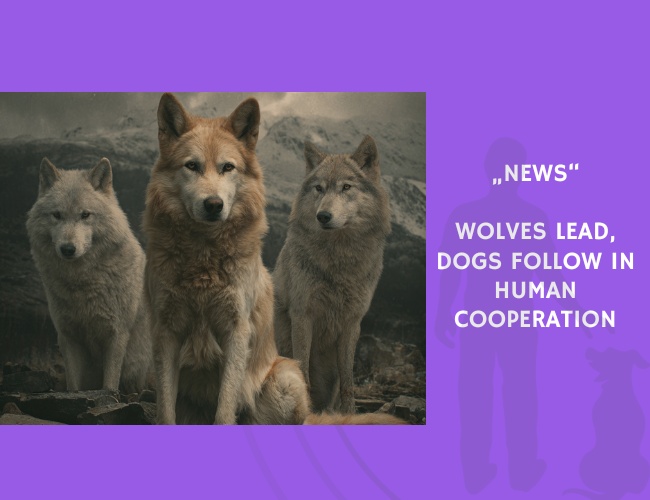
Domestication has long been linked to the evolution of human-like social skills in dogs, yet studies reveal that wolves, their closest relatives, often show greater tolerance and cooperation with conspecifics. To examine whether domestication specifically enhanced dogs’ cooperation with humans, Range and colleagues (2019) compared human-raised wolves and dogs in a cooperative string-pulling task.
Both wolves and dogs successfully cooperated with a familiar human partner, demonstrating that human–dog cooperation likely evolved from wolves’ existing social skills. However, their styles of cooperation differed: wolves more often initiated movement and led the task, whereas dogs tended to wait for humans to act first and then follow.
This pattern supports the Deferential Behaviour Hypothesis, which proposes that during domestication, dogs were selected for submissive inclinations to reduce conflicts over resources and ensure safe coexistence with humans. By learning to defer rather than compete, dogs became more reliable partners in human-led environments.
The study suggests that while both wolves and dogs are capable of effective cooperation with humans, domestication shaped dogs into followers, reinforcing their role as adaptable companions who thrive in human-guided settings.
Source: Range, F., Marshall-Pescini, S., Kratz, C., & Virányi, Z. (2019). Wolves lead and dogs follow, but they both cooperate with humans. Scientific Reports, 9, published March 7, 2019.