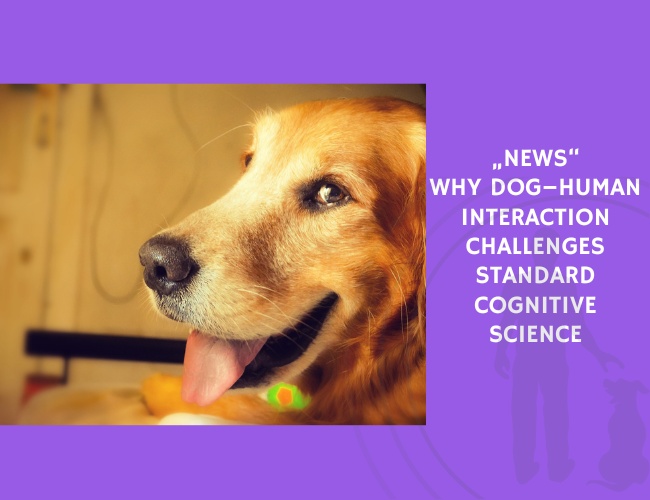
In Dismantling standard cognitive science: it’s time the dog has its day, Michele Merritt presents a philosophical critique of the dominant paradigm in cognitive science, which treats cognition as internal, representational, and propositional. Merritt contends that this framework cannot adequately account for a wide range of cognitive phenomena that emerge through interaction rather than isolated mental states.
Rather than focusing exclusively on debates about human cognition within philosophy of mind, the paper adopts a biological and comparative perspective. Merritt examines cognition as something that evolves and emerges through interaction, drawing attention to the cognitive relevance of relationships between humans and other animals.
Central to the argument is the claim that human–canine interaction produces genuinely cognitive phenomena. Everyday engagements with dogs involve shared meaning making, coordinated action, and mutual responsiveness, none of which can be fully explained by models that locate cognition solely inside individual brains.
Merritt argues that these interactions exemplify embodied and distributed cognition, where understanding arises from dynamic coupling between agents rather than from pre-formed internal representations. The dog–human dyad is presented as a system in which cognition unfolds through movement, attention, affect, and responsiveness.
Importantly, the paper suggests that such interactive and cooperative pairings should not be seen as peripheral or exceptional cases. Instead, Merritt proposes that human–dog relationships can serve as models for human cognition itself, which may be far more shared, relational, and cooperative than standard cognitive science allows.
The work concludes by calling for a radical rethinking of cognition. By taking seriously the cognitive significance of human–animal interaction, particularly with dogs, the paper challenges entrenched assumptions and opens space for theories that better capture the interactive, embodied, and socially distributed nature of thought.
Merritt, M. (2015). Dismantling standard cognitive science: it’s time the dog has its day. Published August 5, 2015.