
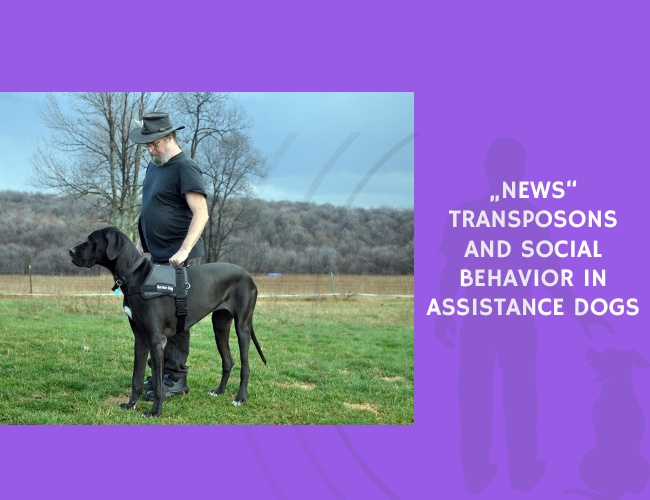
Published in Behavior Genetics, the study by Gitanjali E. Gnanadesikan, Dhriti Tandon, B. VonHoldt and colleagues examined how four structural variants derived from transposons within the Williams–Beuren Syndrome Critical Region (WBSCR) influence dog sociability and working dog suitability. This genomic region has been repeatedly implicated in human-directed social behavior, making it a compelling target for research on assistance dogs.
The authors genotyped 1001 dogs from Canine Companions for Independence®, including both successful program graduates and dogs released for behavioral incompatibility. To capture behavioral variation with high resolution, they integrated puppy-raiser questionnaires, trainer assessments, and behavioral and cognitive tests. This provided a multidimensional phenotype dataset covering sociability, reactivity, separation-related issues, and aggression when challenged or corrected.
Using Bayesian mixed models, the researchers identified strong associations between specific transposon genotypes and key behavior traits. Variants corresponded with separation-related problems, reactivity toward other dogs, and aggressive responses under correction. These results strengthen previous findings that the WBSCR influences attentional bias to social cues and interest in unfamiliar people.
A particularly noteworthy finding was the role of the gene GTF2I. Insertions in this gene showed the strongest positive association with training success (β = 0.23, CI95% = −0.04, 0.49), corresponding to an odds ratio of 1.25 for each insertion. Although moderate, this effect supports the growing consensus that GTF2I variation has broad consequences for social behavior across species. For working dog organizations, such findings may help refine breeding strategies and behavioral evaluation protocols.
Overall, the study provides deeper insight into genetic contributions to canine sociability and reveals how subtle genomic variation can influence behavioral compatibility with demanding assistance roles. By mapping transposon-derived variants to real-world outcomes, Gnanadesikan and colleagues offer a framework for integrating genomics, behavior assessment, and training practice in future working dog programs.
Source: Gnanadesikan, G. E., Tandon, D., Karlsson, E., Gunturkun, O., Akoubian, D., & VonHoldt, B. (2023). Transposons in the Williams–Beuren Syndrome Critical Region are Associated with Social Behavior in Assistance Dogs. Behavior Genetics. Published December 13, 2023.










