
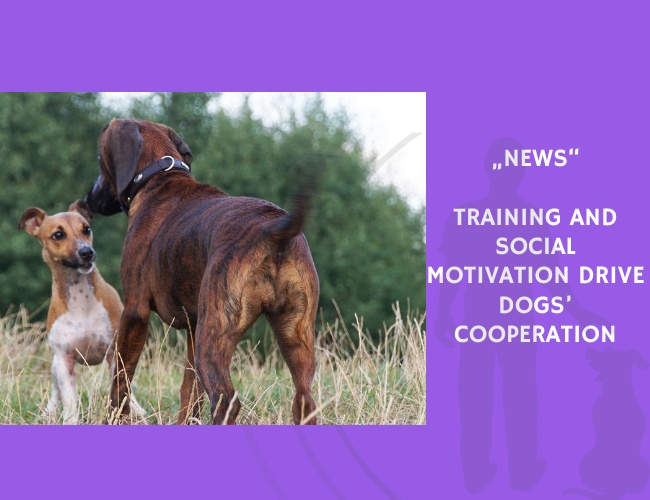
While dogs are renowned for their ability to cooperate with humans, the underlying factors that influence this behavior remain under investigation. Csepregi and Gácsi (2023) explored whether breed function, training background, and social motivation shape spontaneous cooperation between family dogs and their owners.
In their experiment, 100 dogs from different breed groups (non-working, cooperative working, and independent working breeds) were tested in an “out-of-reach” task. Owners did not directly ask for help, leaving cooperation up to the dogs’ own initiative. Surprisingly, breed group had no significant effect on performance. Instead, two factors stood out: training level and social motivation.
Dogs with extensive training were more attentive and better able to engage with the task, while socially motivated dogs were more willing to help their owners. These traits worked independently, meaning both contributed uniquely to cooperation. Importantly, no factor was linked to failures in task comprehension, suggesting that the issue was not intelligence but rather willingness and engagement.
The study emphasizes the need for test procedures that do not depend on pre-trained skills, as well as the importance of nurturing both training and social bonding. This highlights that cooperation in dogs is less about breed stereotypes and more about experience and relationship quality.
Source: Csepregi, M., & Gácsi, M. (2023). Factors Contributing to Successful Spontaneous Dog–Human Cooperation. Animals, 13. Published July 1, 2023.










