
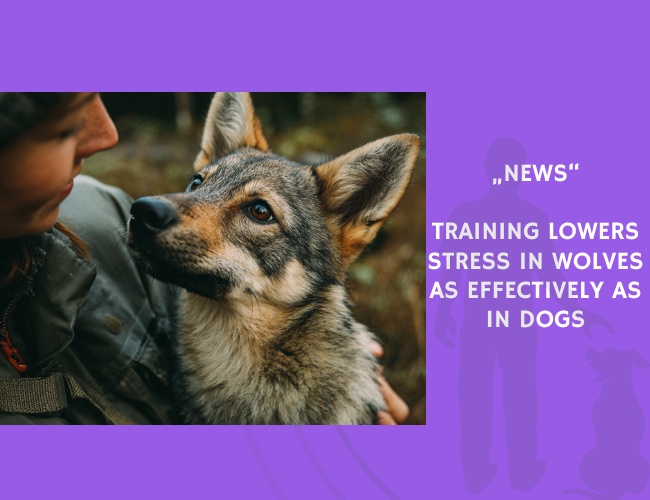
Animal welfare in captivity remains a major ethical and scientific concern, particularly for wild species like wolves that are often stressed by human proximity. While human contact can be a source of anxiety, under certain conditions it may also improve welfare when paired with structured and predictable interactions.
Vasconcellos and colleagues (2016) examined whether training sessions with familiar human caretakers could reduce stress in wolves (Canis lupus) as effectively as in dogs (Canis lupus familiaris). Both species were raised and kept in identical social conditions to ensure equal familiarity with humans and training routines. Salivary cortisol, a key stress hormone, was measured before and after the training sessions to assess physiological changes.
Results showed that during indoor training, wolves stayed voluntarily near trainers, performed requested behaviors attentively, and displayed calm, focused engagement similar to dogs. Importantly, cortisol levels decreased significantly in both wolves and dogs during the sessions, confirming that the interaction had a measurable stress-reducing effect. Variations in response across trainers also highlighted a social component in the animal–human relationship, where familiarity and trust contributed to the calming outcome.
The findings indicate that training serves as more than a management tool—it can function as behavioral enrichment that enhances psychological welfare by providing predictability, agency, and reward-based engagement. The study supports broader welfare practices showing that structured, cooperative human–animal interactions can benefit even wild-born species when conducted ethically and consistently.
Source: Vasconcellos, A. S., Virányi, Z., Range, F., Ades, C., Scheidegger, J. K., Möstl, E., & Kotrschal, K. (2016). Training Reduces Stress in Human-Socialised Wolves to the Same Degree as in Dogs. PLoS ONE, 11, published September 9, 2016.










