
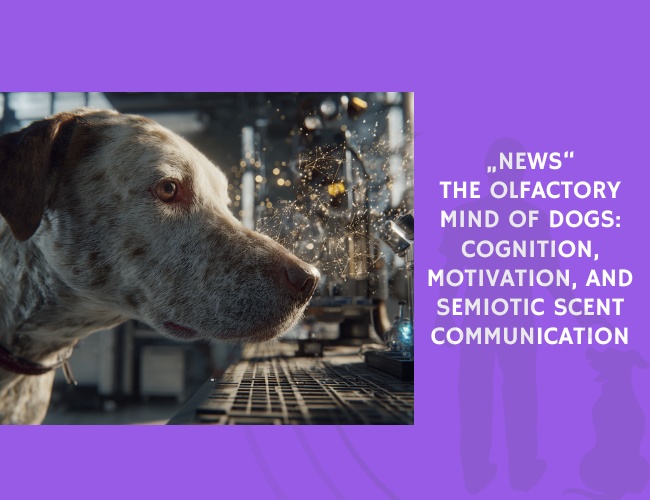
In Domestic Dog Cognition and Behavior, edited by Alexandra Horowitz, the chapter on canine olfaction explores the neurocognitive and neuroconative foundations of scent processing—highlighting how smell is deeply tied to canine cognition, motivation, emotional systems, and behavioral decision-making. Rather than being a mere sensory function, olfaction is presented as a psychological and communicative tool shaping how dogs perceive, interpret, and respond to the world.
The chapter outlines the basic anatomical and neuroscientific structures involved in smell, linking them to behavioral and affective processes. It discusses how olfactory information undergoes cognitive processing, influencing memory, motivation, and environmental evaluation. Dogs interpret chemical cues as social signals, emotional states, territorial indicators, and even health-related information, demonstrating a sophisticated semiotic system.
A significant focus is placed on the integration of ethology, experimental psychology, and neuroscience to understand the behavioral expression of olfaction. The authors examine how both field-based observation and laboratory experimentation contribute to uncovering scent-driven decision-making, problem-solving, and communication strategies.
The chapter introduces the concept of zoosemiotics—the study of signs in animal communication. In this context, odors and scent marks are not merely chemical traces but semiotic messages. Dogs create and interpret “peemails” and “Nosebook” social updates through urine marking, scent gland expression, and sniffing behavior. These signals can represent identity, emotional state, reproductive status, social intent, or territorial claims.
Olfaction “in context” is explored through examples of dogs used in biomedical detection, conservation work, and scent-based communication. By analyzing how dogs process scent information despite the absence of a sender, researchers emphasize that olfaction is a constructive cognitive activity—involving representation, interpretation, and behavioral response.
Horowitz concludes that canine olfaction is a multi-layered cognitive, motivational, and communicative system. Understanding it requires an interdisciplinary approach that appreciates how dogs use scent to navigate social worlds, emotional relationships, environmental meaning, and human cooperation.
Source: Horowitz, A. (Ed.). (2014). Domestic Dog Cognition and Behavior. Springer Berlin Heidelberg.










