
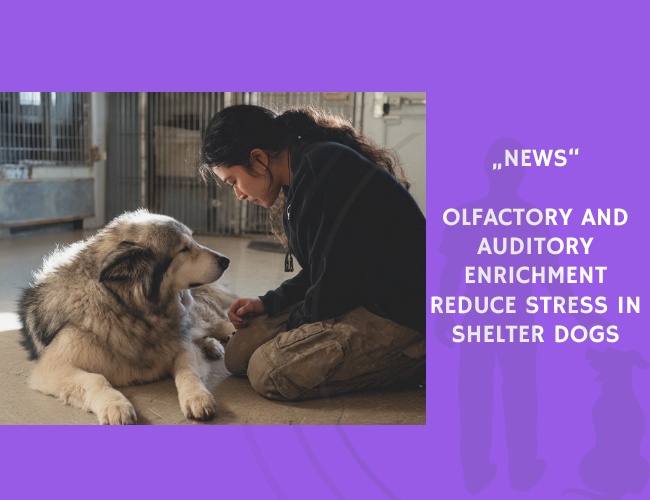
Shelter environments present significant welfare challenges for dogs, who often face high arousal and stress due to noise, confinement, and limited control over their surroundings. Amaya and colleagues (2020) investigated whether targeted sensory enrichment could reduce arousal-related behaviors in shelter dogs.
The study exposed 60 dogs to one of three enrichment treatments—lavender, dog appeasing pheromone (DAP), or music—compared to a control group with no enrichment. Each stimulus was applied for three hours a day across five consecutive days, and the dogs’ behavior was closely observed.
Results showed clear benefits of enrichment. Dogs exposed to music and DAP spent more time lying down, displaying relaxed postures such as resting with the head down. In contrast, control dogs exhibited higher levels of panting, vocalizing, and arousal behaviors, including standing on their hind legs against the kennel door. Notably, these stress-related behaviors persisted into the evening in the control group but were reduced in dogs receiving enrichment.
The findings demonstrate that even small, simple interventions can make a significant difference to shelter dog welfare. By reducing stress and promoting relaxation, sensory enrichment helps improve not only the dogs’ daily quality of life but also their potential for successful rehoming by strengthening the human-animal bond.
Source: Amaya, V., Paterson, M. B. A., & Phillips, C. (2020). Effects of Olfactory and Auditory Enrichment on the Behaviour of Shelter Dogs. Animals, 10. Published March 30, 2020.










