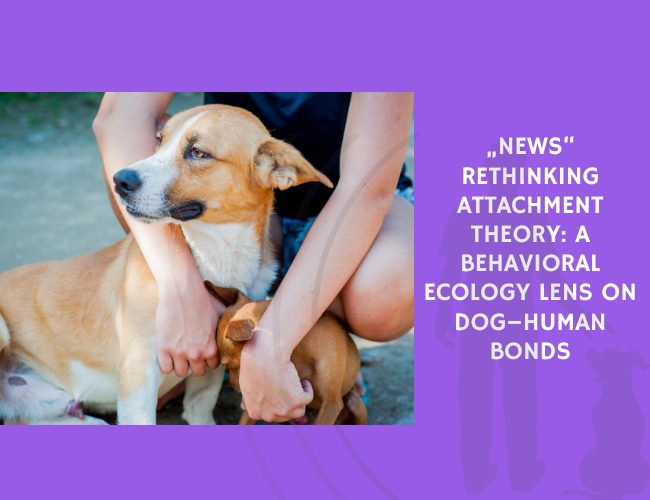
Published in Society & Animals, this conceptual analysis challenges the long-standing application of Ainsworth’s “Strange Situation Test”—originally designed for human infants—to non-human social species like dogs. Lewis contends that this anthropocentric model fails to reflect the mature, reciprocal, and context-dependent nature of canine social bonds. By interpreting adult dog behaviour through a lens of attachment and dependence, welfare research risks overlooking the species’ intrinsic emotional autonomy and ecological adaptability.
The paper proposes a paradigm shift: to move from infant-based attachment frameworks toward a behavioral ecology and cognition model that respects dogs as socially and emotionally developed individuals. According to Lewis, behaviours often labelled as “separation anxiety” may not always reflect pathological dependency, but rather frustration resulting from disrupted adult group dynamics or human-induced over-dependency.
This reconceptualization places emphasis on the social ecology of coexistence—the natural drives, environmental contexts, and cognitive competencies that shape interspecies communication. Lewis argues that mature dogs engage in cooperative strategies and emotional exchanges consistent with evolved adult mammalian social systems, not infantile attachment behaviours. As such, welfare models should integrate insights from ethology, behavioural ecology, and comparative cognition to ensure interventions align with species-appropriate emotional regulation and autonomy.
This perspective aligns closely with NeuroBond methodology, where emotional alignment replaces dependency, and connection emerges from mutual regulation rather than caretaking. Both frameworks advocate that genuine wellbeing arises when dogs are treated as mature cognitive partners rather than perpetual dependents.
Source: Lewis, A. (2020). Infantilizing Companion Animals through Attachment Theory: Why Shift to Behavioral Ecology-Based Paradigms for Welfare. Society & Animals, 1–18. Published September 18, 2020.