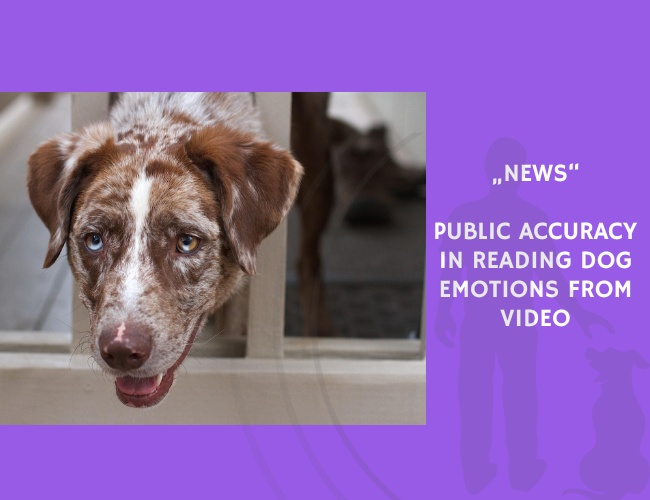
Published on bioRxiv, the preprint study by Lauren Samet and colleagues investigates public understanding of dogs’ emotions using a large-scale online survey. The research highlights the crucial role of accurate emotional interpretation in ensuring dog welfare and public safety.
Over 4,000 participants watched 30 silent videos showing dogs in different situations. They were asked to rate nine possible emotional or motivational states—such as nervous/anxious, stressed, relaxed, comfortable, playful, curious, excited, and frustrated—on a 0–15 scale. Their ratings were then compared to those of 11 canine behavior experts, who provided the benchmark for accurate assessment.
The results revealed strong inter-expert agreement for most emotional categories, except “boredom,” which was excluded due to inconsistency. Analysis using principal components and cluster models showed that both the public and experts grouped emotions similarly, suggesting shared perceptual frameworks. However, accuracy levels differed by emotion—public participants were generally more confident in identifying playful and curious dogs but struggled to accurately judge anxious or stressed states.
Interestingly, public confidence did not always align with accuracy. Participants’ perceptions of difficulty reflected their willingness to rate a video rather than their correctness compared to experts. This indicates that while people may feel they understand dog emotions, misinterpretations—especially of stress or anxiety—remain common, which can have welfare and safety implications.
Samet et al. propose that educational interventions could improve public interpretation of canine emotional cues. By teaching people to recognize subtle signs of distress, frustration, or fear, society can promote safer interactions and prevent negative outcomes such as bites or chronic stress in dogs. The study provides valuable insight into how public awareness can evolve toward more empathetic and evidence-based human–dog relationships.
Source: Samet, L., Muschinski, J. M., Harvey, N. D., Giragosian, K., Upjohn, M., Murray, J., & Owczarczak-Garstecka, S. C. (2025). Public perception of dog emotional and motivational states in videos: A cross-sectional analysis. bioRxiv. Published March 4, 2025.