
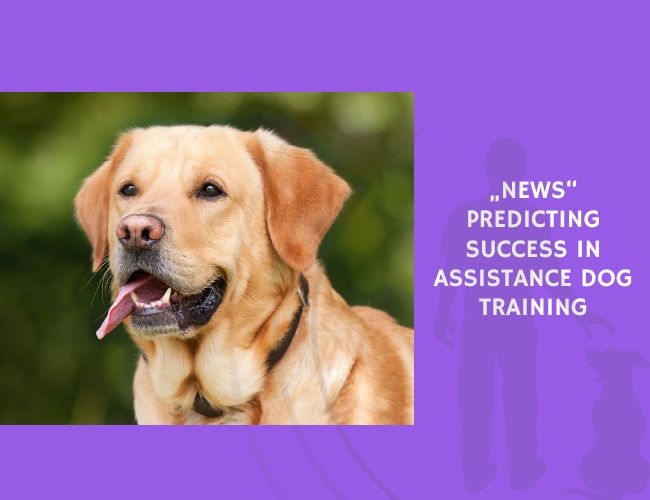
Published in Frontiers in Veterinary Science, the study by Emily E. Bray, Kerinne M. Levy, Brenda S. Kennedy, D. Duffy, J. Serpell, and E. MacLean addresses a major challenge in assistance dog programs: many dogs bred and trained for service roles ultimately do not meet the behavioral requirements, often after significant time and financial investment.
Canine Companions for Independence (CCI), a leading U.S. assistance dog organization, provided over a decade of data from two behavioral measures: the Canine Behavioral Assessment and Research Questionnaire (C-BARQ) and the In-For-Training (IFT) temperament test conducted at the start of formal training.
The researchers developed predictive models using large datasets: 3,569 dogs for C-BARQ, 5,967 dogs for IFT, and 2,990 dogs with both measures combined. Each dataset was split into independent training and test sets, allowing the team to evaluate the robustness and generalizability of their predictions.
All three models performed significantly better than chance, achieving 64–68% accuracy when predicting whether a dog would succeed or be released from the training program. Predictions were strongest for dogs deemed least likely to succeed: for dogs in the lowest 10% of predicted success probabilities, the models were 85–92% accurate. Accuracy for identifying high-probability candidates was moderate (62–72%).
Interestingly, combining C-BARQ and IFT data did not significantly improve overall accuracy beyond using either measure alone. However, the combined model did better at identifying dogs in the lowest 20% of predicted success probabilities, offering value for early elimination decisions.
These findings highlight that both behavioral questionnaires and structured temperament tests can serve as effective screening tools. Early identification of dogs unlikely to succeed allows training programs to allocate resources more efficiently, optimize breeding and selection strategies, and improve long-term outcomes in assistance dog development.
Source: Bray, E. E., Levy, K. M., Kennedy, B. S., Duffy, D., Serpell, J., & MacLean, E. (2019). Predictive Models of Assistance Dog Training Outcomes Using the Canine Behavioral Assessment and Research Questionnaire and a Standardized Temperament Evaluation. Frontiers in Veterinary Science. Published February 27, 2019.










