
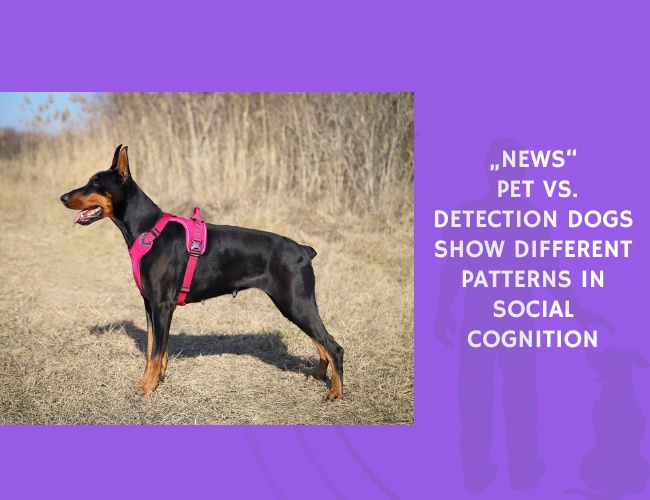
Dogs’ remarkable ability to interpret human signals has been shaped by domestication and further refined through life experience and training. This study compared pet dogs and detection dogs across two sociocognitive domains: responsiveness to human gestures and human-directed communication during an unsolvable task.
The research included 29 pet dogs and 35 detection dogs. Both groups were equally capable of following human pointing gestures, indicating that fundamental gesture comprehension does not depend on specialized working-dog training. However, differences emerged depending on the identity of the signaler. Pet dogs were less responsive to gestures from a stranger than to those from their owner, suggesting that familiarity plays a significant role in how companion dogs interpret human cues.
In the unsolvable task, where dogs were presented with an impossible problem, clear differences appeared in how they sought assistance. Pet dogs showed more frequent gazing toward humans, particularly their owners, demonstrating a familiar-biased communicative strategy. Detection dogs, in contrast, displayed greater persistence in attempting to solve the task independently, reflecting their training to sustain task-focused behavior.
These findings suggest that various dimensions of dog sociocognition—such as attention to human partners and problem-solving communication—are shaped differently by selection pressures and training for specific roles. Working dogs may be conditioned to maintain autonomous task engagement, whereas pet dogs rely more on familiar human partners for social information and assistance.
Source: Lazarowski, L., Thompkins, A. M., Krichbaum, S., Waggoner, L. P., Deshpande, G., & Katz, J. (2020). Comparing pet and detection dogs (Canis familiaris) on two aspects of social cognition. Learning & Behavior. Published June 30, 2020.










