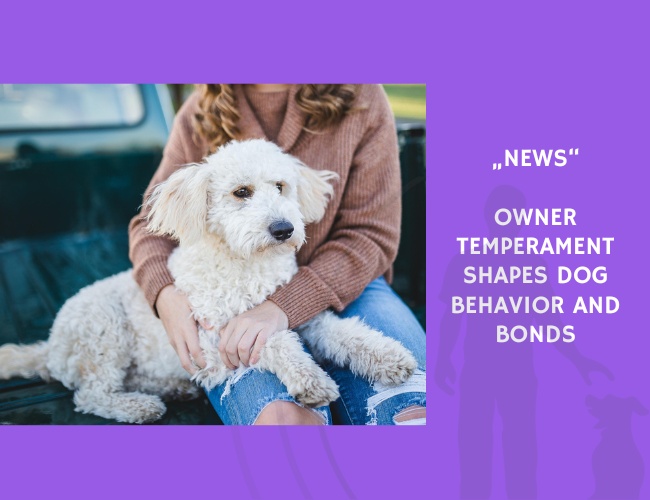
Dogs spend most of their lives alongside humans, making the qualities of their owners central to their development and well-being. Kujala, Imponen, Pirkkala, Silfverberg, Parviainen, Tiira, and Kiuru (2023) examined how owner temperament interacts with dog breed group to influence both the perceived dog–owner bond and dogs’ performance in behavioral tests.
The study surveyed 440 owner–dog pairs, using standardized questionnaires for owner temperament (ATQ-R) and dog–owner relationship (MDORS), alongside three behavioral assessments: the object-choice test, the unsolvable task, and the cylinder test. Results showed that owners high in negative affectivity reported stronger emotional closeness but also greater perceived costs of owning a dog. Conversely, owners with high effortful control reported lower emotional closeness and perceived costs.
Owner temperament also shaped dog behavior. Dogs of owners with high negative affectivity showed altered performance—particularly herding breeds, which scored lower in the object-choice test. In contrast, primitive-type breeds were largely unaffected by owner temperament. Additionally, dogs that were more active during testing tended to be associated with owners who reported lower emotional closeness.
These findings underscore the importance of considering both human personality traits and breed group characteristics when interpreting dog behavior and fostering strong human–canine bonds. The results suggest that matching owner temperament with breed-specific tendencies may improve relationship quality and behavioral outcomes.
Source: Kujala, M. V., Imponen, N., Pirkkala, A., Silfverberg, T., Parviainen, T., Tiira, K., & Kiuru, N. (2023). Modulation of dog–owner relationship and dog social and cognitive behavior by owner temperament and dog breed group. Scientific Reports, 13.