
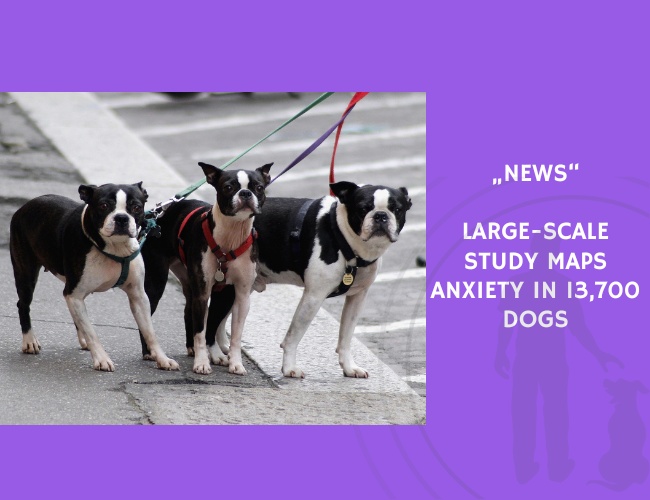
Canine anxiety is a major welfare concern, affecting quality of life and sometimes leading to relinquishment or euthanasia. To better understand its scope, Salonen et al. (2020) conducted one of the largest studies to date, using owner-reported behavioral surveys from 13,700 Finnish pet dogs.
The researchers examined seven anxiety-related traits: noise sensitivity, fearfulness, fear of surfaces/heights, inattention/impulsivity, compulsion, separation-related behavior, and aggression. Among these, noise sensitivity emerged as the most prevalent, affecting 32% of dogs. Fear was also common, often appearing alongside other traits.
Patterns of comorbidity were evident. For example, hyperactivity/inattention strongly overlapped with separation-related issues and compulsive behaviors, while fear and aggression frequently co-occurred. These findings highlight how anxiety traits may not occur in isolation but instead cluster, shaping overall behavior.
Importantly, breed differences were substantial across all traits, indicating a genetic basis for anxiety susceptibility. This suggests that selective breeding strategies focusing on behavior could reduce the prevalence of anxiety disorders in companion dogs. The study also emphasizes that anxious dogs may experience chronic stress, underscoring the need for both genetic and environmental interventions to improve welfare.
By mapping anxiety at this scale, the research provides valuable guidance for breeders, veterinarians, and owners aiming to address behavior issues proactively and compassionately.
Source: Salonen, M., Sulkama, S., Mikkola, S., Puurunen, J., Hakanen, E., Tiira, K., Araújo, C., & Lohi, H. (2020). Prevalence, comorbidity, and breed differences in canine anxiety in 13,700 Finnish pet dogs. Scientific Reports, 10. https://doi.org/10.1038/s41598-020-59837-z










