
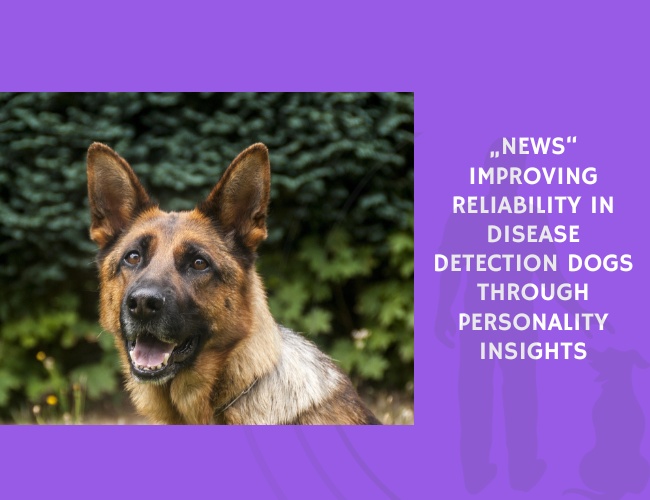
Published in the Journal of Breath Research, this review by K. Hackner and J. Pleil examines why the impressive sensitivity of the canine nose has not translated into uniformly high performance in clinical disease-detection studies. Although dogs routinely excel in scent-based tasks such as tracking, bomb detection, and search and rescue, clinical trials have produced results ranging from near-perfect accuracy to performance no better than chance.
The authors argue that this inconsistency is not rooted in dogs’ olfactory capabilities—known to be exceptionally powerful—but rather in the behavioral and motivational variability inherent to living animals. Unlike analytical instruments, dogs are susceptible to boredom, fatigue, hunger, stress, and environmental distractions. These factors can profoundly affect task engagement and reliability, especially in clinical settings where repetitive sample testing is required.
Central to the review is the concept of ‘dog personality’ as a determinant of task performance. Traits such as focus, persistence, motivation, stress tolerance, and responsiveness to reinforcement vary significantly across individual dogs and can influence diagnostic accuracy. Selecting and training dogs whose personality traits align with the demands of clinical scent detection may be crucial for reproducible outcomes.
The authors highlight the need for structured training, controlled testing conditions, and ongoing performance monitoring to mitigate variability. They argue that integrating behavioral assessment with olfactory testing could help identify dogs best suited for medical detection tasks.
Ultimately, the review emphasizes that while canine olfaction holds great promise as a diagnostic tool, achieving the consistency required in clinical environments depends on understanding and managing the behavioral individuality of disease-detection dogs.
Source: Hackner, K., & Pleil, J. (2017). Canine olfaction as an alternative to analytical instruments for disease diagnosis: understanding ‘dog personality’ to achieve reproducible results. Journal of Breath Research. Published January 9, 2017. Research rooted in veterinary medicine, clinical diagnostics, and scent-detection behavior.










