
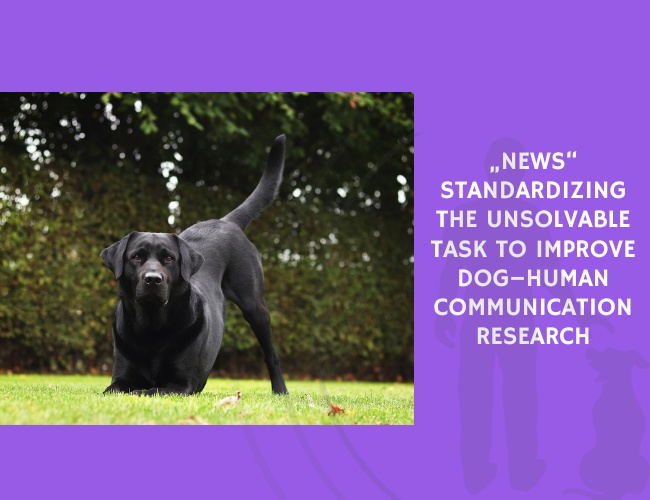
Published in Animal Cognition, this review by Juliana Wallner Werneck Mendes, B. Resende, and C. Savalli evaluates how researchers use the unsolvable task—a paradigm designed to measure human-directed communication when dogs face an impossible problem.
In the task, dogs first learn how to solve a simple problem to obtain a reward. After several successful trials, the task becomes intentionally unsolvable. Dogs often begin directing gaze, vocalizations, or other communicative behaviors toward nearby humans—behaviors thought to reflect attempts to seek assistance.
Despite its popularity, the review found considerable methodological variability across studies. Differences in apparatus design, number of solvable trials, task duration, and criteria for coding communicative behaviors make direct comparisons difficult. Even key proxies—such as gaze duration or gaze alternation—were defined and measured inconsistently.
The authors reviewed 35 studies that met search criteria across Web of Science and Scopus using terms related to dogs, wolves, dingoes, and the unsolvable task. They highlight discrepancies not only in methodology but also in interpretation—for example, whether “looking back” is evidence of help-seeking, frustration, or social referencing.
To address these issues, the authors propose a set of standardization strategies for future research. These include an ethogram describing possible behaviors and their interpretations, and a predefined methodological framework covering apparatus selection, trial structure, and reporting requirements. Such harmonization would significantly improve reproducibility and allow meaningful cross-study comparisons.
The review concludes that while the unsolvable task remains a powerful tool for studying dog cognition and communicative tendencies, its effectiveness depends on consistent application and transparent reporting.
Source: Mendes, J. W. W., Resende, B., & Savalli, C. (2021). A review of the unsolvable task in dog communication and cognition: comparing different methodologies. Animal Cognition. Published March 23, 2021. Research situated within comparative psychology and animal communication fields.










