
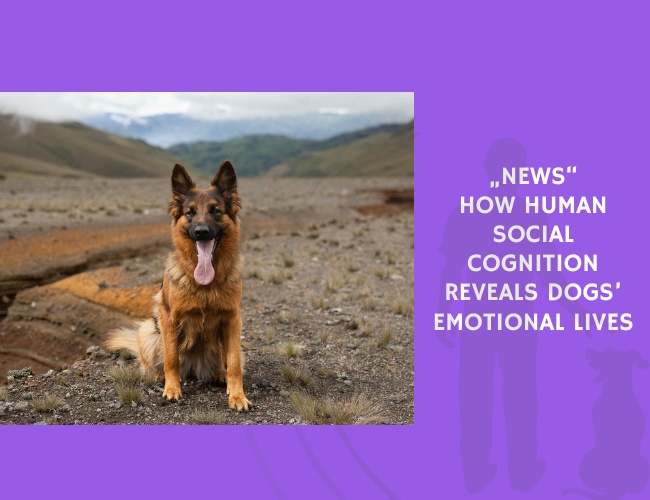
Published in 2017, this review by Miiamaaria V. Kujala addresses a central challenge in comparative psychology: understanding emotions in animals when subjective experiences cannot be measured directly. The author emphasizes that this limitation applies not only to dogs, but also to humans—where researchers rely on indirect indicators of emotional states.
Kujala argues that, just as human emotional research depends on behavioral cues, physiological responses, facial expressions, and contextual interpretation, similar premises can be applied to dogs. Recent advances in canine cognition research allow investigators to assess what dogs perceive and how they react to emotionally relevant stimuli.
Key evidence shows that dogs attend closely to social cues, including human and canine facial expressions, body language, and vocal signals. They respond appropriately to positive and negative emotional valence, demonstrating sensitivity to both species-specific and cross-species emotional displays.
The review highlights research indicating that dogs can integrate multimodal emotional cues—such as combining facial expressions with tone of voice—to form coherent interpretations of others’ emotional states. These abilities suggest a sophisticated form of social-emotional processing.
Moreover, studies show that dogs derive meaningful information from the emotions they observe in others, influencing their behavior in ways consistent with empathy-like or socially aware responses. Examples include approaching distressed humans, avoiding angry individuals, or adjusting behavior based on their caregiver’s emotional reactions.
Kujala concludes that although scientists cannot directly prove that dogs “feel” emotions, the indirect evidence—parallel to methods used in human emotional science—strongly supports the view that dogs experience affective states and use emotional information in socially adaptive ways.
Source: Kujala, M. V. (2017). Canine emotions as seen through human social cognition. Published July 8, 2017. Research grounded in comparative psychology and canine social cognition.










