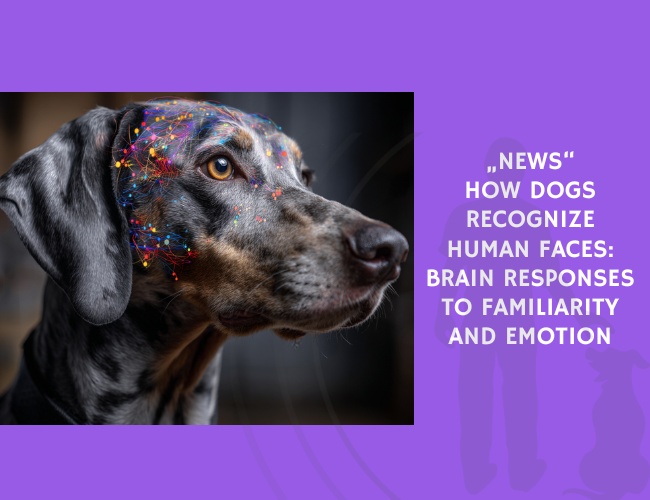
In this 2021 study published in Animal Cognition, Andie M. Thompkins, Lucia Lazarowski, J. Katz, and colleagues used awake canine fMRI to explore how dogs process human facial familiarity and emotional expressions. The research examined both neural activation patterns and behavioral responses to images and videos of familiar and unfamiliar human faces displaying positive, neutral, and negative emotions.
The findings revealed that when dogs viewed familiar or emotionally salient human faces, three key brain structures were activated: the caudate nucleus (reward processing), the hippocampus (memory and familiarity), and the amygdala (emotion recognition and emotional salience). This activation pattern suggests that dogs process human faces using reward, emotional, and social memory systems—similar to mechanisms observed in human social cognition.
Behaviorally, the study used an unsolvable task paradigm to measure how dogs oriented toward familiar and unfamiliar humans. The strength of brain activation in the caudate, hippocampus, and amygdala correlated directly with the duration of human-oriented behavior toward familiar individuals. This supports the idea that dogs form emotionally meaningful and memory-based social relationships with specific humans.
These findings provide a bio-behavioral foundation for understanding attachment in dog–human relationships. Dogs do not simply respond to human faces due to conditioning—they exhibit neural markers of emotional recognition, familiarity, and reward, indicating deeper socio-emotional processing.
The study concludes that dogs possess specialized neural mechanisms for interpreting human emotions and recognizing familiar individuals, demonstrating the cognitive and emotional depth of the dog–human bond.
Source: Thompkins, A. M., Lazarowski, L., Katz, J., et al. (2021). Dog–human social relationship: representation of human face familiarity and emotions in the dog brain. Animal Cognition. Published February 18, 2021.