
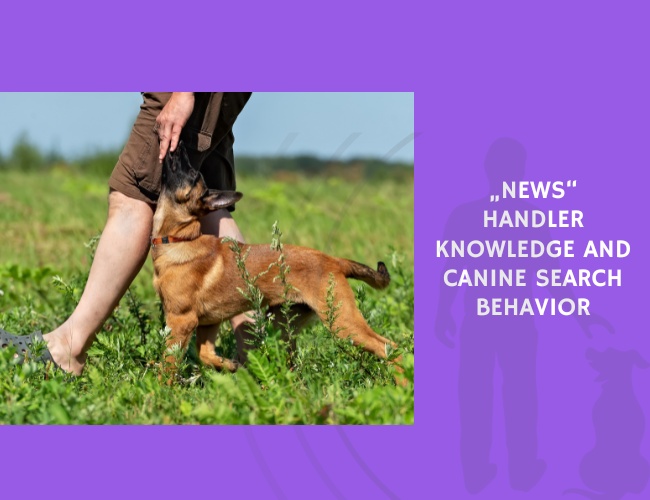
Published in Frontiers in Veterinary Science, M. DeChant, C. Ford, and Nathaniel J. Hall investigated how a handler’s knowledge of the detection task—specifically the number of target odors (hides)—affects canine search behavior and performance. The study compared professional and sport detection teams working under two conditions: Known (handlers informed about the number of hides) and Unknown (handlers given no information).
Results showed that handler knowledge significantly altered search behavior, particularly in sport detection teams. Dogs in the Unknown Group spent longer searching in blank areas and looked back more frequently toward their handlers, suggesting increased handler-dependent decision-making. However, despite these behavioral differences, overall false alert rates and detection accuracy remained statistically similar between the Known and Unknown groups.
In a follow-up experiment, teams performed single-blind and double-blind searches. Again, no significant difference in detection accuracy was found, reinforcing that while handler expectations influence search strategy and team dynamics, they do not necessarily compromise detection success.
The authors conclude that handler cognition shapes canine search patterns and decision reliance, but does not directly increase error rates. This underscores the importance of understanding the subtle effects of human influence in canine detection work, especially in operational and training environments where handler expectations may unintentionally guide search behavior.
Source: DeChant, M., Ford, C., & Hall, N. J. (2020). Effect of Handler Knowledge of the Detection Task on Canine Search Behavior and Performance. Frontiers in Veterinary Science. Published May 27, 2020.










