
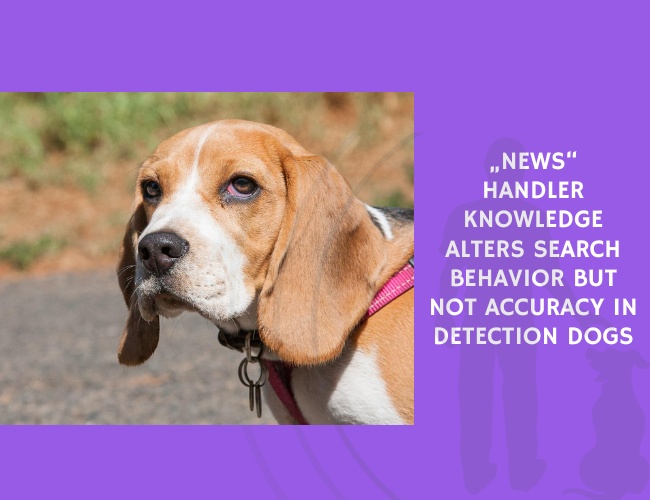
Published in Frontiers in Veterinary Science, this study by M. DeChant, C. Ford, and Nathaniel J. Hall addresses whether knowing the number of target odor hides affects detection accuracy or alters handler–dog team dynamics during real-world search scenarios.
The research involved 59 detection teams—20 professional and 39 sport teams—who completed searches across three areas: one with a hide, another with a hide, and a blank area. Teams were split into two groups: a Known Group, told that two hides were present across the search areas, and an Unknown Group, given no information.
Sport teams in the Unknown Group searched significantly longer in the blank area (69.04 seconds) than those in the Known Group, and sport dogs looked back at their handlers more frequently—a behavior likely reflecting uncertainty. When a miss occurred, both professional and sport dogs showed more interest at the actual target location compared to control locations, indicating strong odor-driven behavior even without handler cues.
Importantly, the study found no difference in false alert rates between Known and Unknown Groups in either professional or sport teams. This contrasts with earlier findings showing that deception can increase false alerts, suggesting that simple knowledge of hide quantity does not impair accuracy.
A second experiment assessed performance under single-blind (handler blind, evaluator informed) and double-blind (both handler and evaluator blind) conditions. Both professional and sport teams performed with similar accuracy in both setups, reinforcing that handler knowledge did not significantly impact error rates.
Overall, the findings show that while handler knowledge of hide numbers changes search duration and handler–dog interaction patterns, it does not affect detection accuracy. These results highlight the resilience and odor-driven reliability of trained detection dogs, even when handler expectations differ.
Source: DeChant, M., Ford, C., & Hall, N. J. (2020). Effect of Handler Knowledge of the Detection Task on Canine Search Behavior and Performance. Frontiers in Veterinary Science. Published May 27, 2020. Authors affiliated with programs in canine behavior, scent detection, and applied animal psychology.










