
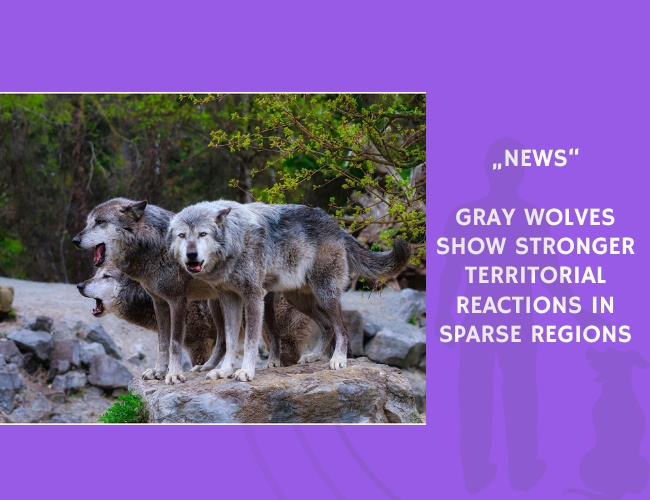
Gray Wolves (Canis lupus) are territorial animals that use olfactory and auditory cues to communicate occupancy and defend resources. However, the intensity of their territorial behavior may depend on how densely populated an area is with other wolf packs.
Wyrick and colleagues (2025) examined wolf responses to simulated intrusions across areas of differing pack density in Wisconsin. Using commercial wolf urine and recorded howls to mimic non-resident intruders, the researchers monitored reactions with camera traps and field observations over two winters and one summer.
The results showed that wolves in low-density regions spent significantly more time investigating scent cues than those in high-density territories. This heightened investigative response suggests that wolves in sparsely populated areas perceive a greater need to assess and verify intrusions, possibly due to less frequent encounters with rivals and a higher value placed on maintaining extensive territories.
Conversely, wolves in high-density regions appeared more habituated to the presence of neighboring packs, displaying reduced exploratory behavior toward simulated intrusions. The findings reveal that territorial strategies in wolves are context-dependent, shaped by ecological pressures and population distribution.
Overall, the study underscores the behavioral flexibility of wolves, whose vigilance and investigative behavior intensify when competition for territory is less constant but potentially more consequential.
Source: Wyrick, S., Kapfer, J., & Waraczynski, M. (2025). Density of Gray Wolf (Canis lupus) Territories Affects Response to Simulated Conspecific Intrusion in Wisconsin. Northeastern Naturalist, 32, 52–65, published February 17, 2025.










