
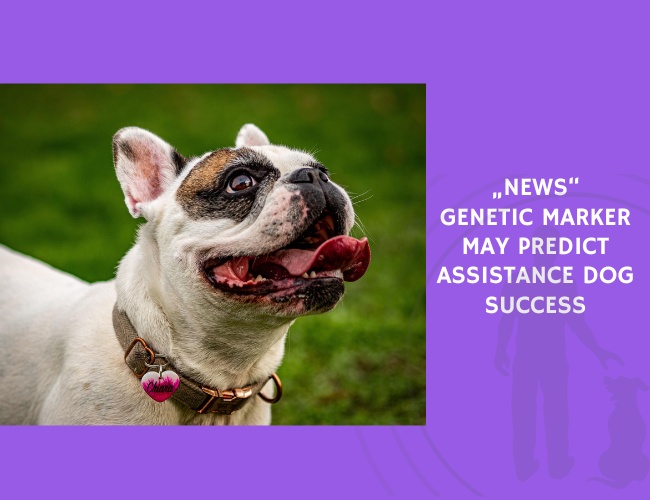
Assistance dog programs face a persistent challenge: up to 60% of dogs entering training fail to complete certification, often due to behavioral incompatibilities rather than physical limitations. Although behavioral assessments are widely used to screen candidates, their predictive reliability remains inconsistent.
In this study, Dhriti Tandon, Kyra Ressler, Bridgett vonHoldt, and colleagues investigated whether genetic markers linked to hypersociability could improve prediction of training success. The team focused on four retrotransposon mobile element insertions (MEIs) previously identified in domestic dogs and gray wolves near genes associated with human-directed social behavior, including WBSCR17, GTF2I, and POM121.
Using a dataset of 837 dogs, including 228 individuals with paired behavioral data from the Canine Behavioral Assessment and Research Questionnaire (C-BARQ©), the researchers found that a single insertion at the Cfa6.6 locus within WBSCR17 emerged as the strongest genetic predictor of sociable behaviors related to human proximity and engagement.
Dogs carrying this insertion showed significantly higher scores for traits such as seeking human contact and social attentiveness, characteristics essential for effective assistance dog performance. However, the same insertion was also positively correlated with separation-related distress, expressed as restlessness when owners prepared to leave, highlighting a trade-off between sociability and emotional sensitivity.
Crucially, dogs enrolled in assistance dog programs displayed a heterozygosity deficiency at the Cfa6.6 locus and a higher frequency of insertions at Cfa6.6 and Cfa6.7, suggesting that selective pressures—intentional or unintentional—may already be shaping the genetic profiles of working dog populations.
The authors propose that genetic screening for WBSCR17 mobile element insertions could be used as an adjunct to behavioral testing, improving early identification of dogs whose innate social traits align with the demands of assistance work. Importantly, they emphasize that such tools should complement, not replace, behavioral evaluations and welfare-focused training practices.
Taken together, these findings support the idea that canine sociability has a measurable genetic component closely tied to performance in human-centered working roles. Integrating genetic insights with behavioral science may help reduce training attrition, lower costs, and improve long-term outcomes for both dogs and handlers.
Source: Tandon, D.; Ressler, K.; et al.; vonHoldt, B. Genes (2019). Homozygosity for Mobile Element Insertions Associated with WBSCR17 Could Predict Success in Assistance Dog Training Programs. Published June 1, 2019. https://doi.org/10.3390/genes10060418










