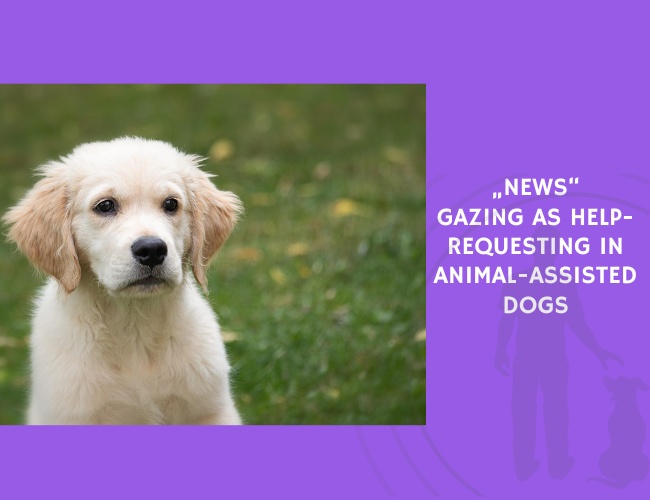
When dogs are confronted with an unsolvable problem, such as inaccessible food, they frequently gaze at nearby humans. This behavior has been widely interpreted as a form of social communication, potentially functioning as a request for assistance. Dogs involved in animal-assisted interventions (AAI) interact with many unfamiliar people throughout their lives, making them a particularly relevant population for studying human-directed communication.
In this study, the authors compared AAI dogs (n = 15) and pet dogs (n = 16) using an unsolvable task paradigm. Dogs were presented with food placed inside a container fixed to a wooden board, which could not be opened. During the task, the dog’s owner and an unfamiliar woman stood on opposite sides of the apparatus and deliberately ignored the dog.
Behavioral analyses revealed that AAI dogs spent significantly more time gazing at humans than pet dogs. They also showed a higher frequency of gaze alternation between the container and the people, a pattern often interpreted as referential communication linking an object to a social partner.
In addition to increased gazing, AAI dogs spent more time in physical proximity to the unfamiliar person, suggesting greater social engagement beyond their primary handler. However, no differences were found between groups in the total time spent gazing at the owner versus the unfamiliar person, indicating that AAI dogs did not preferentially direct their requests to a familiar human.
Importantly, the two groups did not differ in the time spent interacting with the apparatus itself, nor in the overall frequency of gaze alternation. This suggests that the observed differences were not due to varying levels of persistence or task engagement, but rather to distinct communicative styles.
The findings support the idea that gazing functions as a communicative, help-requesting behavior and that repeated experience with diverse humans, as occurs in AAI work, may enhance this tendency. Such communicative sensitivity may contribute to the high coordination and responsiveness required in animal-assisted settings.
The authors conclude that understanding these behavioral characteristics may be valuable for the selection, training, and welfare assessment of AAI dogs, particularly as animal-assisted interventions continue to expand in therapeutic and educational contexts.
Source: Cavalli, C., Carballo, F., Dzik, M. V., & Bentosela, M. (2019). Gazing as a help requesting behavior: a comparison of dogs participating in animal-assisted interventions and pet dogs. Animal Cognition, published November 12, 2019.