
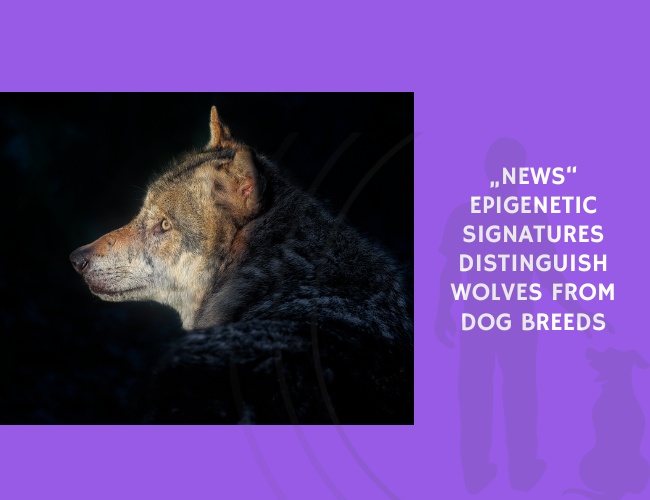
Published in Zeitschrift für Induktive Abstammungs- und Vererbungslehre, this study by Z. Banlaki, Giulia Cimarelli, Z. Virányi, E. Kubinyi, M. Sasvári-Székely, and Z. Rónai examined whether epigenetic markers—specifically DNA methylation patterns—can effectively distinguish canine populations. While genetic divergence between wolves and dogs is well documented, the role of epigenetics in population separation is less understood.
Researchers analyzed 79 CpG sites organized into 65 CpG units across promoter regions of genes associated with behavior and temperament, including COMT, HTR1A, MAOA, OXTR, SLC6A4, TPH1, and WFS1. These genes are considered likely targets of selection during domestication and breed formation.
DNA methylation in buccal cells was measured using EpiTYPER mass spectrometry. Significant inter-population differences were detected in 52.3% of CpG units, demonstrating widespread epigenetic divergence across gray wolves and domestic dog breeds.
Hierarchical clustering based solely on methylation data produced a clear separation between wolves and dogs. Moreover, one dog breed—the Golden Retriever—formed a distinct epigenetic cluster, suggesting that breed-specific selection pressures have shaped unique methylation signatures.
The authors conclude that population segregation is closely tied to shifts in DNA methylation, at least within behavior-related genomic regions subjected to selection. These findings also imply that epigenetic profiles may be powerful enough to assign individuals to populations without relying solely on genetic markers.
Source: Banlaki, Z., Cimarelli, G., Virányi, Z., Kubinyi, E., Sasvári-Székely, M., & Rónai, Z. (2017). DNA Methylation Patterns of Behavior-Related Gene Promoter Regions Dissect the Gray Wolf from Domestic Dog Breeds. Published March 21, 2017.










