
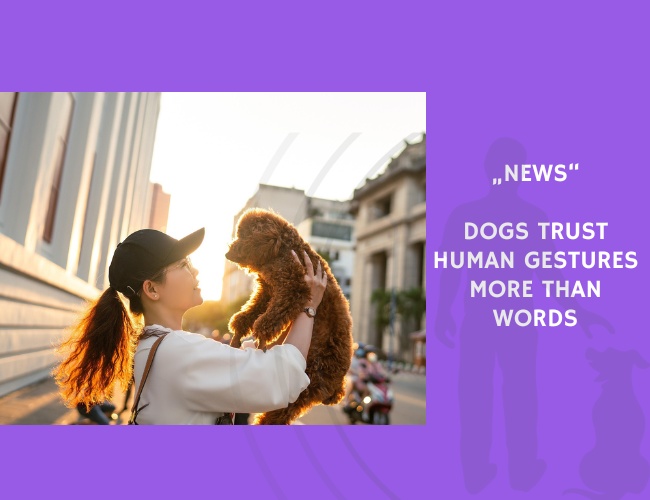
Published in Animal Cognition, this study by B. D’Aniello and colleagues investigated how dogs interpret incongruent communication cues—specifically when gestures and spoken words conflict. The research focused on trained water rescue dogs accustomed to responding to both verbal and gestural instructions from their handlers.
In controlled tests, dogs were given commands that combined conflicting cues: one gestural and one verbal. The results were striking—dogs consistently followed the gesture rather than the word. This preference for visual over auditory information suggests that dogs rely heavily on human body language when decoding meaning, even when both signals are familiar and well-trained.
The findings reveal that canine perception and attention are biased toward visual social signals. Dogs evolved alongside humans to interpret posture, movement, and gaze—cues that often convey intention more clearly than speech. This ability likely enhanced their cooperation with humans during hunting, working, and companionship roles throughout domestication.
D’Aniello et al. conclude that effective human–dog communication depends not only on spoken commands but also on non-verbal synchrony and clarity. For trainers and pet owners, this underscores the importance of consistent gestures and calm body language. A dog’s trust and understanding are built as much through what it sees as through what it hears.
Source: D’Aniello, B., Scandurra, A., Alterisio, A., Valsecchi, P., & Prato-Previde, E. (2016). The importance of gestural communication: a study of human–dog communication using incongruent information. Animal Cognition, 19, 1231–1235. Published June 23, 2016.










