
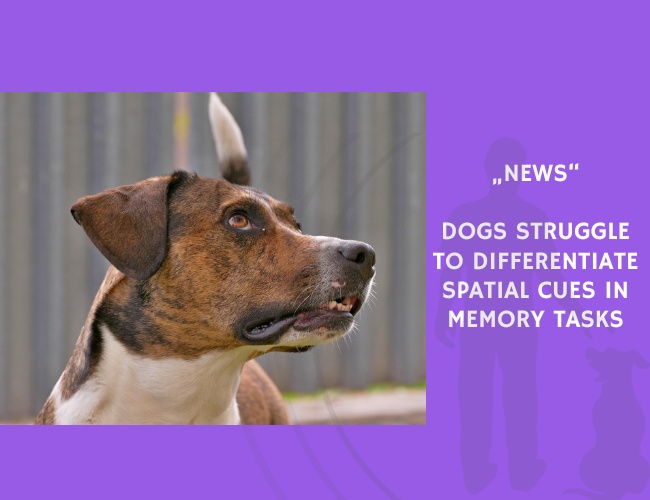
Spatial working memory plays a critical role in how animals navigate and solve problems. In this experiment, seven domestic dogs were trained to track an attractive object as it moved and disappeared behind one of three opaque boxes. Researchers then introduced a detour task, forcing the dogs to follow a U-shaped pathway to reach the hiding place. During these trials, local cues (e.g., boxes and experimenter) and global cues (e.g., walls of the room) were systematically shifted.
While three of the dogs successfully learned to use the shifting cues, they consistently failed when local and global cues conflicted. Although they passed control trials, they could not reliably distinguish between different sources of allocentric information. This suggests that dogs experience difficulty in separating contextual cues in spatial tasks, particularly when confronted with competing references.
Fiset and Malenfant (2013) proposed several hypotheses for these results. One possibility is that dogs rely heavily on egocentric strategies—centered on their own position—rather than fully processing external allocentric cues. Another explanation is that the experimental setup imposed cognitive demands that exceeded dogs’ working memory capacity, leading to confusion when cues were in conflict.
This study highlights the complexities of canine spatial cognition and shows that while dogs can track objects using certain cues, their ability to differentiate between local and global references remains limited under experimental conditions. These findings contribute to a deeper understanding of how dogs perceive and process spatial information.
Source: Fiset, S., & Malenfant, N. (2013). Encoding of local and global cues in domestic dogs’ spatial working memory. Open Journal of Animal Sciences, 3, 1–11. Published July 17, 2013.










