
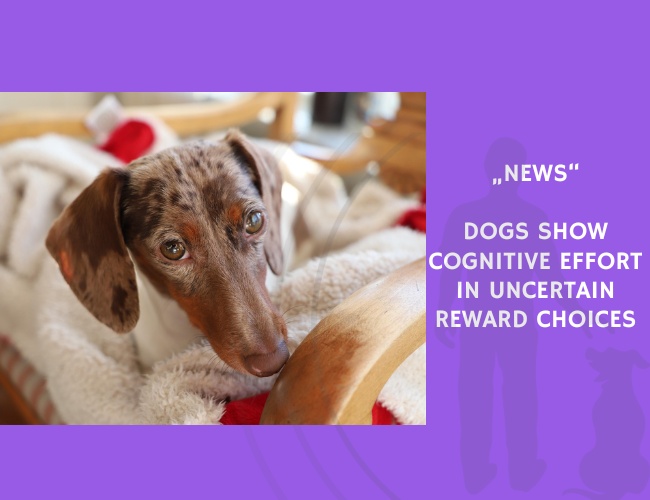
Decision-making under uncertainty is a fundamental aspect of cognition in both humans and animals. In this study, Chilingarian, Preobrazhenskaia, and Merzhanova (2010) tested how dogs responded to reinforcement choices that varied in both probability and value. The researchers observed how latency—the time taken to make a choice—shifted when outcomes were certain versus uncertain.
Dogs consistently chose the 100% reinforcement option more quickly, while choices involving less probable rewards were made with longer delays. This pattern became even more pronounced as uncertainty increased, suggesting that dogs engage in heightened cognitive processing when faced with difficult or ambiguous decisions.
The findings highlight that dogs are not merely reactive in choice tasks but demonstrate cognitive effort when weighing uncertain options. This parallels research in other species, showing that latency under uncertainty can serve as a behavioral marker of cognitive engagement and decision difficulty.
Such insights deepen our understanding of canine cognition, especially in contexts where dogs must balance risk and reward, from training tasks to natural problem-solving scenarios.
Source: Chilingarian, L. I., Preobrazhenskaia, L. A., & Merzhanova, G. (2010). Individual prognostic behavioral features in dogs during the choice between probability and value of reinforcement. Zhurnal Vyssheĭ Nervnoĭ Deiatelnosti Imeni I P Pavlova, 60(4), 438–445.










