
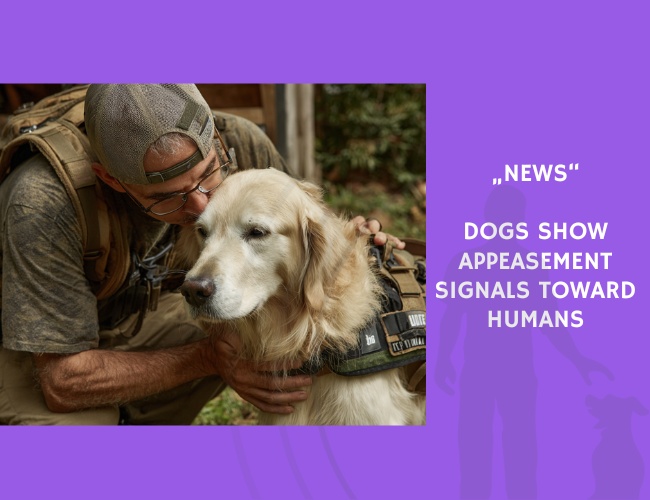
Appeasement signals in animals are behaviors that communicate a willingness to avoid conflict. In dogs, certain displacement behaviors—actions performed outside the immediate context, like blinking or nose licking—have been hypothesized to function as such signals. To investigate this, Pedretti et al. (2023) studied how dogs respond to both neutral and threatening approaches from unfamiliar humans.
Fifty-three dogs were tested with two different types of human interaction: a neutral approach and a mildly threatening one. Researchers classified the dogs’ reactions as either reactive (barking, lunging) or non-reactive (remaining passive). Specific displacement behaviors—including blinking, nose licking, and lip wiping—were strongly associated with non-reactive, non-aggressive responses across both conditions. Additionally, head turning was linked to a non-reactive attitude specifically when confronted with a threatening human.
The findings suggest that these signals may not be limited to conflict situations but instead represent broader markers of a dog’s non-aggressive intent. This supports the idea that dogs use subtle, non-verbal cues to manage interactions with humans, potentially reducing tension and promoting social harmony.
While these behaviors confirm an association with non-aggression, the study also emphasized that appeasement signals are complex and context-dependent, calling for further research into their role in canine communication.
Source: Pedretti, G., Canori, C., Biffi, E., Marshall-Pescini, S., & Valsecchi, P. (2023). Appeasement function of displacement behaviours? Dogs’ behavioural displays exhibited towards threatening and neutral humans. Animal Cognition, 26, 943–952.










