
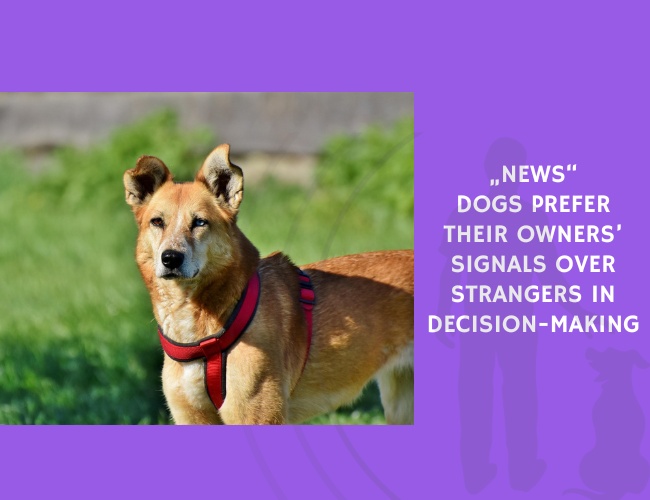
Published in Animal Cognition, this study by Amy L. Cook, Jennifer Arter, and L. Jacobs explores how familiarity with humans influences dogs’ decision-making. Although dogs are known to be sensitive to human behavior and form strong social bonds with specific individuals, these two research areas are rarely examined together.
The researchers investigated whether dogs’ relationships with their owners would affect how they respond to different human signals during a food-choice task. Dogs were presented with two containers and observed humans indicating one of them using various types of social cues. In some conditions, the owner indicated the container containing food while a stranger indicated the empty one; in others, this was reversed.
The results showed a clear pattern: dogs were more likely to choose the container indicated by or nearest to their owner, even when following the owner’s cue meant receiving no food reward. This suggests that familiarity influences not only social preference but also decision-making and trust in human communication.
Two conditions resulted in chance-level performance: one in which both signalers were strangers, and another in which no social signals were provided (both humans sat reading books). These controls demonstrate that the observed effects were driven specifically by social cues from familiar individuals, not by the physical context or random choice.
This study is the first to directly compare owner versus stranger influence within a single food-choice setup. Its findings highlight the strength of owner–dog social bonds and indicate that dogs may weigh social information based on their relationship with the signaler. Such preference for familiar individuals has implications for training, behavior modification, cooperative tasks, and welfare, suggesting that owners’ signals carry unique motivational weight in canine cognition.
Source: Cook, A. L., Arter, J., & Jacobs, L. (2013). My owner, right or wrong: the effect of familiarity on the domestic dog’s behavior in a food-choice task. Animal Cognition. Published August 31, 2013.










