
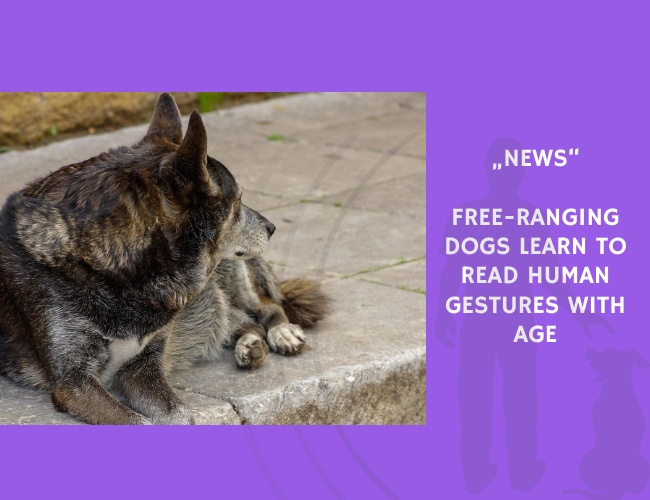
Human–dog communication relies on social cues like pointing and gaze, often taken as hallmarks of domestication. However, it remains debated whether these abilities are innate or shaped by experience. Free-ranging dogs—those living independently of human homes but still within human environments—offer a unique opportunity to explore this question.
Bhattacharjee and colleagues (2017) tested urban free-ranging dogs of different ages to see how they responded to human pointing gestures. The study used dynamic proximal pointing cues—gestures directing dogs toward hidden food. Results showed that pups readily followed human points and were less fearful of people, while juveniles and adults displayed more cautious and selective responses.
Interestingly, adults adjusted their behavior based on human reliability: after being rewarded, they were more likely to trust the experimenter’s cues, suggesting that experience and feedback shaped their responsiveness. This developmental shift indicates that behavioral plasticity—the ability to adapt to changing social contexts—plays a key role in how dogs interpret human signals.
Overall, the findings reveal that free-ranging dogs’ understanding of human gestures evolves with age. Early openness and curiosity give way to selective trust, illustrating a balance between innate social tendencies and learned caution. This highlights the adaptive intelligence of dogs living alongside humans without direct domestication pressures.
Source: Bhattacharjee, D., N. D. N., Gupta, S., Sau, S., Sarkar, R., Biswas, A., Banerjee, A., Babu, D., Mehta, D., & Bhadra, A. (2017). Free-ranging dogs show age related plasticity in their ability to follow human pointing. PLoS ONE, 12, published July 17, 2017.










