
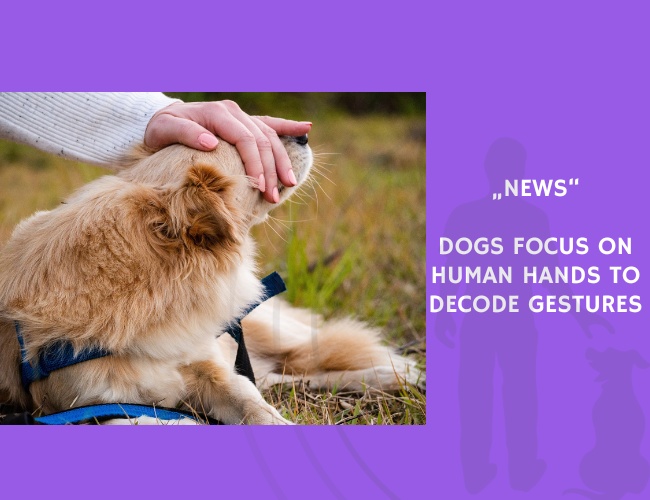
Published in Animals, the study by T. Ogura and colleagues explored the visual attention patterns of dogs to understand how they perceive and interpret human signals. Using a liquid crystal display monitor, researchers presented dogs with images of humans (with and without hand signs), other dogs, and cats. The dogs’ gaze patterns were recorded with a precise eye-tracking device.
The results showed a striking difference in how dogs viewed humans compared to other species. While dogs tended to focus on the head and body when looking at images of other dogs or cats, they gazed significantly more at the hands and limbs of humans. When human hand gestures were present, dogs’ gaze toward the hands increased even further, suggesting that dogs are particularly attuned to hand movements as communicative signals.
This attentional bias reflects the evolution of dog–human communication. Dogs have adapted to read and respond to subtle visual cues, such as gestures and postures, which form a foundation for training and cooperative interaction. The researchers suggest that this visual specialization is one reason dogs excel in understanding commands, detecting human intent, and engaging in interspecies cooperation.
Ogura et al. conclude that the dog’s gaze toward human hands represents a key element of their social intelligence—one that bridges species barriers through nonverbal understanding. Future studies comparing visual attention across different species may further clarify how dogs evolved such refined perceptual attunement to humans.
Source: Ogura, T., Maki, M., Nagata, S., & Nakamura, S. (2020). Dogs (Canis familiaris) Gaze at Our Hands: A Preliminary Eye-Tracker Experiment on Selective Attention in Dogs. Animals, 10. Published April 26, 2020.










