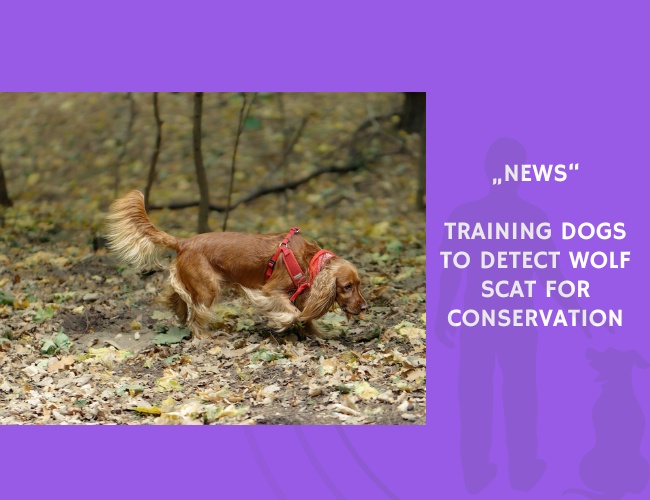
Detection dogs have become vital tools in conservation biology, assisting researchers in locating and identifying traces of elusive species. In this study, published in the Bulletin of University of Agricultural Sciences and Veterinary Medicine Cluj-Napoca, Hilde Vervaecke and colleagues explored whether dogs trained on a limited number of samples could reliably detect and generalize the scent of wolf scat (Canis lupus).
Four experienced detection dogs were introduced to wolf scat for the first time. Interestingly, all initially showed signs of aversion toward the unfamiliar odor. The dog demonstrating the least aversion underwent two weeks of training, during which researchers evaluated his ability to distinguish wolf scat from distracting odours such as dog feces and other environmental scents. The testing process involved a blind lineup of eight scent boxes with randomized placements of wolf scat and control odours, ensuring objectivity.
Results revealed that the trained dog achieved partial generalization—it successfully identified new wolf scats beyond the initial training samples, though not perfectly. This outcome highlights both the remarkable olfactory discrimination capabilities of dogs and the importance of refined training protocols for ecological scent detection. The study also identified key methodological improvements for future training, emphasizing controlled exposure and reinforcement consistency.
While preliminary, these findings underscore the potential of detection dogs as non-invasive, efficient tools in monitoring wolf populations. Their ability to learn and generalize specific biological scents supports long-term conservation strategies, enabling researchers to collect data without disturbing wildlife.
Source: Vervaecke, H., Krunkelsven, E., & Berge, K. V. D. (2021). Training of Ecological Detection Dogs for Wolf Scat (Canis lupus). Bulletin of University of Agricultural Sciences and Veterinary Medicine Cluj-Napoca. Animal Science and Biotechnologies, 78, 49. Published May 14, 2021.