
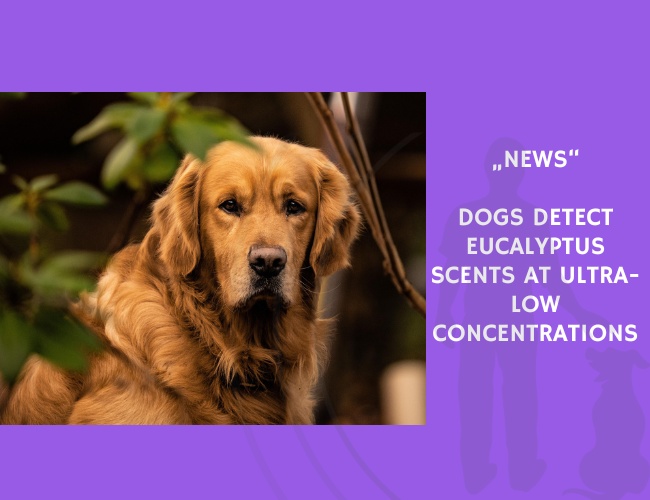
Dogs’ ability to detect and distinguish scents far surpasses that of humans. Their highly specialized nasal anatomy and extensive olfactory receptor network enable them to perceive minute quantities of airborne compounds. In this study published in Animals, Soile Turunen and colleagues examined how low the concentration of a familiar scent—Eucalyptus hydrolat—could be while still remaining detectable by trained dogs.
Fifteen dogs participated in a three-part detection experiment using a three-alternative forced-choice method. The dogs were trained to identify Eucalyptus hydrolat as it was progressively diluted, with their performance measured until the first incorrect response marked their individual detection threshold. The researchers also conducted nuclear magnetic resonance spectroscopy to analyze ten commercial hydrolat products, revealing chemical variability that could influence training consistency.
The findings were remarkable: trained dogs detected Eucalyptus hydrolat even when diluted to between 1:10¹⁷ and 1:10²¹. Initially, detection limits varied from 1:10⁴ to 1:10²³, but focused training narrowed these thresholds. The results confirm that with systematic exposure, dogs can discriminate vanishingly small scent concentrations, reaffirming their suitability for applications from nose-work sports to search-and-rescue and medical detection.
Beyond confirming dogs’ remarkable olfactory acuity, the study emphasizes the importance of consistent scent sources in training. Variations among commercial hydrolats—particularly in levels of eucalyptol and lower alcohols—can alter odor profiles, potentially affecting learning and performance. The researchers recommend standardizing scent materials to ensure reliability across canine olfactory research and competitive detection disciplines.
Ultimately, the study not only showcases the incredible sensitivity of dogs’ noses but also highlights how deliberate, structured training can push those natural limits even further, allowing dogs to detect targets that would be completely imperceptible to humans.
Source: Turunen, S., Paavilainen, S., Vepsäläinen, J., & Hielm-Björkman, A. (2024). Scent Detection Threshold of Trained Dogs to Eucalyptus Hydrolat. Animals, 14. Published April 1, 2024.










