
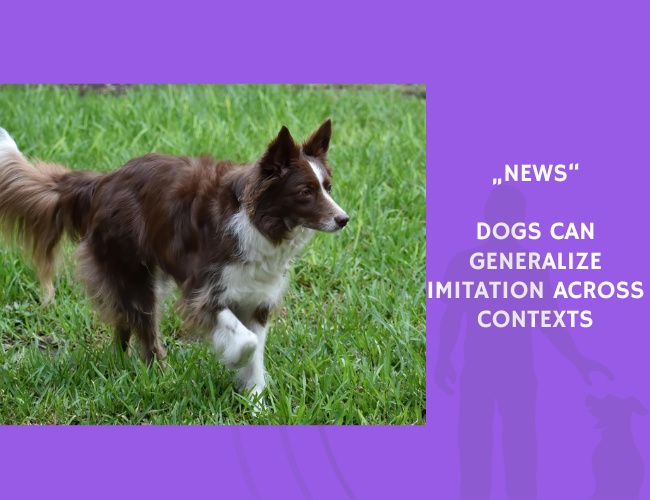
Imitation in animals is a central topic in understanding learning and cognition. While dogs are known to imitate human actions, it has remained unclear whether they can generalize these imitative behaviors when contexts change. Fugazza, Pogány, and Miklósi (2016) addressed this question using a deferred imitation task in domestic dogs.
The researchers tested dogs’ ability to reproduce demonstrated actions after a delay, while modifying aspects of the context. They found that dogs could generalize learned behaviors across such modifications, but the extent of generalization was limited. Crucially, object features acted as retrieval cues, supporting the recall of the specific action associated with them.
These findings highlight that imitation in dogs is not simply rote copying but involves context-sensitive memory processes. Dogs’ reliance on physical object features underscores their importance in facilitating recall and guiding flexible learning.
By demonstrating spatial generalization in imitation, this study adds to the growing body of evidence that dogs possess sophisticated cognitive skills, bridging memory, perception, and social learning. This research also emphasizes the role of context and cues in shaping how dogs transfer learned behaviors to new situations.
Source: Fugazza, C., Pogány, Á., & Miklósi, Á. (2016). Spatial generalization of imitation in dogs (Canis familiaris). Journal of Comparative Psychology, 130(3), 249–258.










