
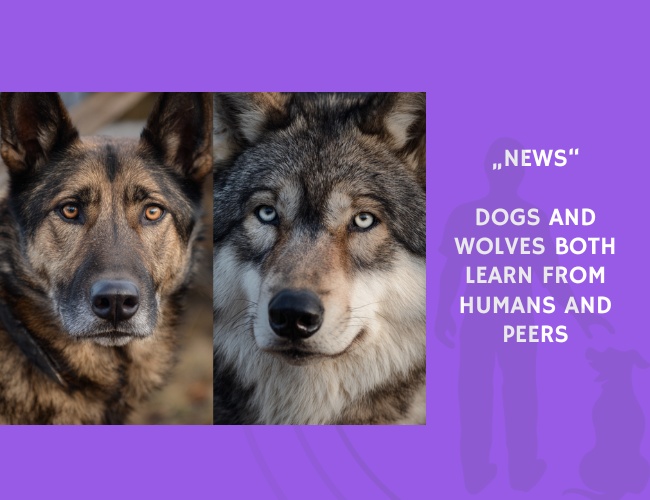
Domestication hypotheses often suggest that dogs evolved specialized skills for communication and learning from humans. Yet whether these abilities are entirely new, or partly inherited from their wolf ancestors, remains debated. To explore this, Range and Virányi (2013) compared juvenile wolves and dogs raised under identical conditions in a social learning experiment.
In a local enhancement task, both wolves and dogs benefited from demonstrations, whether the demonstrator was a human or another dog. Compared to control conditions with no demonstration, the presence of a demonstrator increased success in locating food, showing that social learning functions across species boundaries.
Interestingly, when demonstrators only pretended to hide food, responses diverged. Dogs distinguished between genuine and false demonstrations regardless of whether the model was human or canine. Wolves, however, only made this distinction when the demonstrator was human. The authors suggest this may be due to wolves paying closer attention to conspecific details, but being less motivated when demonstrator dogs lacked enthusiasm for the food reward.
These findings reveal that both wolves and dogs are capable social learners, but domestication may have subtly shaped the ways dogs generalize social information. The study underscores the need for more fine-grained research to disentangle how human selection influenced the balance between inherited wolf skills and novel canine adaptations.
Source: Range, F., & Virányi, Z. (2013). Social learning from humans or conspecifics: differences and similarities between wolves and dogs. Frontiers in Psychology, 4, published December 3, 2013.










