
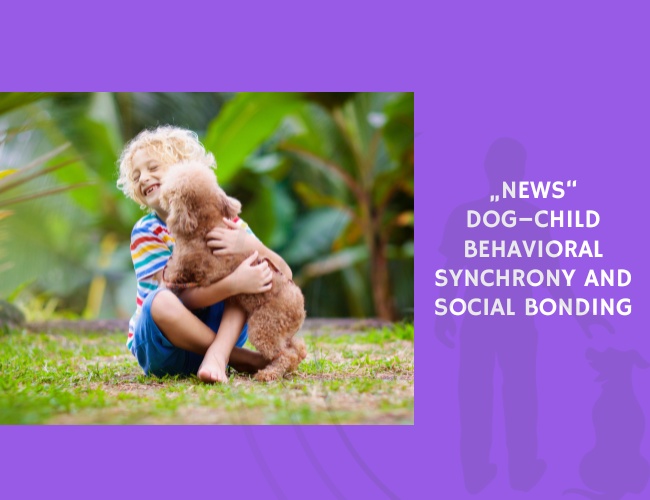
Published in the Animal Cognition journal, S. Wanser and colleagues conducted a comprehensive study to explore how family dogs synchronize their behavior with children within everyday social contexts. Although many studies have examined dog synchronization and affiliative responses with adult humans, the understanding of dog–child interactions from a cognitive and behavioral perspective has often been limited.
Through a behavioral analysis of activity, proximity, and orientation between dogs and child family members, the authors identified evidence of significant behavioral synchrony across all measured components. Specifically, dogs demonstrated activity synchrony (p < 0.0001), proximity-based alignment (p < 0.0001), and orientation toward the child (p = 0.0026) at levels notably higher than chance, suggesting attunement to child behavior.
Wanser and her team found that while many researchers focus on dog responsiveness to adult actions, few consider the mutual adjustments and communicative exchanges that occur between dogs and children. The study underscores the importance of recognizing dogs not merely as companions but as socially adaptive partners whose behavior dynamically adjusts to the movements and actions of child family members.
To address these gaps, the paper introduces a social-cognitive framework designed to guide future research. This approach integrates insights from developmental psychology, animal cognition, and family interaction studies to form a more holistic understanding of dog–child behavioral dynamics. By emphasizing synchrony, attunement, and social responsiveness, this framework highlights the potential of dogs to engage in meaningful synchrony beyond adult-directed interactions.
The authors conclude that adopting such a framework will enhance both research design and practical applications in the field of human–animal social behavior. By accounting for the relational complexity of dog–child interactions, practitioners and researchers can develop more informed, ethical, and effective intervention models that support safe and successful integration of dogs into family and child-centered environments.
Source: Wanser, S., MacDonald, M., & Udell, M. (2021). Dog–human behavioral synchronization: family dogs synchronize their behavior with child family members. Animal Cognition. Published January 12, 2021.










