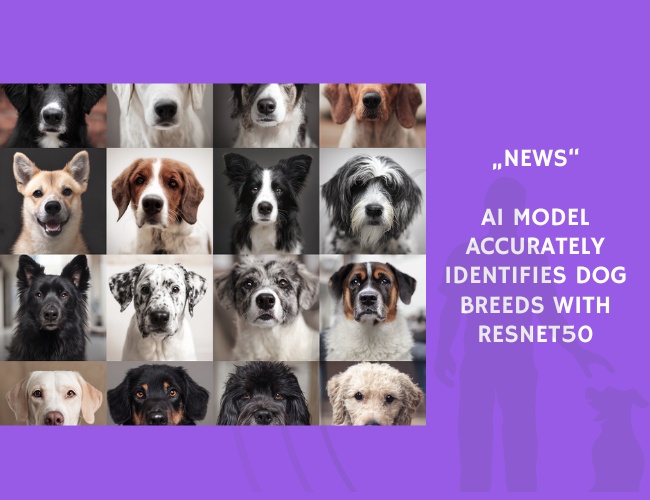
Identifying dog breeds is not just a matter of curiosity—it can provide insights into a dog’s behavioral tendencies and training needs. Traditionally, breed identification required expert evaluation, but artificial intelligence now offers efficient alternatives. The rise of deep learning has brought powerful tools for solving such image-based classification tasks.
S., R., A., and Y. (2023) developed an advanced classification model using ResNet50 architecture to improve dog breed identification accuracy. The team trained their convolutional neural network (CNN) on a dataset of over 10,000 dog images, comparing its performance to other deep learning models. ResNet50 consistently outperformed alternative approaches, achieving the highest accuracy in correctly classifying breeds.
The study emphasizes that knowing a dog’s breed can help owners and trainers anticipate behavioral drives linked to historical working roles, such as guarding, herding, or retrieving. By enabling fast and affordable identification from a smartphone photo, the ResNet50 model has practical applications for both pet owners and the animal husbandry sector. This technology removes reliance on expert identification and can enhance training and care strategies tailored to breed-specific traits.
These results highlight the potential of AI-powered recognition tools to transform everyday dog care and professional breeding practices. As accuracy continues to improve, such systems could become integral to veterinary medicine, animal shelters, and personalized dog training programs.
Source: S., S., R., T., S., A., & S., Y. (2023). ResNet50 Architecture Based Dog Breed Identification Using Deep Learning. Applied and Computational Engineering.