
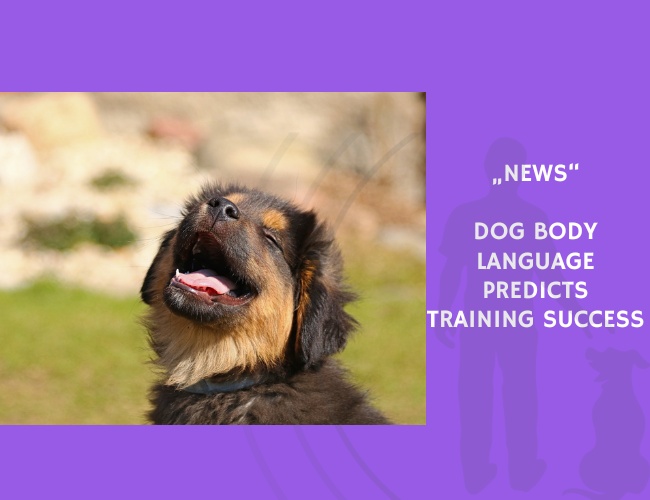
Effective training requires not only clear communication but also an understanding of a dog’s emotional and attentional state. Hasegawa et al. (2014) investigated how body language during operant conditioning could predict dogs’ learning outcomes. Recognizing these signals may help owners and trainers adjust methods to improve success and strengthen human–dog communication.
The study tested 46 untrained dogs of various breeds in operant conditioning sessions. Each training period consisted of five minutes with food rewards, followed by a short rest, and then a standardized test involving 20 hand-motion cues. Over three days, the researchers recorded the duration of specific body behaviors during training, focusing on eyes, mouth, ears, tail position, and wagging style.
Results showed that certain physical cues were strongly linked with higher success rates. Dogs displaying wide eyes, closed mouths, erect ears, and forward or high tail carriage—with little or quick wagging—achieved more correct responses in the learning tests. These behaviors appeared to signal focused attention and engagement, key factors for successful operant learning.
The findings demonstrate that dog body language is a window into their learning state. By observing and interpreting these subtle cues, owners can better recognize when their dog is attentive, motivated, and ready to succeed in training tasks, ultimately fostering more effective and empathetic communication.
Source: Hasegawa, M., Ohtani, N., & Ohta, M. (2014). Dogs’ Body Language Relevant to Learning Achievement. Animals, 4, 45–58. Published February 27, 2014.










