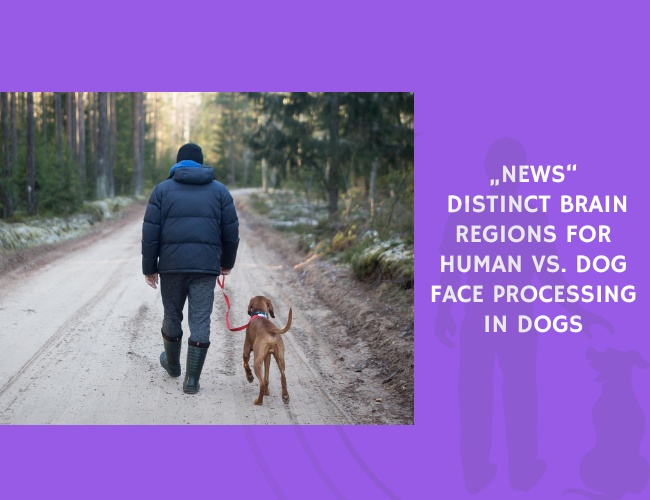
A study published in Learning & Behavior used awake functional magnetic resonance imaging (fMRI) to investigate how dogs process visual images of human and dog faces. Working dogs viewed pictures of faces that differed in species, familiarity, and emotional valence while researchers examined neural activation in the temporal cortex.
The findings showed that dogs possess two adjacent but clearly separate cortical regions dedicated to processing faces: a Human Face Area (HFA) and a Dog Face Area (DFA). Both areas responded to emotional valence, indicating that the distinction between HFA and DFA is not based on emotion. Furthermore, the regions did not differ in response to familiar versus unfamiliar faces, suggesting that species identity is the primary organizing dimension.
To explore broader organizational principles, the researchers compared resting-state fMRI connectivity patterns from dogs and humans. The canine HFA showed a connectivity fingerprint similar to the human fusiform face area, whereas the DFA aligned most closely with the human superior temporal gyrus. These parallels suggest deep evolutionary roots in how mammalian brains structure face-perception systems.
This work not only advances understanding of canine social cognition but also provides a comparative framework for studying how face processing evolved across species. The clear functional segregation for human and dog faces demonstrates that dogs’ social brains may be finely tuned to navigate both conspecific and interspecies relationships.
Source: Thompkins, A. M., Ramaiahgari, B., Wulff, B., Berns, G., Dodge, C., Dilks, D. D., & Katz, J. (2018). Separate brain areas for processing human and dog faces as revealed by awake fMRI in dogs (Canis familiaris). Learning & Behavior. Published October 22, 2018.