
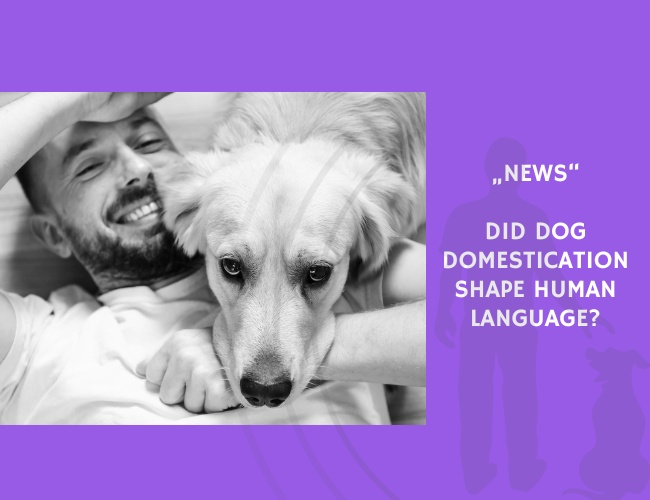
The origins of human language remain one of the most intriguing puzzles in evolutionary science. In their 2020 review, Antonio Benítez‐Burraco, Dominic Pörtl, and Carel Jung argue that our close relationship with dogs may have played an unexpected role in shaping it. Drawing from ethological, archaeological, genetic, and physiological evidence, the authors suggest a co-evolutionary feedback loop between dog domestication and human self-domestication.
The theory of human self-domestication proposes that, over time, humans selected for reduced aggression and greater social tolerance within their own species—traits also seen in domesticated animals. According to the authors, our domestication of dogs likely amplified these same traits in humans. By living alongside canines that required cooperation and emotional sensitivity, early humans may have been pushed toward greater empathy, prosociality, and emotional control.
This shift would have created a social environment conducive to language evolution. Reduced aggression and heightened social tolerance favor the emergence of complex social networks, cooperative learning, and cultural transmission—key conditions for the development of structurally complex languages. In turn, humans capable of more sophisticated communication may have been better suited to train, coordinate, and live with dogs, further strengthening the feedback loop.
The authors’ interdisciplinary synthesis suggests that our long partnership with dogs was not just emotional or utilitarian—it may have had profound cognitive and cultural consequences. By shaping our social and emotional systems, dog domestication may have indirectly sculpted the neural and behavioral foundations of language itself.
Source: Benítez‐Burraco, A., Pörtl, D., & Jung, C. (2020). A Feedback Loop Between Human Self-Domestication and Dog Domestication Contributing to Language Evolution. Published March 15, 2020.










