
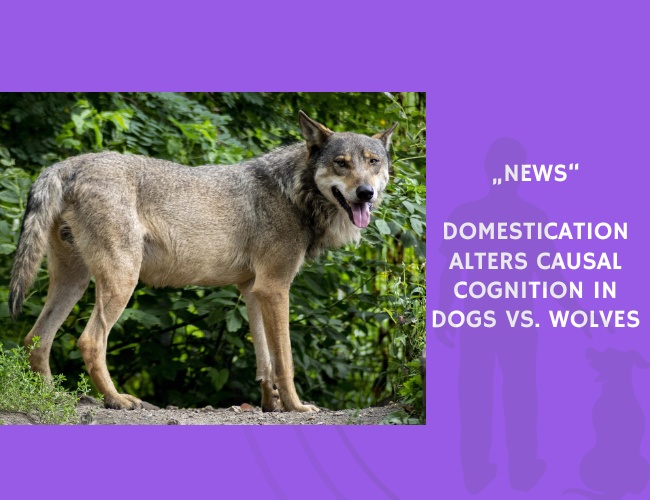
Cognition allows animals to adapt flexibly to their environments, and both domestication and upbringing are thought to influence these abilities. To better understand how domestication shaped dogs’ cognition, Lampe and colleagues (2017) compared wolves and dogs raised under similar pack-living conditions, alongside pet dogs raised in human homes.
The study tested animals using a series of object-choice tasks, where they had to respond to communicative, behavioral, and causal cues. Interestingly, wolves outperformed dogs in following causal cues, such as understanding the physical relationships between objects and outcomes. This suggests that domestication may have reduced dogs’ problem-solving abilities in certain non-social contexts.
By contrast, all three groups—wolves, pack-living dogs, and pet dogs—performed similarly in social cognition tasks. Both communicative and behavioral cues were interpreted with comparable success, suggesting that ontogeny (developmental environment) had little influence on these domains. This finding points to a strong flexibility in social cognition across both species, likely shaped by the demands of interacting with conspecifics and humans.
The results highlight a domain-specific effect of domestication: while dogs may have lost some efficiency in causal reasoning, they retained or even enhanced social skills that facilitate cooperation with humans. Further research is needed to disentangle how selection pressures during domestication reshaped these cognitive abilities compared to their wolf ancestors.
Source: Lampe, M., Bräuer, J., Kaminski, J., & Virányi, Z. (2017). The effects of domestication and ontogeny on cognition in dogs and wolves. Scientific Reports, 7, published September 15, 2017.










