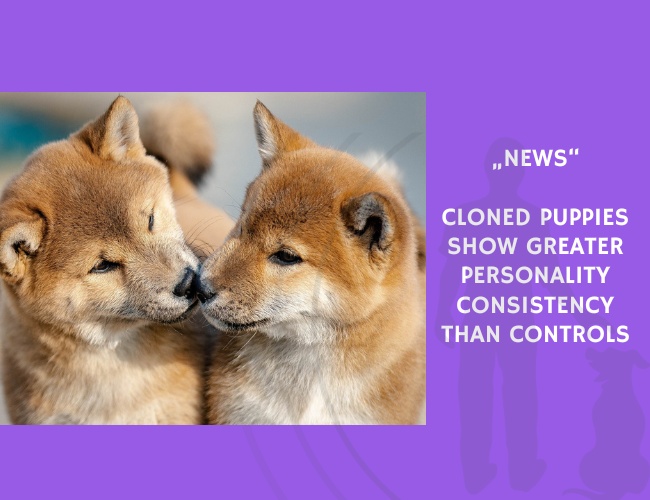
Personality consistency—the stability of behavioral traits over time—plays a crucial role in selecting working dogs and predicting their suitability for demanding tasks. Choi et al. (2017) investigated whether genetic identity affects this consistency by comparing cloned and non-cloned Beagle puppies bred as quarantine detector dog candidates.
Six cloned and four control puppies were evaluated using a modified Puppy Aptitude Test (PAT), which included subtests measuring social attraction, restraint, prey drive, noise sensitivity, and reaction to startling stimuli. Puppies were tested at both 7–10 weeks and 16 weeks of age to examine repeatability across developmental stages.
The results revealed that cloned puppies maintained consistent scores across tests, particularly in Pack Drive (social bonding and following behaviors) and Fight or Flight Drive (responses to restraint and stability). In contrast, the control group showed significant variability in their scores, suggesting less stable personality traits. Prey Drive behaviors were inconsistent in both groups.
These findings suggest that genetic identity contributes to personality consistency in dogs. For working dog programs, such as quarantine detection, cloned dogs may offer more predictable behavioral outcomes, potentially reducing training costs and improving selection efficiency. However, the authors caution that further research is needed to evaluate broader welfare and ethical considerations in canine cloning.
Source: Choi, J., Kim, H., Kang, Y., Kim, M. J., Lee, S. I., Oh, H., Kim, G. A., Jo, Y., Park, E., Park, J. Y., Choi, Y. G., & Byeong-Lee. (2017). Personality consistency analysis in cloned quarantine dog candidates. Acta Veterinaria Brno, 86, 273–283. https://doi.org/10.2754/avb201786030273