
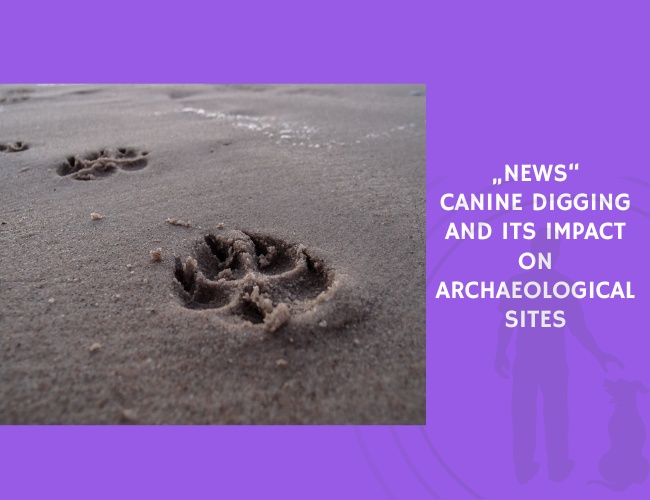
This study challenges a long-standing assumption in archaeology: that pit features uncovered at excavation sites are necessarily the result of human cultural activity. Jeske and Kuznar argue that because the number, shape, and distribution of pits strongly influence interpretations of past human behavior, their origins must be demonstrated rather than assumed.
Drawing on ethnoarchaeological observations of dog digging behavior and the deep, symbiotic history between humans and canines, the authors propose that dogs are a significant but underrecognized disturbance agent in archaeological contexts. Dogs dig under a wide range of conditions, including those typical of hunter-gatherer, pastoral, and agricultural societies, making their presence highly relevant across many site types.
The study documents that dogs create pits with distinctive yet variable forms, some of which closely resemble features commonly attributed to human excavation in the archaeological record. Excavations of recent dog-dug holes revealed marked similarities in size, profile, and sediment displacement to pits described in archaeological literature.
Beyond creating new pits, canines are also implicated in the modification and disturbance of human-dug features, potentially altering their original shape and stratigraphic context. This disturbance can complicate interpretations of site use, activity areas, and occupational intensity.
Jeske and Kuznar conclude that canine activity should be systematically considered in site formation analysis. Recognizing dogs as active agents in shaping archaeological deposits leads to more cautious, nuanced reconstructions of past human behavior and underscores the importance of integrating behavioral ecology into archaeological interpretation.
Source: Jeske, R., & Kuznar, L. (2001). Canine Digging Behavior and Archaeological Implications. Published January 1, 2001.










