
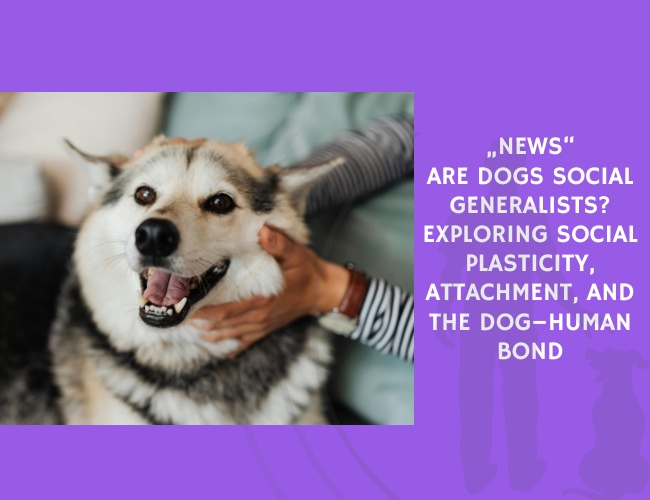
Published in 2016 by M. Udell and Lauren Brubaker, this study challenges the idea that inconsistency in dog behavior complicates our understanding of canine cognition. Instead, the authors suggest that social plasticity—the ability to flexibly adapt social behavior across individuals, breeds, and environments—is a defining feature of the domestic dog. This flexibility, they argue, is what makes dogs uniquely capable of forming strong bonds not only with humans but also with other dogs and even other species.
The researchers highlight that dogs display high variability in attachment styles, responsiveness to human cues, and emotional regulation. Rather than being a limitation, this variability represents an evolutionary advantage, allowing dogs to thrive across diverse human contexts—from working roles to companion environments. Social plasticity enables dogs to adjust their behavior in response to human emotions, household dynamics, and relational experiences, making them effective social partners.
Udell and Brubaker emphasize that investigating individual, breed, and population-level differences in canine social cognition will improve our understanding of how dogs interpret human signals, regulate attachment, and modulate behavior based on context. They point to research opportunities in studying secure, anxious, and avoidant attachment patterns in dogs, mirroring attachment frameworks commonly used in human psychology.
The study further proposes that social plasticity may be a major reason for the biological and social success of domestic dogs. This trait helps explain how dogs can equally serve as service partners, emotional companions, working animals, or family members—while maintaining the ability to learn, adapt, and emotionally connect across environments.
Ultimately, the authors conclude that a deeper understanding of social plasticity and attachment variation in dogs will contribute to more effective human–dog relationships, better training approaches, and improved welfare in applied settings. Recognizing dogs as social generalists opens a broader perspective on canine cognition and emphasizes the importance of flexibility in relational bonding.
Source: Udell, M., & Brubaker, L. (2016). Are Dogs Social Generalists? Canine Social Cognition, Attachment, and the Dog–Human Bond. Published October 1, 2016.










