You might notice your dog seems anxious, reactive, or withdrawn—and wonder if it’s just their personality. But what if the real issue lies not in your dog’s temperament, but in the invisible mismatch between your household’s rhythm and your dog’s ability to process the world around them?
Modern family life moves fast. Between busy mornings, work schedules, children’s activities, and evening routines, our homes buzz with constant motion, noise, and ever-shifting attention. While humans can adapt to this pace, our dogs often cannot. The result is a growing phenomenon: environmental mismatch—when the demands of daily life exceed a dog’s cognitive and emotional processing capacity.
This article explores the behavioral and emotional consequences when family lifestyle outpaces canine capacity, examining the science behind stress dysregulation, attachment disruption, and the pathways back to harmony. 🐾
The Hidden Cost of Modern Living
When Chaos Becomes the Norm
Your morning routine probably looks something like this: alarms blaring, voices overlapping, doors slamming, the television providing background noise, children rushing to get ready, and you juggling multiple tasks at once. For your dog, this isn’t just “morning energy”—it’s sensory bombardment.
Dogs process environmental information differently than humans. Their sensory systems are finely tuned to detect subtle changes in sound, scent, and movement—adaptations that served their ancestors well but can become overwhelming in modern domestic settings. When multiple voices issue conflicting commands, when timing is inconsistent, and when the emotional climate shifts rapidly, dogs experience what can only be described as cognitive overload.
Think of your dog’s brain like a computer processor. When too many programs run simultaneously, the system slows down, freezes, or crashes. The same happens with your furry friend when the household pace exceeds their processing capacity. This constant overstimulation diminishes their ability to learn, regulate behavior, and maintain emotional balance.
The Threshold of Too Much
Every dog has a processing threshold—an invisible line where environmental input exceeds their capacity to cope. This threshold varies based on temperament, breed predisposition, early socialization, and neurological sensitivity. Some dogs handle chaos better than others, but all dogs have limits.
The point at which sensory and social overload occurs is individual, but it’s exacerbated by multiple conflicting commands and inconsistent timing. When this threshold is crossed regularly, you might observe:
- Increased reactivity to everyday sounds like doorbells, footsteps, or voices
- Difficulty settling or maintaining calm states
- Mouthing, jumping, or other attention-seeking behaviors that escalate
- Avoidance behaviors such as hiding, leaving the room, or refusing to engage
- Hypervigilance—always watching, always alert, never truly relaxed
- Excessive barking or whining that seems disproportionate to triggers
- Destructive behaviors that emerge during high-stress periods
- Sleep disruption or difficulty staying asleep
These aren’t behavioral problems in the traditional sense. They’re adaptive responses to an environment that moves too fast for your dog’s nervous system to process safely. 🧠
Understanding Cognitive Overload in Dogs
The Science of Too Much
Cognitive overload theory helps us understand what happens when environmental demands exceed available mental resources. Just as students struggle to learn when overwhelmed with information, dogs struggle to process and respond appropriately when their environment bombards them with too many stimuli.
When your dog faces excessive cognitive demands, their executive functioning—the mental processes that include working memory, flexible thinking, and self-control—becomes impaired. This isn’t stubbornness or disobedience. It’s neurological overwhelm.
During overload, your dog’s brain prioritizes survival over learning. The thinking, rational part of their brain goes offline, and the reactive, emotional centers take over. This is why a dog who knows basic commands perfectly in a quiet living room might seem to “forget” everything in a chaotic household moment.
Breed and Temperament Considerations
While breed explains only about nine percent of behavioral variation in individual dogs, temperament profiles matter significantly. Certain dogs show lower tolerance for environmental chaos regardless of their breed.
Sensitive temperaments process sensory information more intensely. These dogs notice subtle changes in their environment and react more strongly to stimuli that other dogs might ignore. For them, a moderately busy household can feel like a sensory assault.
High-drive dogs with strong working instincts need clear outlets for their energy and focus. When their drive has nowhere to go in a chaotic environment, it transforms into frustration, reactivity, or destructive behavior.
Anxious predispositions make dogs vulnerable to environmental stress. These dogs already operate with heightened baseline arousal, so additional chaos pushes them quickly beyond their coping threshold.
Understanding your dog’s temperament helps you recognize their unique processing limits and adjust your household accordingly. 😄
Emotional and Attachment Dynamics
The Impact of Fragmented Feedback
Imagine trying to have a conversation with five people simultaneously, each giving you different instructions in varying tones. Confusing, right? This is what many dogs experience in multi-person households where emotional feedback is fragmented or inconsistent.
Attachment security requires stable, predictable feedback. When different family members provide contradictory cues—one person rewards jumping, another punishes it; one uses a stern tone for the same behavior another treats playfully—your dog experiences relational confusion.
This inconsistency undermines their sense of safety. Dogs rely on pattern recognition to predict outcomes and feel secure. When patterns become unpredictable, anxiety fills the void where confidence should be.
Relational Confusion: When Signals Don’t Match
Dogs are remarkably skilled at reading human emotional expressions. They recognize facial cues, body language, and vocal tones with impressive accuracy. But this skill becomes a liability when different humans communicate contradictory emotional and behavioral messages.
Consider this scenario: Dad comes home stressed from work, his body tense and voice clipped. Mom greets the dog with enthusiastic energy. An older child ignores the dog completely while a younger child smothers them with chaotic affection. The dog must navigate four completely different emotional landscapes within minutes.
This relational confusion prevents dogs from developing secure attachment patterns. They don’t know which human emotional state to attune to, which response will be rewarded, or how to predict what comes next. The result is a dog who seems uncertain, anxious, or inconsistently responsive.
The NeuroBond approach recognizes that emotional synchrony between human and dog requires consistency across all family members. When everyone in the household provides aligned emotional feedback, your dog can relax into secure attachment. 🧡
The Oxytocin-Cortisol Balance
Your dog’s hormonal landscape tells the story of their emotional experience. Two hormones play particularly important roles: oxytocin and cortisol.
Oxytocin is the bonding hormone, released during positive social interactions, gentle touch, and moments of connection. It promotes feelings of trust, safety, and affection. In stable, predictable homes where interactions are consistent and attuned, dogs experience healthy oxytocin release that strengthens their bond with family members.
Cortisol is the primary stress hormone, released when your dog perceives threat or experiences chronic uncertainty. Short-term cortisol elevation helps dogs respond to challenges, but chronic elevation damages health, impairs learning, and erodes emotional stability.
In fast-paced, multi-stimulus households, dogs often show elevated and dysregulated cortisol patterns. Their bodies remain in a state of chronic alert, never fully relaxing. Meanwhile, fragmented attention and inconsistent interaction patterns may reduce opportunities for the calm, connected moments that promote oxytocin release.
The imbalance between these hormones creates a physiological environment where stress dominates, and bonding opportunities diminish. Restoring balance requires deliberate changes to household rhythm and interaction patterns.

Behavioral and Learning Consequences
The Impact of Inconsistent Interaction
Your daily routine profoundly affects your dog’s ability to learn, focus, and self-regulate. Inconsistent interaction patterns—busy mornings where the dog is ignored, long absences during the day, followed by high evening activity—create a rollercoaster of arousal states.
Dogs thrive on predictability. When they can anticipate what comes next, they relax into routines and develop self-regulation skills. But when each day brings unpredictable timing, varying levels of attention, and inconsistent expectations, they remain in a state of uncertainty.
This chronic unpredictability impairs learning. Your dog’s brain can’t consolidate lessons when the environment keeps shifting. Commands that worked yesterday might not work today because the context—your energy, the household chaos level, the time of day—has changed dramatically.
Moreover, inconsistent interaction prevents the development of impulse control and emotional regulation. These skills require practice in a stable environment where cause and effect remain consistent. Without that stability, your dog struggles to develop the self-control you desire.
From Overstimulation to Reactivity
Chronic overstimulation follows a predictable pathway: first comes hypervigilance, then reactivity, and finally either explosive behavior or complete shutdown.
Hypervigilance is your dog’s attempt to monitor and predict an unpredictable environment. They watch everything, react to small changes, and never fully relax. You might notice they startle easily, bark at minor sounds, or can’t settle even during quiet moments.
Reactivity emerges when hypervigilance becomes unsustainable. Your dog’s nervous system, constantly activated, begins responding to stimuli with exaggerated intensity. The doorbell triggers explosive barking. Meeting another dog on walks provokes lunging or fear responses. Normal household activities elicit disproportionate reactions.
Shutdown states represent the final stage when your dog’s system can’t maintain high arousal any longer. They become withdrawn, unresponsive, or appear depressed. This resembles learned helplessness—a state where your dog has given up trying to control or predict their environment.
Understanding this progression helps you recognize early warning signs before reaching the shutdown stage. The goal is intervention during hypervigilance, before reactivity becomes entrenched. 🐾
Emotional Contagion: When Your Stress Becomes Theirs
Dogs don’t just observe human emotions—they absorb them. Emotional contagion means your dog picks up and mirrors your emotional state, particularly stress and anxiety.
When you rush through the morning, your elevated arousal and stress hormones communicate danger to your dog. When family members argue, the tension in your voices and bodies signals threat. When you’re anxious about your dog’s behavior, your anxiety amplifies their anxiety, creating a feedback loop.
This phenomenon explains why dogs often seem more reactive or anxious with certain family members. It’s not that your dog “prefers” one person over another—it’s that they’re responding to the emotional energy each person brings to interactions.
The Invisible Leash concept reminds us that emotional energy, not just physical control, guides our dogs. When you learn to regulate your own emotional state, you create an atmosphere where your dog can regulate theirs. This is co-regulation at its most fundamental level.
The Nervous System Connection
Understanding Co-Regulation
Co-regulation is the process where two nervous systems synchronize, each influencing the other’s physiological state. In healthy human-dog relationships, the human’s calm, regulated nervous system helps down-regulate the dog’s arousal.
But co-regulation requires the human nervous system to be genuinely calm, not just appearing calm on the surface. Dogs detect authenticity through micro-expressions, scent cues, and subtle body language changes. You can’t fake calm with a dog—they feel your actual physiological state.
When there’s a mismatch in nervous system tempo—your high-speed, multi-tasking state conflicts with your dog’s need for slower processing—co-regulation becomes impossible. Instead of helping your dog regulate, your dysregulated state amplifies their stress.
The Polyvagal Theory explains this through the lens of safety perception. Your dog’s nervous system constantly asks: “Am I safe?” When your behavior is fast, unpredictable, or emotionally inconsistent, the answer becomes “No,” triggering defensive responses that prevent learning and bonding.
Restoring Physiological Alignment
Calm, attuned interaction periods can restore physiological alignment between you and your dog. These don’t require hours of dedicated time—even brief moments of genuine connection make a difference.
What creates physiological alignment:
- Regulated breathing when near your dog communicates safety to their nervous system
- Slow, predictable movements rather than quick, sudden gestures
- Soft, warm vocal tones instead of sharp or loud voices
- Gentle, consistent touch that respects your dog’s preferences and boundaries
- Mindful presence where you’re fully attentive rather than distracted
- Eye contact that is soft and inviting, not direct and intense
- Body language that is open and relaxed, not tense or hurried
These practices activate your dog’s social engagement system, the neurological state where learning, bonding, and calm behavior become possible. Regular periods of physiological alignment help buffer against the stress of busier household moments.
Soul Recall—those moments when past emotional experiences resurface in present behavior—becomes positive when aligned interactions create memories of safety and connection. Your dog recalls these feelings even during challenging times, drawing on them as emotional resources. 🧠
Fast. Loud. Unseen.
Overload hides in love. When family life races ahead, dogs fall behind in silence. The chaos we call normal can drown their senses, leaving even the most loyal companion lost in noise and motion.
Every mind has limits. Cognitive thresholds are real—each sound, movement, and inconsistency adds weight. When the load exceeds capacity, dogs don’t rebel; they retreat, react, or unravel.



Calm restores connection. Slowing the rhythm lets trust breathe again. Through structure, softness, and mindful pace, a home becomes not just busy—but balanced, and finally safe for the dog’s nervous system.
The NeuroBond Model: Balancing Human Pace with Canine Needs
Understanding Emotional Synchrony
The NeuroBond model focuses on achieving emotional synchrony between humans and dogs through conscious emotional pacing and co-regulation. This approach recognizes that behavioral problems often stem from nervous system mismatch rather than training deficits.
Emotional synchrony means your emotional output matches your dog’s processing capacity. When you slow your internal tempo to align with your dog’s needs, magic happens. Reactivity decreases. Learning improves. The relationship deepens. This isn’t about slowing down your entire life—it’s about creating pockets of aligned interaction.
The model emphasizes several key principles:
Emotional pacing requires you to consciously modulate your energy level, vocal tone, and physical presence to match your dog’s optimal learning state. This might mean pausing before interactions to center yourself, or deliberately softening your approach when household energy is high.
Shared calm creates a neurological environment where both human and dog can access their thinking brains rather than reactive survival modes. This shared state makes training, bonding, and behavior modification possible.
Sensory safety involves creating environments and interactions that don’t overwhelm your dog’s sensory processing capacity. This might mean reducing background noise during training, minimizing visual chaos in your dog’s resting areas, or spacing activities to allow processing time between stimuli.
Practical Application in Daily Life
Implementing the NeuroBond approach doesn’t require perfection—it requires awareness and intentional moments of connection throughout your day.
Morning routines can be modified to include two minutes of calm connection before the chaos begins. This might be quiet sitting together, gentle petting, or simply breathing deeply while your dog settles nearby. This brief alignment sets a calmer foundation for the busy morning ahead.
Transition moments between activities offer opportunities for reset and regulation. When you come home from work, take thirty seconds to settle your own nervous system before greeting your dog. This prevents the excitement-anxiety spiral that many dogs experience during reunions.
Evening wind-down periods help both you and your dog transition from activity to rest. Create a ritual—dim lights, soft voices, calm touch—that signals the nervous system that safety and rest are coming. This might include slow walks, gentle grooming, or quiet time together on the couch.
Training sessions become opportunities for alignment rather than just skill-building. Approach training with regulated energy, clear communication, and patience for your dog’s processing speed. Success comes not from drilling commands but from creating the neurological state where learning happens naturally.
The Invisible Leash works through this alignment—you guide your dog not through physical control or verbal commands, but through your regulated presence and emotional energy. 🧡
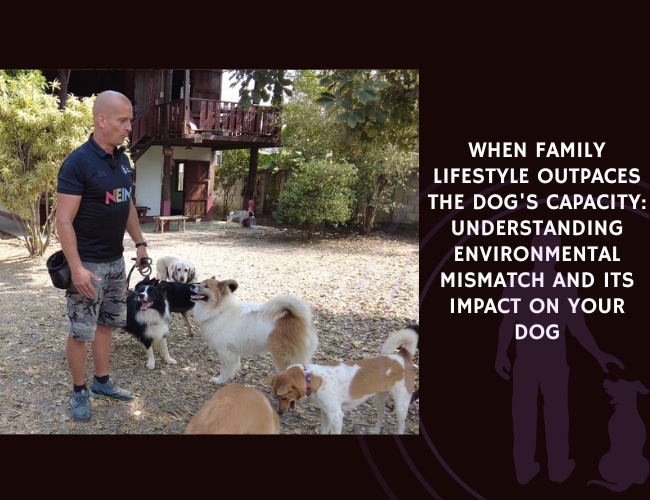
🏠 When Family Lifestyle Outpaces Your Dog’s Capacity
Understanding environmental mismatch and restoring harmony between household pace and canine processing capacity 🐾
🧠 Understanding Cognitive Overload
What Is Environmental Mismatch?
Environmental mismatch occurs when your household’s pace—constant motion, noise, and fragmented attention—exceeds your dog’s cognitive and emotional processing capacity. This isn’t a training problem; it’s a nervous system compatibility issue.
• Every dog has a processing threshold
• Breed matters less than individual temperament
• Chronic overstimulation impairs learning and regulation
• Your dog’s “misbehavior” may be adaptive overwhelm
The Science Behind the Struggle
When environmental demands exceed mental resources, your dog’s executive functioning—working memory, flexible thinking, and self-control—becomes impaired. The thinking brain goes offline, and reactive emotional centers take over.
• Cognitive overload prevents learning
• Cortisol elevation becomes chronic
• Emotional contagion amplifies household stress
• Co-regulation becomes impossible during mismatch
🔄 Creating Physiological Alignment
Daily Rituals for Regulation
Small, consistent moments of aligned interaction reshape your dog’s nervous system patterns from chronically activated to adaptable and resilient.
• Morning grounding: 5 minutes of calm connection before chaos
• Transition moments: 30-second nervous system reset when you arrive home
• Evening wind-down: Predictable ritual with dim lights and soft voices
• Weekend reset: Longer low-stimulation periods for deeper recovery
The NeuroBond Approach
Emotional synchrony requires matching your emotional output to your dog’s processing capacity. This creates pockets of aligned interaction where learning and bonding naturally emerge.
• Regulate your breathing before interactions
• Use slow, predictable movements
• Maintain soft, warm vocal tones
• Practice mindful presence without distraction
🏡 Environmental Modifications
Creating Sensorily Safe Spaces
Every dog needs physical refuges where sensory input is minimized and safety is guaranteed. These calm zones become essential when household activity exceeds processing capacity.
• Physical boundaries separate from household traffic
• Reduced sensory input (lower noise, dimmer lighting)
• Positive associations through special treats and chews
• Family respect—no interruptions when dog retreats
Family Alignment Strategies
Transformation happens when the entire family commits to supporting your dog’s nervous system needs through consistent, aligned interactions.
• Hold family meetings about dog’s emotional needs
• Establish consistent rules across all members
• Create shared language for household energy levels
• Practice calm greetings and regulated touch together
⚠️ Early Warning Signs of Mismatch
Recognizing Overwhelm Before Collapse
Identifying mismatch early allows intervention before behaviors become entrenched patterns requiring intensive modification.
• Physical indicators: Stress yawning, lip licking, excessive shedding
• Sleep disruption: Startling during rest, fitful sleep patterns
• Attention issues: Can’t focus despite knowing commands
• Social withdrawal: Opting out of previously enjoyed activities
Long-Term Consequences
Chronic environmental mismatch gradually erodes emotional resilience and physical health through cumulative stress exposure.
• Stress-related health issues (digestive, immune, skin)
• Behavioral rigidity and increased reactivity
• Relationship erosion and trust breakdown
• Reduced quality of life despite appearing to cope
⚡ Quick Assessment Framework
Does your household rhythm match your dog’s capacity? Evaluate these key areas:
• Daily schedule consistency — Predictable routines vs. constant shifts
• Sensory environment — Noise levels and competing stimuli
• Family interaction patterns — Aligned expectations vs. contradictory cues
• Arousal cycles — Calm periods vs. consistently high energy
• Human stress levels — Regulated presence vs. chronic tension
🧡 The Invisible Leash of Co-Regulation
Your dog doesn’t need a perfect environment—they need you to recognize their capacity, respect their limits, and provide the co-regulation that helps them navigate your shared world. Through the NeuroBond approach, you guide not through physical control but through regulated presence and emotional energy. Small moments of aligned interaction create Soul Recall—memories of safety your dog carries as emotional anchors during challenging times.
When you slow your internal tempo to match your dog’s processing needs, magic happens. Reactivity decreases. Learning improves. The relationship deepens. This is the essence of the Invisible Leash—leading through awareness, not force.
© Zoeta Dogsoul – Where neuroscience meets soul in dog training
Assessing Household Rhythm and Environmental Match
Should Trainers Evaluate Lifestyle First?
Behavior modification without understanding household context is like treating symptoms without diagnosing the disease. Trainers and behaviorists who assess household rhythm before developing intervention plans can identify whether behavioral issues stem from environmental mismatch rather than training deficits.
Key assessment areas include:
- Daily schedule consistency: How predictable are routines? Do meal times, walks, and family activities happen at similar times daily, or does the schedule shift constantly?
- Sensory environment: What are typical noise levels? How many competing stimuli exist simultaneously? Are there quiet spaces where the dog can retreat?
- Family interaction patterns: Do all family members interact with the dog consistently? Are commands, boundaries, and expectations aligned across people?
- Arousal cycles: How does household energy shift throughout the day? Are there calm periods, or is arousal consistently high?
- Human stress levels: What emotional climate dominates the home? Are family members generally regulated and present, or stressed and distracted?
- Physical exercise patterns: Does the dog receive appropriate physical outlets, or do energy levels remain chronically elevated or suppressed?
- Mental stimulation opportunities: Are there enrichment activities, or does boredom compound environmental stress?
This assessment often reveals that the dog isn’t “misbehaving”—they’re responding predictably to an environment that exceeds their processing capacity. The intervention then focuses on environmental modification rather than just dog training.
Early Warning Signs of Environmental Mismatch
Identifying mismatch before behavioral collapse requires recognizing subtle signs that your dog is struggling to cope:
Physical indicators include stress yawning, lip licking, whale eye (showing whites of eyes), excessive shedding, digestive issues, and changes in appetite. These physical manifestations of stress often appear before obvious behavioral problems.
Sleep disruption signals that your dog can’t fully relax. If they startle easily during rest, have trouble settling, or sleep fitfully, their nervous system remains on alert even during rest periods.
Attention and focus issues emerge when cognitive overload prevents learning. Your dog might seem “stubborn” or “distracted” but actually can’t process information in their current state.
Inconsistent behavior where your dog responds beautifully sometimes but not others suggests environmental factors affect their ability to perform rather than true skill deficits.
Social withdrawal from family members or activities they previously enjoyed indicates emotional resource depletion. When your dog opts out of interaction, they’re communicating overwhelm.
Recognizing these early signs allows intervention before behaviors become entrenched patterns requiring intensive modification. 🐾
Family-Based Emotional Training
Mindful Presence as Foundation
Mindful presence means being fully attentive during interactions with your dog, without distraction or divided attention. This isn’t about spending more time—it’s about being genuinely present during the time you do spend.
Dogs detect presence versus distraction immediately. When you’re scrolling your phone while petting them, they feel the divided attention. When you’re mentally planning tomorrow while on a walk, they sense the disconnection. But when you’re fully present, even briefly, the quality of connection transforms.
Practicing mindful presence:
- Put away electronic devices during dog interactions
- Notice your dog’s body language and emotional state
- Match your energy to the moment rather than bringing external stress
- Breathe consciously and maintain soft, open body language
- Respond to your dog’s communication attempts with attention
- Make eye contact that is warm and acknowledging
- Observe without judgment—simply notice what your dog is experiencing
This level of presence creates Soul Recall moments—experiences of genuine connection that your dog carries as emotional anchors during more challenging times.
Tone Regulation and Vocal Awareness
Your voice communicates far more than words. Dogs respond to pitch, volume, rhythm, and the emotional undertone of your voice before processing any verbal meaning. Tone regulation means consciously using your voice to support co-regulation.
Calm, lower-pitched tones activate your dog’s social engagement system and promote relaxation. Even during correction or redirection, maintaining a regulated vocal quality prevents defensive arousal.
Consistent vocal patterns help your dog predict outcomes. When “good dog” always sounds warm and pleased, and “leave it” always carries firm clarity without harshness, your dog can trust the information your voice provides.
Regulated volume respects your dog’s sensitive hearing. Loud voices, even when cheerful, can be jarring. Soft doesn’t mean weak—it means controlled and intentional.
Practice noticing your vocal tone throughout the day. Record yourself during interactions with your dog. Many people are surprised by how their stress, frustration, or urgency colors their voice in ways they didn’t realize.
The Power of Predictable Touch
Touch is a primary language of co-regulation, but only when it’s predictable, consensual, and appropriate for your dog’s preferences. Chaotic, unpredictable, or unwanted touch increases stress rather than reducing it.
Predictable touch means approaching from where your dog can see you, moving slowly enough for them to anticipate contact, and consistently using similar pressure and areas. This predictability allows your dog’s nervous system to relax into the experience.
Consensual touch respects your dog’s choice. Offer touch and allow them to move into it or decline. Dogs who can control when and how they’re touched develop greater emotional security.
Calming touch techniques include slow, rhythmic stroking along the body, gentle pressure on the chest or shoulders, and calm hand placement on areas your dog finds soothing. Rapid petting, patting, or vigorous rubbing often increases arousal rather than promoting calm.
For families with children, teaching appropriate touch is crucial. Children’s natural exuberance can overwhelm dogs through unpredictable, intense physical contact. Teaching kids to be “slow and gentle” protects both child and dog while building the foundation for co-regulation. 🧡
Creating a Sensorily Safe Home Environment
Designing Calm Spaces
Every dog needs physical spaces where sensory input is minimized and safety is guaranteed. These calm zones become essential refuges when household activity exceeds processing capacity.
Effective calm spaces share several features:
- Physical boundaries create clear separation from household traffic—this might be a crate, a specific room, a corner behind furniture, or a designated bed in a quiet area
- Reduced sensory input means lower noise levels, dimmer lighting, and minimal visual chaos with white noise machines masking household sounds
- Positive associations built by providing special chews, food puzzles, or treats only in this space
- Family respect where everyone understands that when the dog is in their calm space, they’re not to be disturbed
- Comfortable bedding that provides physical comfort and maintains the dog’s scent
- Temperature control ensuring the space isn’t too hot or too cold
- Accessibility so the dog can retreat to this space whenever needed without barriers
These spaces don’t need to be large or elaborate—they need to be consistent, available, and truly calm.
Managing Household Activity Levels
You can’t eliminate all chaos from family life, but you can create structures that prevent continuous overstimulation.
Activity zoning means designating certain areas for high-energy activities and others for calm. If children play actively in the living room, ensure the dog has access to a quiet bedroom or den where that energy doesn’t penetrate.
Scheduled calm periods build recovery into the day’s rhythm. This might be quiet time after school where everyone engages in calmer activities, or evening wind-down periods before bed.
Transition warnings help your dog prepare for changes in household energy. Simple cues like “okay, getting busy now” before chaotic morning routines or “quiet time” before calm periods help your dog anticipate and adjust.
Managing entrances and exits prevents the explosive energy that often accompanies comings and goings. Teaching family members to enter calmly, ignore the dog briefly until arousal settles, then offer calm greeting reduces the stress of these high-arousal moments.
These structures create rhythm and predictability within an otherwise busy household, giving your dog’s nervous system opportunities for recovery and regulation. 🐾
Long-Term Welfare and Relationship Health
The Cumulative Impact of Mismatch
Environmental mismatch isn’t dramatic in single moments—it’s cumulative over time. Like water wearing away stone, daily overstimulation gradually erodes your dog’s emotional resilience and physical health.
Dogs living with chronic environmental mismatch often develop:
- Stress-related health issues including digestive problems, immune suppression, skin conditions, and accelerated aging from chronic cortisol elevation
- Behavioral rigidity where your dog becomes less adaptable and more reactive instead of building confidence
- Relationship erosion as the bond with family members weakens under constant stress and trust diminishes
- Reduced quality of life even without obvious behavioral problems, living in chronic low-grade stress
- Sleep disorders that prevent restorative rest and recovery
- Chronic pain sensitivity as stress lowers pain thresholds
- Cognitive decline potentially accelerated by prolonged stress hormone exposure
- Shortened lifespan linked to the physiological toll of unmanaged chronic stress
Understanding these long-term consequences motivates the intentional work of creating better environmental fit. This isn’t about perfection—it’s about awareness and progressive improvement.
Building Resilience Through Aligned Interaction
The goal isn’t creating a completely stress-free environment—that’s neither possible nor beneficial. The goal is building resilience through aligned interactions that provide recovery and regulation between challenges.
Resilience develops when your dog experiences manageable stress followed by successful coping and recovery. This builds confidence and expands their capacity to handle challenges. But this requires the stress to be truly manageable and the recovery to be genuine.
Aligned interaction provides the foundation for resilience-building. When your dog knows they can return to a regulated state through connection with you, they’re more willing to engage with novel or challenging situations.
Progressive exposure to household activity becomes possible when your dog has tools for self-regulation and access to co-regulation with family members. Instead of flooding them with chaos, you build capacity gradually while maintaining safety nets.
The essence of Zoeta Dogsoul philosophy recognizes that dogs don’t need us to create artificial calm—they need us to help them navigate real life from a foundation of emotional security and nervous system alignment. 🧠
Practical Steps for Restoration
Creating Family Alignment
When the entire family commits to supporting your dog’s nervous system needs, transformation happens more quickly and sustainably. This requires communication, consistency, and shared understanding.
Steps for family alignment:
- Hold a family meeting to discuss your dog’s needs and the environmental factors affecting their behavior
- Establish consistent rules that everyone follows regarding interactions, boundaries, and expectations
- Assign responsibilities so each family member has a role in the dog’s care and emotional support
- Create shared language for discussing the dog’s emotional state and household energy levels
- Practice together new interaction patterns like calm greetings and regulated touch
- Check in regularly to assess progress and adjust approaches as needed
- Celebrate improvements to maintain motivation and reinforce positive changes
- Model for children the emotional regulation and mindful presence you want them to practice
This collaborative approach ensures your dog receives consistent messages from all family members, reducing relational confusion and supporting secure attachment.
Daily Rituals for Regulation
Establishing daily rituals creates predictable moments of connection and regulation that become anchors in your dog’s day.
Effective regulation rituals:
- Morning grounding: Five minutes of calm connection before the household activates
- Midday check-in: A brief moment of touch or attention if you’re home, or a consistent routine upon your return
- Evening decompression: Dedicated wind-down time with dimmed lights and calm activities
- Pre-bed settling: A predictable sequence that signals safety and sleep
- Weekend reset: Longer periods of low-stimulation activities that allow deeper recovery
- Weekly enrichment: Structured mental stimulation activities that engage without overwhelming
- Monthly assessment: Reviewing your dog’s stress signals and adjusting environmental support
These rituals don’t require extensive time—they require consistency and genuine presence. Over weeks and months, they reshape your dog’s nervous system patterns from chronically activated to adaptable and resilient. 🧡
Conclusion: Is Your Lifestyle Compatible with Your Dog’s Capacity?
The question isn’t whether your family lifestyle is “good” or “bad”—it’s whether it matches your specific dog’s processing capacity and emotional needs. Some dogs genuinely thrive in busy, active households. Others wilt under the same conditions. Neither the household nor the dog is wrong—they’re simply mismatched.
Recognizing environmental mismatch empowers you to make conscious choices. You might modify your household rhythm to better support your current dog. You might build your dog’s capacity through gradual exposure and resilience training. You might make different choices about future dogs, selecting temperaments better suited to your lifestyle.
What matters most is awareness. When you understand that behavioral challenges might stem from environmental overwhelm rather than training deficits, you can address root causes rather than just managing symptoms. When you recognize your dog’s processing limits, you can respect those boundaries while gently expanding them.
The pathway back to harmony involves three essential elements: understanding your dog’s unique capacity, honestly assessing your household rhythm, and implementing practices that create alignment between them. This might mean family meetings about consistency, creating structure in daily routines, designating calm spaces, or prioritizing brief moments of genuine connection throughout busy days.
Small changes create significant impacts when they address nervous system needs. Two minutes of calm morning connection can set a different tone for the entire day. Consistent family communication patterns can replace confusion with security. Respecting your dog’s need for quiet time can prevent behavioral collapse.
The NeuroBond approach offers a framework for this work—emphasizing emotional synchrony, co-regulation, and the understanding that behavior flows from emotional and physiological states. When you create the neurological conditions where your dog feels safe, learning and positive behavior emerge naturally.
As you move forward, remember that perfection isn’t the goal. Progress is. Every moment of aligned interaction builds your dog’s resilience and strengthens your relationship. Every time you consciously regulate your own nervous system before interacting with your dog, you practice the Invisible Leash—guiding through energy and presence rather than force.
Your dog doesn’t need a perfect environment. They need you to recognize their capacity, respect their limits, and provide the co-regulation that helps them navigate your shared world. That awareness, combined with intentional action, transforms challenging relationships into harmonious ones and good relationships into extraordinary ones.
That balance between understanding behavioral science and honoring the emotional reality of the human-dog bond—that’s the essence of Zoeta Dogsoul. 🧡🐾