Introduction: The Invisible Thread Between Your Dogs
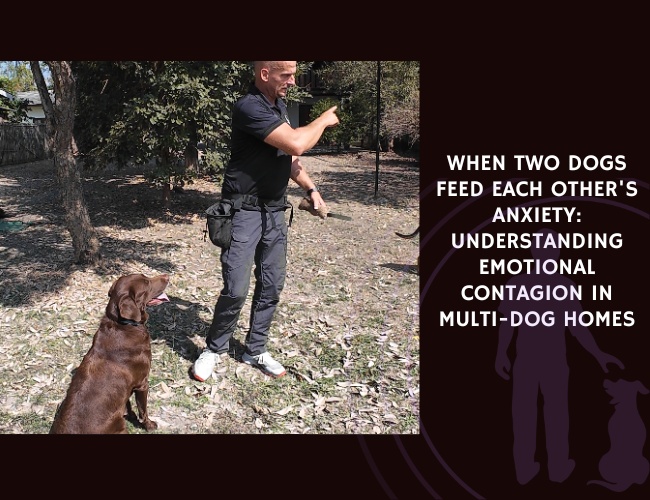
Have you ever noticed how when one of your dogs becomes anxious, the other seems to mirror that tension almost immediately? Perhaps your older dog’s trembling during a thunderstorm triggers your younger pup to pace and whine, even though she’s never shown fear of storms before. Or maybe your rescue dog’s reactivity at the front door has slowly transformed your once-calm companion into a barking sentinel.
This isn’t coincidence. It’s emotional contagion—a sophisticated form of communication that binds your dogs together in ways both beautiful and challenging.
In multi-dog households, anxiety doesn’t exist in isolation. Your dogs form an interconnected emotional system where feelings ripple through the group like waves across water. While this deep connection can create harmony and mutual comfort, it can also amplify stress, turning one dog’s fear into a household-wide anxiety spiral.
Common signs that your dogs may be feeding each other’s anxiety:
- One dog’s barking immediately triggers the other to join in, even when the second dog can’t see the trigger
- Both dogs show heightened vigilance during specific times or situations, mirroring each other’s tense postures
- A previously calm dog has gradually become more reactive since living with an anxious companion
- Separation of the dogs during stressful events reduces anxiety in both individuals
- Your dogs seem unable to relax in each other’s presence, constantly monitoring one another
- When one dog startles or panics, the other immediately adopts similar defensive behaviors
Let us guide you through the fascinating science of how dogs transmit emotions to one another, why some households become trapped in cycles of shared anxiety, and most importantly, how you can restore balance and calm to your entire canine family. Understanding this invisible thread is the first step toward creating a more peaceful home for everyone. 🧡
Emotional and Physiological Synchrony: The Science of Shared Feelings
Understanding How Your Dogs Detect Each Other’s Stress
Your dogs are reading each other constantly, processing a symphony of signals that most humans never notice. They’ve inherited sophisticated communication systems from their wolf ancestors, designed to keep social groups coordinated and safe.
Body language speaks volumes. A stiff posture, lowered tail, pinned-back ears, or wide eyes—these subtle shifts in one dog’s physical bearing send immediate messages to others nearby. When your anxious dog freezes at the sound of fireworks, her rigid body becomes a billboard announcing danger to her companion. Dogs are masters at reading these postural cues, often responding before you’ve even noticed the first dog’s distress.
Vocalizations carry emotional weight. The pitch, rhythm, and intensity of barking, whimpering, or growling transmit emotional states with remarkable precision. Research on vocal communication in social animals reveals that vocalizations can spread emotional states throughout a group. That high-pitched whine from your nervous dog isn’t just noise—it’s an emotional broadcast that triggers attentional shifts in other dogs, making them hyperaware and primed to respond.
Scent reveals invisible truths. While we’re still unraveling the full picture, dogs almost certainly detect stress pheromones in each other’s breath, saliva, and skin secretions. When your anxious dog pants and drools during a vet visit, she’s likely releasing chemical signals that her housemate can smell, even from across the room. This olfactory channel operates beneath human awareness but powerfully influences canine emotional states.
The presence of companions profoundly affects how dogs allocate their attention. When dogs live together, they develop a heightened awareness of each other’s emotional signals, creating what researchers call “attentional synchrony”—they’re literally tuned into the same emotional frequency. 🧠
The Body’s Response: Physiological Mirroring
But emotional contagion goes deeper than behavior—it extends into the body’s internal landscape. While direct research on dogs is still emerging, we can draw insights from related studies that paint a compelling picture.
Hearts beat in rhythm. When one dog experiences stress, her heart rate elevates. In closely bonded pairs, the companion dog’s heart rate likely shifts in response, even without direct exposure to the stressor. This physiological synchrony reflects a shared autonomic nervous system response, where both dogs’ bodies prepare for potential threat together.
Stress hormones rise together. Cortisol, the primary stress hormone, floods the system during anxiety. In multi-dog households experiencing chronic stress, cortisol levels may elevate across the group, creating a shared physiological state of alertness. This isn’t just emotional—it’s a measurable biological phenomenon that affects sleep, digestion, immune function, and overall health.
Vagal tone coordinates calm and chaos. The vagus nerve, a major component of the parasympathetic nervous system, plays a central role in emotional regulation. Polyvagal Theory suggests that when dogs feel safe together, their vagal tone—the activity level of this calming nerve—can synchronize, promoting collective calm. Conversely, when safety cues are absent and anxiety prevails, vagal withdrawal occurs simultaneously, leaving both dogs in a state of defensive readiness.
This physiological synchrony means that your dogs aren’t just observing each other’s stress—they’re experiencing it in their own bodies. Through the NeuroBond approach, we recognize that emotional alignment operates on multiple levels simultaneously: behavioral, cognitive, and deeply physiological.
When Chronic Anxiety Becomes Contagious
Temporary stress synchrony is normal and even adaptive—it helps groups respond to genuine threats. But when one dog lives in chronic anxiety, the consequences for her companions can be profound and lasting.
Conditioned hypervigilance takes root. Imagine living with someone who’s constantly scanning for danger, jumping at every sound, tensing at every movement. Over time, you’d start doing the same. Dogs in multi-dog households develop the same pattern. Chronic exposure to an anxious companion acts as a persistent environmental stressor, training the other dog’s nervous system to maintain constant alertness. Even in objectively safe situations—relaxing in the living room, napping in the afternoon—the formerly calm dog now mirrors her companion’s hypervigilant state.
Key signs of conditioned hypervigilance in multi-dog households:
- Constant scanning of the environment, even during rest periods
- Exaggerated startle responses to normal household sounds
- Difficulty settling or maintaining relaxed body postures
- Elevated baseline arousal levels—dogs seem “on edge” even without obvious triggers
- Interrupted sleep patterns or restless resting behaviors
- Generalization of fear responses to previously neutral situations
Learned helplessness can develop. In some cases, prolonged exposure to uncontrollable anxiety in a companion creates the opposite effect: learned helplessness. When a dog repeatedly witnesses her companion’s distress without any ability to change it, she may eventually stop trying to cope at all. This manifests as withdrawal, depression, and a diminished response to both positive and negative stimuli. The dog has learned that nothing she does matters, so she stops engaging.
The buffering mechanisms break down. Healthy social groups balance emotional contagion with emotional buffering—the ability of calm individuals to reduce anxiety in others. But chronic anxiety overwhelms these natural buffers. Social signals that once suppressed fear become less effective as the persistent presence of stress rewires how dogs interpret their social environment. The safety that companionship should provide erodes, replaced by a constant low-level tension.
You might notice this progression in your own home. Perhaps your second dog used to calm your anxious first dog. But over months or years of exposure, that calming influence has faded. Now both dogs escalate together, each one’s anxiety feeding the other’s in an exhausting cycle. Understanding this process is crucial because it reveals that you’re not dealing with two separate anxiety problems—you’re addressing one shared emotional system that needs collective healing. 😄
Behavioral Transmission and Reinforcement: How Anxiety Spreads Through Action
Alarm Responses as Social Triggers
When your dog suddenly barks at the window, freezes at a strange sound, or bolts from the room, she’s not just reacting to a perceived threat—she’s sending a powerful message to every other dog in your home. These alarm responses function as social triggers, activating anxiety in companions through multiple psychological pathways.
Social facilitation amplifies arousal. The mere presence of a reactive dog increases the motivation and behavioral intensity of others. When your first dog launches into a barking frenzy at the mail carrier, your second dog—even if she couldn’t care less about mail carriers—experiences an arousal surge simply from witnessing her companion’s intense behavior. This is social facilitation in action: one dog’s goal-directed behavior (alerting to threat) creates a mimicry response in others, independent of any actual competition or direct threat perception.
Mirror neurons activate shared response patterns. Dogs, like humans and other social mammals, likely possess mirror neuron systems that fire both when performing an action and when observing another perform that same action. When your anxious dog paces, your calm dog’s brain activates similar motor patterns, making pacing more likely in her as well. This neurological mirroring creates a literal sharing of behavioral states.
Emotional contagion spreads like wildfire. Just as panic can sweep through a human crowd, transforming individuals into a panicked mob, anxiety spreads through dog groups with remarkable speed. One dog’s alarm response signals potential danger, and others interpret this as reason to adopt similar defensive states. The emotional spread is often faster than cognitive processing—dogs react to their companion’s anxiety before they’ve even identified what triggered it.
You might observe this when one dog’s separation anxiety manifests as destructive digging at the door. Within weeks, your previously content second dog begins digging alongside her, even though she’d never shown separation distress before. The behavior has transmitted socially, reinforced through observation and shared arousal.
Repetitive Exposure: When Fear Becomes the Teacher
Single instances of emotional contagion are temporary—the anxiety fades once the trigger passes. But repetitive exposure to a fearful companion creates lasting changes in how dogs perceive and respond to the world.
Social learning cements phobic responses. Dogs are exceptional observational learners. When one dog consistently reacts with fear or aggression to specific triggers—veterinary offices, men with beards, bicycles passing by—a cohabiting dog learns to associate those triggers with danger through social observation alone. She hasn’t had a negative experience herself, but she’s learned from her companion’s reactions that these situations warrant fear.
Normalized anxiety becomes expected anxiety. In households where anxiety is constant, it becomes the emotional baseline. Dogs learn that tension is normal, alertness is appropriate, and relaxation is rare. This normalization makes anxiety feel “correct” to dogs, embedding it into their daily behavioral repertoire. Your once-playful dog might stop initiating play because play feels inconsistent with the household’s anxious energy.
Reinforcement patterns multiply the effect. Each time dogs experience shared anxiety and nothing catastrophic happens, you might think they’d learn the fear is unfounded. But anxiety doesn’t follow logical learning rules. Instead, the anxious response itself becomes self-reinforcing—the hypervigilance feels like it’s keeping them safe, so it continues. When two dogs reinforce this cycle together, the pattern becomes deeply entrenched.
This is why early intervention matters so much. The longer fearful or reactive behaviors are practiced together, the more neurologically embedded they become. What starts as simple emotional contagion transforms into learned, habitual anxiety that resists easy modification.

Social Confidence and Vulnerability: Can Any Dog Resist?
A common question: “My dominant dog is so confident—surely she won’t pick up my anxious dog’s fears, right?” The answer is more nuanced than many expect.
Confidence provides initial resilience. Socially confident, secure dogs do show greater initial resistance to emotional contagion. They’re less reactive to their companions’ distress signals and more likely to maintain calm in the face of others’ anxiety. In group dynamics, these are the individuals that other dogs reference for safety cues—the emotional anchors who help buffer stress.
But prolonged exposure erodes even strong defenses. No dog is immune to persistent emotional contagion. The social brain hypothesis tells us that neuronal activity and emotional states are modulated by conspecific presence, regardless of individual temperament. A confident dog living with a chronically anxious companion experiences constant exposure to stress signals—elevated cortisol environments, repeated alarm responses, perpetual vigilance cues. Over months and years, even emotionally robust dogs begin mirroring anxiety.
The interconnected system affects everyone. Studies of group-living animals reveal that individual movements and behaviors are influenced by all group members, creating an interconnected system where everyone affects everyone else. Dominant individuals may be less affected initially, but they remain part of the emotional web. The pervasive emotional state gradually shapes their responses, sometimes so subtly that the change goes unnoticed until the confident dog is suddenly reacting to triggers she previously ignored.
You might see this pattern unfold in your own home. Your older, steady dog initially calms your anxious younger dog. But after two years of daily exposure to separation anxiety, reactivity at the door, and fear of unfamiliar people, your older dog now exhibits mild versions of the same behaviors. She’s not as anxious as your younger dog, but she’s no longer the unshakeable anchor she once was. This reveals an important truth: managing anxiety in multi-dog households requires protecting all dogs, not just treating the most obviously affected one. 😄
Cognitive and Social Learning Mechanisms: How Dogs Make Sense of Shared Anxiety
Social Referencing: Looking to Each Other for Safety Cues
When faced with ambiguous situations—an unfamiliar object in the living room, a strange noise outside, a new person approaching—dogs engage in social referencing, looking to others for information about how to respond. This cognitive process is fundamental to how anxiety spreads or subsides in multi-dog households.
In your absence, dogs reference each other. While dogs certainly look to humans for safety cues, in multi-dog households where you’re not always present, dogs rely heavily on their companions for emotional guidance. If one dog interprets a situation as threatening and displays fear, other dogs often adopt that interpretation, even without directly experiencing the threat themselves. This collective detection shapes how the entire group perceives their environment.
Calm companions can buffer fear. The same mechanism works in reverse. If one dog remains relaxed during a potentially frightening event, her calmness can buffer the fear response in more anxious companions. This is why the presence of a confident dog can be so therapeutic—she becomes a living safety signal. However, this buffering effect is delicate and easily overwhelmed if the anxious dog’s signals are more frequent or intense.
Social signals create shared meaning. Through repeated interactions, your dogs develop shared understandings about what different behaviors mean. One dog’s posture becomes another dog’s lexicon of safety or danger. This shared meaning system allows for rapid communication but also means that anxious interpretations spread efficiently through the group.
Think of your dogs as having their own little culture, with shared beliefs about what’s safe and what’s threatening. If that culture is built on anxiety—where the prevailing belief is that strangers are dangerous, noises warrant alarm, and new situations require vigilance—that anxious worldview becomes the group’s reality. Through the lens of Soul Recall, we understand that these collective emotional memories shape not just individual responses but the entire household’s relationship with their environment. 🧠
Group Instability: When Structure Collapses, Anxiety Flourishes
The emotional stability of multi-dog households depends heavily on the presence of clear social structures and predictable routines. When these foundations crumble, anxiety levels surge across the group.
Competition breeds constant tension. When dogs compete over resources—your attention, food, toys, access to preferred resting spots—the household exists in a state of low-grade conflict. This competition creates chronic stress for all dogs, regardless of who “wins” these contests. Even the dominant dog experiences stress from maintaining her position, while subordinate dogs experience stress from the constant threat of confrontation.
Leadership ambiguity eliminates calm reference points. In group-living species, clear hierarchies provide predictability and reduce conflict. When roles are ambiguous—when it’s unclear who has priority access to resources or who makes decisions in uncertain situations—anxiety fills the vacuum. Dogs in these households lack stable emotional reference points, making them more susceptible to emotional contagion because no individual serves as a reliable source of calm.
Separation stress multiplies across the group. When you separate bonded dogs—taking one to the vet while the other stays home, for instance—both animals experience stress. The one left behind may vocalize, pace, or refuse food. The one taken away may show anxiety about being apart from her companion. This separation stress becomes particularly problematic when one dog’s intense reaction to separation triggers anticipatory anxiety in others whenever they sense an upcoming separation.
The ripple effect of instability. Instability in one domain often spreads to others. Competition over food might make dogs more possessive of space. Unclear hierarchies might increase reactivity to visitors. Separation stress might intensify other anxieties. The interconnected nature of these factors means that group instability creates a vulnerability to anxiety contagion across multiple contexts.
Creating structure doesn’t mean rigid dominance hierarchies—it means establishing predictable routines, clear boundaries around resources, and consistent expectations for behavior. When dogs know what to expect and can trust the stability of their environment, they’re far less prone to spreading or absorbing anxiety from companions.
The Inadvertent Shaping of Group Emotions
Your responses to one dog’s anxiety don’t just affect that individual—they shape the emotional learning of all dogs watching the interaction. This makes your role as emotional teacher more complex and consequential in multi-dog homes.
Reinforcing fear multiplies the lesson. When you inadvertently reinforce one dog’s fearful behavior—perhaps by picking her up when she’s scared, which she interprets as confirmation that the situation is indeed dangerous—other dogs observe this interaction. They learn that fear earns special attention and that the situation truly warrants fear. What seems like comforting one dog becomes an anxiety lesson for the entire group.
Punishment creates more potent contagion sources. Conversely, punishing a fearful dog dramatically increases her anxiety, making her an even more powerful source of emotional contagion. The punishment adds a layer of unpredictability and threat to an already stressed animal, elevating her cortisol and making her fear responses more intense and persistent. Other dogs detect this heightened distress, amplifying the emotional contagion effect.
Inconsistent responses breed confusion. When you respond calmly to one dog’s barking but react with frustration to another dog’s identical behavior, you create confusion about what’s expected. This inconsistency makes dogs more reliant on each other’s cues rather than your guidance, strengthening inter-dog emotional transmission at the expense of your ability to moderate the group’s emotional state.
Classical conditioning spreads through observation. If one dog develops a conditioned fear response—perhaps associating your keys jingling with the anxiety of being left alone—other dogs can acquire the same association simply by observing her response. They begin showing stress at the sound of keys, even though they don’t personally experience separation anxiety. The emotional association has spread through social learning.
This interconnectedness means that training in multi-dog households must be systemic. You cannot effectively modify one dog’s anxiety without considering how your intervention affects the emotional learning of others. Through the Invisible Leash principle, we understand that true guidance occurs through emotional awareness and calm leadership that influences the entire household system, not just individual dogs. 🧡
Human-Dog Systemic Interactions: You Are Part of the Emotional Equation
Your emotional state sets the household tone. In multi-dog households, you function as more than a caregiver—you’re a primary emotional regulator, a reference point, and often the linchpin holding the entire system together or allowing it to spiral into anxiety.
How your emotional state influences multi-dog anxiety dynamics:
- Stress transmission: Your anxiety about triggering situations (guests arriving, vet visits, storms) signals danger to your dogs before the event even occurs
- Tension in handling: Tight leash grips, tense body language, or rushed movements communicate your stress physically to your dogs
- Vocal tone shifts: Changes in your voice pitch, speed, or volume reveal your emotional state with remarkable clarity to canine ears
- Inconsistent responses: Reacting calmly one day but anxiously the next to the same situation creates confusion and increases overall household anxiety
- Anticipatory worry: Your preemptive stress about potential problems can create a self-fulfilling prophecy as dogs detect and mirror your concern
- Divided attention: Anxiously monitoring both dogs simultaneously often amplifies tension rather than reducing it
Dogs read your emotional signature. Your dogs are extraordinarily perceptive of your emotional states, detecting subtle shifts in your tone of voice, body tension, facial expressions, breathing patterns, and even your scent. When you’re stressed—perhaps worried about an upcoming event or frustrated by your dogs’ reactivity—they detect these signals immediately. This human stress becomes another layer of input feeding into the multi-dog emotional system.
Anxiety spreads from you to them. If you approach a potentially triggering situation with tension in your body and worry in your voice, you’re essentially broadcasting a danger signal to your dogs. They interpret your stress as confirmation that the situation warrants vigilance. In multi-dog households, your anxiety can trigger both dogs simultaneously, or one dog picks up your stress and transmits it to the other, amplifying the effect.
Your calm is contagious too. The positive flip side of this sensitivity is that your calm, confident emotional state can dramatically buffer anxiety in your dogs. When you approach a triggering situation with relaxed body language, steady breathing, and a warm but neutral tone, you signal safety to your entire canine family. This human-led safety signal can interrupt the dog-to-dog anxiety contagion cycle.
Your handling reveals your emotional state. The way you physically interact with your dogs—whether you tense the leash, pull them away from each other, separate them anxiously, or touch them with tight, worried hands—communicates your emotional assessment of the situation. Tense handling amplifies arousal, while calm, confident handling helps regulate it.
You might not realize how much your own emotional state contributes to your dogs’ anxiety patterns. That moment when both dogs start barking at visitors might correlate with your own stress about having guests. The evening walk where both dogs become reactive might happen right after you’ve had a stressful work call. Your emotional state ripples through your dogs, affecting their individual anxiety levels and their tendency to transmit anxiety to each other. 😄
Calm Co-Regulation: Your Most Powerful Intervention
Polyvagal Theory teaches us that physiological and emotional regulation can be achieved through social connection with a calm, present individual. In multi-dog households, you have the potential to serve as this regulating presence for your entire canine family.
Vagal tone synchronizes through social engagement. When you maintain a state of calm physiological regulation—characterized by activated social engagement systems, slow breathing, relaxed facial expressions, and a warm vocal tone—your dogs’ vagus nerves respond. Your regulated state helps regulate theirs, promoting parasympathetic activation that reduces defensive responses and anxiety.
You can interrupt the contagion loop. When you notice anxiety beginning to transmit between your dogs, your calm intervention can break the cycle. By positioning yourself physically and emotionally as an anchor point—perhaps by calmly calling both dogs to you, engaging them in a simple trained behavior they know well, or simply sitting peacefully in the midst of their anxiety—you introduce a pattern-interrupt that can reset the emotional trajectory.
Co-regulation requires conscious presence. Effective co-regulation isn’t about “doing” something to your dogs—it’s about embodying calm so authentically that it becomes available for your dogs to synchronize with. This requires present-moment awareness of your own emotional and physiological state, conscious regulation of your breathing and muscle tension, and genuine confidence (or at least the appearance of confidence) in your ability to handle whatever situation has triggered anxiety.
The human as emotional anchor. In the NeuroBond framework, we recognize that humans serve as primary emotional anchors in multi-dog households. Your consistent, regulated presence provides the stable reference point that allows anxious dogs to begin downregulating their stress responses. When dogs look to you and perceive safety, calm, and confidence, they can gradually learn to reference you rather than each other’s anxiety during triggering situations.
This is why your personal emotional regulation practice matters so much. Meditation, breathing exercises, body awareness techniques—whatever helps you maintain calm in stressful situations—directly benefits your dogs. When you become skilled at self-regulation, you become a more effective co-regulator for your entire household. 🧠
Mirror. Merge. Multiply.
Anxiety echoes through connection. One heartbeat quickens, and the other follows. What begins as empathy becomes entanglement when calm leadership is missing.
Bodies sync before thought. Posture, tone, and scent transmit emotion faster than words. Two nervous systems align, turning one dog’s fear into shared vigilance.



Balance restores the bond. Separation, structure, and grounded energy reset the rhythm. When safety is felt, not forced, peace spreads the same way fear once did.
Treating the System, Not Just the Individual
Traditional behavior modification often focuses on treating one dog at a time. But in multi-dog anxiety cases, this individual approach frequently fails because it ignores the systemic nature of emotional contagion.
Isolation creates temporary improvement. You might work with your anxious dog individually and see significant progress. She learns to relax during training sessions, shows decreased reactivity, and seems much better. But when reintroduced to the multi-dog environment, the old patterns reemerge within days or weeks. The system pulls her back toward the established anxious baseline.
Collective treatment addresses the real problem. A systemic approach treats the entire household as an emotional unit. This means:
- Establishing consistent routines and structures that apply to all dogs
- Training all dogs simultaneously on calming protocols
- Modifying the physical environment to reduce competition and triggers for everyone
- Addressing your own emotional regulation as part of the treatment plan
- Creating positive emotional experiences that all dogs share together
Core principles of systemic multi-dog anxiety treatment:
- Simultaneous intervention: Work with all dogs together rather than isolating individuals for separate treatment sessions
- Environmental modification: Change the physical space to reduce triggers and competition (separate feeding areas, multiple water sources, individual resting zones)
- Routine consistency: Establish predictable daily patterns that all dogs can rely on for emotional stability
- Human regulation: Prioritize your own emotional state as the primary intervention tool
- Positive association building: Create new shared experiences where all dogs experience calm and reward together
- Graduated exposure: Introduce challenges at levels where all dogs can succeed simultaneously
- Long-term commitment: Accept that systemic change requires sustained effort over months, not weeks
The group as a therapeutic tool. Rather than viewing the multi-dog dynamic as an obstacle to overcome, systemic treatment uses the group as a therapeutic resource. When one dog begins responding more calmly to triggers, her calm becomes available for others to reference. As the collective emotional baseline shifts toward regulation, each individual dog’s progress reinforces and stabilizes everyone else’s improvement.
Success requires patience and consistency. Systemic change takes longer than individual treatment because you’re reshaping patterns embedded in multiple nervous systems and the relationships between them. But the results tend to be more stable and comprehensive because the entire emotional ecosystem has been addressed.
Think of your multi-dog household like a mobile hanging from the ceiling. If you push one piece, everything moves. Similarly, positive changes in one dog, in you, or in the environment affect the entire system. This is why addressing collective emotional regulation, rather than isolating individual dogs, often yields the most profound and lasting improvements.
🐕🔗🐕 The Multi-Dog Anxiety Journey
Understanding How Emotional Contagion Develops and How to Break the Cycle
Phase 1: Recognition
Identifying the invisible thread
Dogs detect each other’s stress through body language, vocalizations, and stress pheromones. One dog’s tension becomes a signal that activates the other’s nervous system, creating an immediate emotional ripple effect throughout your household.
• Both dogs barking in unison without seeing the trigger
• Mirrored tense postures and hypervigilance
• Previously calm dog becoming increasingly reactive
• Inability to relax in each other’s presence
Start documenting when anxiety spikes occur. Note which dog reacts first, what triggers the response, and how quickly it spreads. This baseline assessment reveals your household’s unique emotional patterns.
Phase 2: Understanding Transmission
How anxiety spreads between dogs
Emotional contagion operates through social facilitation and mirror neuron systems. When one dog shows alarm behavior—barking, pacing, freezing—other dogs experience arousal surges even without perceiving the original threat. Their bodies synchronize physiologically: heart rates elevate together, cortisol rises in tandem, and vagal tone shifts simultaneously.
• One dog’s startle response triggering immediate vigilance in others
• Synchronized pacing or scanning behaviors
• Escalating reactions that amplify with each repetition
• Difficulty interrupting the anxiety cycle once it begins
Never comfort one dog’s fear excessively while ignoring the other. This inadvertently teaches both dogs that fear is appropriate and worthy of attention, reinforcing the very pattern you’re trying to break.
Phase 3: Systemic Assessment
Evaluating the whole emotional system
• Individual baselines: Each dog’s typical anxiety level and triggers
• Group stability: Resource competition, hierarchy clarity, routine consistency
• Human factor: Your emotional state during triggering situations
• Environmental stressors: Physical space, noise levels, visitor frequency
For one week, track: (1) Which dog shows anxiety first, (2) Your emotional state at that moment, (3) Environmental triggers present, (4) How quickly anxiety spreads, (5) What (if anything) interrupts the cycle. This data reveals your household’s unique emotional architecture.
You’ll likely discover that your dogs’ anxiety isn’t random—it follows predictable patterns tied to specific times, situations, or even your own stress levels. This predictability is actually good news: patterns can be reshaped.
Phase 4: Human Emotional Regulation
Becoming the household’s emotional anchor
Your dogs synchronize their vagal tone—their physiological calm—with yours. Through the Invisible Leash principle, your regulated nervous system becomes the most powerful intervention tool you possess. When you embody calm, you create a safety signal that can interrupt dog-to-dog anxiety contagion.
• Morning centering: 5 minutes of slow breathing before interacting with dogs
• Body scanning: Release shoulder and jaw tension your dogs detect
• Trigger preparation: Pre-regulate before known stressful events
• Conscious touch: Pet with calm, steady hands, not anxious, tight movements
Week 1-2: You become aware of your emotional states. Week 3-4: You can maintain calm during mild triggers. Week 5-8: Your regulated presence begins visibly affecting your dogs’ responses. Patience with yourself is essential—this is skill-building, not instant transformation.
Phase 5: Environmental Restructuring
Creating physical space for emotional calm
• Separate feeding stations: Eliminate resource competition anxiety
• Multiple water sources: Reduce stress around shared resources
• Individual rest zones: Each dog needs retreat space
• Visual barriers: Block views of anxiety triggers when possible
• Sound management: White noise can mask triggering sounds
Predictable daily rhythms reduce anxiety by eliminating uncertainty. Establish fixed times for feeding, walks, training, play, and rest. When dogs know what to expect, their baseline arousal decreases, making them less vulnerable to emotional contagion.
Each dog needs both individual time (separate walks, one-on-one training) and positive collective experiences (parallel walks, synchronized calm time). This balance prevents enmeshment while building healthy group dynamics.
Phase 6: Synchronized Training
Teaching collective calm as a skill
Expose all dogs simultaneously to triggers at very low intensity. Doorbell at barely audible volume, distant dog sightings, brief key-jingling without leaving. Reward any calm attention from both dogs immediately. Gradually increase intensity over weeks, always staying below any dog’s anxiety threshold.
Teach “settle” as a cued behavior for both dogs. Practice in calm moments first, capturing and rewarding natural relaxation. Pair with mat training where each dog learns her specific rest spot means it’s time to decompress. Through the NeuroBond approach, these shared calm experiences build new neural pathways together.
Watch both dogs carefully during training. If either shows stress signals (lip licking, yawning, tension), you’ve progressed too quickly. Success requires the slowest dog sets the pace—frustrating, but essential for building collective resilience.
Phase 7: Active Intervention
Breaking the anxiety loop in real-time
• Redirect attention: Call both dogs to a trained behavior before anxiety escalates
• Position yourself: Calmly place your body between dogs and trigger
• Environmental change: Move to a different room or space
• Engagement task: Offer puzzle toys or sniff games simultaneously
• Calm anchor: Sit peacefully, inviting dogs to join you
Anxiety contagion happens fast but not instantly. There’s usually a 2-10 second window between one dog’s initial response and full escalation in both dogs. Learn to recognize this window and act within it—calmly, not frantically—to prevent the spiral.
Yelling, physical corrections, or anxious rushing to separate dogs amplifies the problem. Your stress adds to theirs, accelerating contagion. Punishment makes anxious dogs more anxious, creating even more potent sources of emotional contagion.
Phase 8: Long-Term Stability
Sustaining collective calm
Watch for subtle early warning signs that anxiety might be creeping back: slight increases in vigilance, minor reactivity upticks, disrupted sleep patterns. Early detection allows quick intervention before full patterns reestablish.
• Monthly intensive training refreshers
• Continued daily calm rituals (never stop these)
• Proactive support during life transitions
• Regular environmental check-ins for needed adjustments
• Sustained personal emotional regulation practice
Notice and acknowledge improvements: calmer walks, reduced doorbell reactivity, more relaxed rest periods. These victories prove the system is shifting. Through Soul Recall, recognize that you’re building new emotional memories—collective experiences of safety that gradually replace the anxious patterns.
🔬 Multi-Dog Anxiety: Key Comparisons
Individual: Works with one dog, temporary improvement, relapses in group context
Systemic: Treats whole household, slower but stable, addresses root emotional architecture
High Risk: Two anxious/sensitive dogs amplify each other’s fears exponentially
Moderate: Anxious + confident dog; works initially but confidence erodes over time
Lower Risk: Secure + resilient dogs with strong individual identities
Acute: Temporary synchrony, resolves when trigger passes, limited long-term impact
Chronic: Persistent patterns, physiological changes, conditioned hypervigilance, requires systemic intervention
Structured: Predictable routines, clear hierarchies, individual resources—creates emotional stability
Chaotic: Inconsistent patterns, resource competition, unstable dynamics—amplifies anxiety contagion
Regulated Human: Serves as emotional anchor, buffers dog-to-dog contagion, promotes collective calm
Anxious Human: Adds third anxiety source, accelerates contagion, destabilizes entire system
Weeks 1-4: Assessment, human regulation building, initial environmental changes
Weeks 5-12: Active training, visible improvements, occasional setbacks
Months 4-6+: Stabilization, maintenance, new patterns solidifying
Emotional Contagion Speed = (Individual Sensitivity + Group Instability + Human Anxiety) – (Structure + Training + Co-Regulation)
Key Faustregeln:
• The intervention window is 2-10 seconds before full anxiety escalation
• Your emotional state affects both dogs simultaneously—regulate yourself first
• Synchronized training progresses at the pace of the slowest dog
• Environmental changes show results in 1-2 weeks; neural rewiring takes 2-3 months
• One anxious human = three anxiety sources in a two-dog household
Multi-dog anxiety reveals a profound truth: your dogs are not separate beings who happen to share space—they’re an interconnected emotional system, bound by invisible threads of communication, mirroring, and shared physiological states. Through the NeuroBond framework, we understand that healing requires addressing this system as a whole, fostering emotional alignment between all members of your household.
The Invisible Leash reminds us that the most powerful guidance doesn’t come from physical control or isolated training—it flows through your regulated presence, your calm energy, and your ability to serve as an emotional anchor during storms of anxiety. When you embody the stability your dogs need, you create a resonance that can interrupt even the most entrenched contagion patterns.
Through Soul Recall, we recognize that every moment of shared calm you create becomes a new emotional memory, gradually replacing the anxious patterns with experiences of collective safety. Your dogs are learning—together—that the world can be navigated with confidence rather than fear, that their bond can be a source of strength rather than amplified anxiety.
This journey from shared anxiety to collective calm is not about fixing broken dogs—it’s about understanding and working with the sophisticated emotional intelligence that makes dogs such extraordinary companions. When you honor the connections between your dogs while building their individual resilience, when you bring conscious awareness to your own emotional state, when you create structure that supports rather than suppresses—you’re not just managing behavior. You’re weaving a new emotional pattern for your entire family, one thread of calm at a time.
Applications to Behavioral Therapy and Welfare: Practical Solutions for Multi-Dog Anxiety
Synchronized Desensitization: Reshaping Collective Responses
Traditional desensitization works with one dog at a time, gradually exposing her to anxiety-provoking stimuli at levels low enough not to trigger fear, while rewarding calm behavior. Synchronized desensitization applies this principle to the entire household simultaneously, leveraging the power of social learning to reshape collective emotional responses.
The protocol in practice. Identify the trigger that causes shared anxiety—perhaps the sound of the doorbell, the sight of other dogs on walks, or your departure cues. Expose all dogs to this trigger at a very low intensity—a quiet recording of the doorbell, a dog visible at a distance, or simply picking up your keys without leaving. Immediately reward all dogs for any sign of calm attention or relaxation. Gradually increase intensity over multiple sessions, always staying below the threshold that triggers anxiety in any dog.
Social learning amplifies the effect. The beauty of synchronized protocols is that dogs observe their companions remaining calm and earning rewards. This social modeling accelerates learning for anxious dogs who might struggle alone but can follow their companions’ lead. The shared positive experience also builds a new collective emotional memory—that these triggers predict good things rather than threats.
Timing and observation are crucial. You must carefully observe all dogs simultaneously, reading subtle signs of rising stress in any individual. If one dog begins showing anxiety—lip licking, yawning, whale eye, tension—you’ve gone too far too fast. The intensity must be low enough that all dogs can succeed. This might mean progressing more slowly than you would with an individual dog, but the collective learning that occurs justifies the patience.
Building new neural pathways together. Each successful synchronized exposure literally rewires your dogs’ brains, creating new neural associations between previously frightening stimuli and feelings of safety and reward. Because these experiences happen in the presence of companions, the new patterns become embedded in the social context where the anxiety originally developed. 🧡
Relaxation Protocols: Teaching Calm as a Skill
Beyond desensitization to specific triggers, teaching your dogs relaxation as a trained skill provides a foundation for managing anxiety across multiple contexts.
Relaxation on cue. Train all dogs to relax on a specific cue—perhaps a word like “settle” or “calm,” or a physical signal like you sitting on the floor. Start by capturing natural moments of relaxation, marking and rewarding when you see them, then gradually pairing these moments with your cue. Over time, the cue itself becomes associated with the parasympathetic state, actually helping trigger physiological relaxation.
Mat training for the entire group. Teach each dog that going to her specific mat or bed means it’s time to relax. Practice this in low-stress situations first, heavily rewarding any calm behavior on the mat. Gradually introduce mild stressors while dogs are on their mats, rewarding continued calm. Eventually, sending all dogs to their mats becomes your tool for creating collective calm during potentially triggering situations.
Breathing together. Dogs’ respiratory rates tend to synchronize with humans they’re bonded with. Practice slow, deep breathing while sitting calmly with your dogs. This simple act can help downregulate their nervous systems through respiratory entrainment. Pairing this breathing practice with gentle massage or calm petting further enhances the relaxation response.
Creating a calm ritual. Establish a daily ritual that signals relaxation time for the entire household. This might be a specific time of day when all dogs get puzzle toys, when you all sit together with gentle music playing, or when you practice massage and stretching with each dog. These rituals become anchors of predictable calm in your dogs’ day, raising the baseline of emotional regulation. 😄
When Separation is Necessary: Strategic Staggered Training
In severe co-anxiety cases where emotional contagion is so intense that one dog’s presence immediately triggers anxiety responses in others, temporary separation during training may be necessary.
Recognizing when separation is appropriate. If your dogs’ anxiety has become so synchronized that they cannot calm down in each other’s presence, if one dog’s reactions are so intense that they immediately overwhelm any calming signals from others, or if attempts at synchronized training consistently fail because the anxiety contagion is too rapid—these signs suggest that temporary separation during training might be beneficial.
Staggered exposure protocols. Work with each dog individually or in carefully controlled pairs, building resilience and new coping skills without the overwhelming influence of highly anxious companions. For example, work with your less anxious dog first, establishing strong calm responses to triggers. Then gradually work with your more anxious dog, building her individual skills. Finally, carefully reintroduce them during training sessions, allowing the first dog’s calm to serve as a model.
Building individual capacity. The goal of separation training isn’t permanent isolation—it’s developing each dog’s individual emotional regulation capacity so that when they’re together, they’re more resilient to emotional contagion. Think of it as giving each dog her own emotional foundation before asking her to support the collective emotional system.
Gradual reintegration is key. Don’t rush the process of bringing dogs back together during training. Start with very brief periods of joint training during low-stress activities, heavily rewarding any moments of calm coexistence. Gradually extend the duration and complexity of shared training sessions as each dog’s individual skills solidify.
Maintaining connection during separation. Even when temporarily separating dogs for training purposes, ensure they maintain positive connections through shared activities that don’t trigger anxiety—parallel walks where they can see each other but have individual space, shared positive experiences in neutral locations, or calm together time during naturally relaxed periods.
The NeuroBond framework provides a comprehensive approach to restoring and maintaining emotional balance in multi-dog households by addressing the interconnected nature of the human-dog-dog system.
Essential components of the NeuroBond framework for multi-dog households:
- Baseline assessment: Document each dog’s individual emotional patterns, triggers, and resilience levels, plus the collective household emotional baseline
- Human regulation training: Develop your personal practices for maintaining calm (breathing techniques, meditation, body awareness, stress management)
- Emotional anchor positioning: Learn to consistently embody regulated presence during triggering situations, becoming the stable reference point for all dogs
- Positive social referencing: Structure environments so dogs naturally reference calm companions and calm humans for safety cues
- Synchronized reinforcement: Reward collective calm states, strengthening the association that group regulation earns group reward
- Predictable enrichment: Create consistent daily rhythms that provide mental stimulation without triggering competition or anxiety
- Safe space architecture: Design physical environments where each dog has access to retreat areas when overwhelmed
- Shared positive experiences: Build collective memories of calm, successful, rewarding interactions together
Assessing individual and collective baselines. Begin by understanding each dog’s typical emotional state—her triggers, her resilience, her role in the group dynamic. Also assess the collective emotional baseline: Is the household generally tense or relaxed? Are there specific times or situations when collective anxiety peaks? Understanding both individual and systemic patterns is essential for targeted intervention.
Human as primary emotional anchor. Train yourself first. Develop consistent practices that keep you emotionally regulated even during stressful situations. Your dogs will benefit more from your regulated presence than from any specific training technique applied from an anxious state. This might mean:
- Daily personal regulation practices (breathing, meditation, exercise)
- Conscious emotional monitoring during interactions with your dogs
- Practicing calm responses to your dogs’ anxiety rather than matching their emotional intensity
- Developing body awareness so you can release tension before your dogs detect it
Structuring for positive social referencing. Arrange your environment and routines so dogs have opportunities to reference calm companions and calm humans for safety cues. This might include:
- Ensuring all dogs can see you during potentially triggering events
- Positioning calmer dogs near more anxious dogs during training
- Creating physical spaces where dogs can observe without being overwhelmed
- Establishing predictable routines that reduce uncertainty
Synchronized positive reinforcement. Actively reward calm, relaxed behaviors across all dogs simultaneously. When everyone is lying peacefully, acknowledge it. When one dog remains calm during a trigger while the other shows the beginning signs of anxiety, heavily reinforce both—the calm dog for her regulation and the anxious dog for any small improvement. This creates a shared association: collective calm earns collective reward.
Environmental enrichment and predictability. Reduce overall stress through:
- Consistent daily routines for feeding, walking, play, and rest
- Individual resources for each dog (separate food bowls, multiple water stations, several resting areas)
- Enrichment activities that engage minds without triggering competition or anxiety
- Safe spaces where each dog can retreat when feeling overwhelmed
- Gradual, positive exposure to novel experiences that build collective confidence
Creating shared positive experiences. Build positive emotional memories that all dogs share together. Parallel walks where all dogs explore calmly side by side. Training sessions where everyone succeeds. Puzzle toys distributed simultaneously. Calm together time where everyone receives gentle attention. These shared positive experiences become the foundation of a healthier collective emotional state.
Through this framework, you’re not just managing anxiety—you’re actively cultivating emotional alignment and co-regulation throughout your household. The goal is a resilient, interconnected system where calm is as contagious as anxiety once was, where dogs reference each other for safety rather than fear, and where the invisible thread binding your dogs together becomes a source of strength rather than shared suffering. That balance between understanding behavioral science and honoring emotional connection—that’s the essence of Zoeta Dogsoul. 🧡
Long-Term Welfare Considerations: Building Sustainable Emotional Health
Recognizing the Costs of Chronic Shared Anxiety
Multi-dog anxiety isn’t just a behavioral inconvenience—it carries real costs to your dogs’ physical health, mental wellbeing, and quality of life. Understanding these costs helps maintain motivation during the lengthy process of systemic behavioral modification.
Physical health impacts. Chronic anxiety elevates cortisol persistently, which suppresses immune function, disrupts digestion, interferes with sleep quality, and accelerates cellular aging. Dogs living in chronically anxious multi-dog households may experience more frequent illness, digestive issues like diarrhea or loss of appetite, poor coat quality, and shortened lifespans. These physical manifestations aren’t separate from the behavioral issues—they’re direct consequences of the same dysregulated stress response systems.
Mental and emotional suffering. Anxiety is inherently aversive. Dogs experiencing chronic anxiety suffer psychologically just as humans do. They experience less joy, show reduced interest in previously enjoyed activities, and live in a perpetual state of apprehension. In multi-dog households where anxiety is shared, this suffering multiplies—each dog not only experiences her own distress but is also continually exposed to her companions’ suffering, creating a feedback loop of emotional pain.
Reduced quality of life. Anxious dogs miss out on many of life’s pleasures. They can’t relax fully during rest periods. They can’t enjoy walks because they’re too vigilant. They struggle with novel experiences that could enrich their lives. Social opportunities become sources of stress rather than joy. The very relationship that should provide comfort—their bond with their canine companion—instead becomes entangled with anxiety.
Impact on human-dog bonds. Chronic multi-dog anxiety also strains your relationships with your dogs. Managing constant reactivity, anxiety, and related behavioral issues is exhausting. You might feel frustrated, guilty, or helpless. These emotional responses affect how you interact with your dogs, potentially creating additional tension in the household. The joy that brought you to add a second dog—companionship, playfulness, enriched lives—becomes obscured by the daily challenges of managing shared anxiety.
Recognizing these costs isn’t meant to induce guilt or despair. Rather, it’s about validating the seriousness of the issue and affirming that investing time and energy into systemic treatment is genuinely worthwhile for everyone’s wellbeing. 🧠
Prevention: Setting Up Multi-Dog Households for Success
While this article primarily addresses existing multi-dog anxiety, prevention is always preferable to treatment. If you’re considering adding a second dog or are in the early stages of multi-dog life, these strategies can help prevent the development of shared anxiety patterns.
Essential strategies for preventing anxiety contagion in new multi-dog households:
- Temperament matching: Choose a second dog whose energy level and emotional resilience complement your current dog’s personality
- Individual bonding time: Ensure each dog develops a secure, independent relationship with you before allowing deep inter-dog bonds to form
- Separate resources: Provide individual food bowls, water stations, toys, and resting areas from day one to prevent resource-based tension
- Staggered attention: Give each dog individual training sessions, walks, and quality time to maintain their sense of individual identity
- Early anxiety intervention: Address any emerging anxiety in either dog immediately, before transmission patterns can establish
- Calm introduction protocols: Introduce dogs gradually in neutral locations, rewarding calm behavior and preventing overwhelming initial interactions
- Structured routines: Establish predictable daily patterns for feeding, walks, play, and rest that both dogs can rely on
- Individual safe spaces: Create retreat areas where each dog can decompress alone when needed, preventing constant emotional exposure
Thoughtful matching matters. When selecting a second dog, consider not just whether you can handle her needs, but how her temperament will interact with your current dog’s personality. Pairing an extremely anxious dog with an equally sensitive companion may amplify anxiety in both. Conversely, a calm, confident dog can serve as an emotional anchor for a more anxious companion—though remember that even confident dogs can eventually be affected by chronic exposure to anxiety.
Establish individual relationships first. Before allowing dogs to form a strong bond with each other, ensure each has a secure, calm relationship with you. You should be each dog’s primary emotional reference point, not just another dog in the household. This human-centered attachment provides stability that prevents dogs from becoming overly dependent on each other’s emotional states.
Create individual identities and experiences. Even in multi-dog homes, each dog needs individual time with you, individual training sessions, and individual experiences. This prevents enmeshment—the psychological term for when individuals lose their separate identities and become overly reactive to each other’s emotional states. Dogs with strong individual identities are less vulnerable to complete emotional merging with companions.
Address anxiety early and individually. If one dog begins showing anxiety, address it immediately before it has time to transmit to others. Early intervention prevents the establishment of shared anxiety patterns that are much harder to modify once entrenched. This might mean temporarily increasing individual work with the anxious dog while maintaining the stability of the overall household.
Build collective calm from the beginning. From day one, establish household rituals and structures that promote calm rather than arousal. Mealtimes are peaceful and predictable. Greetings are calm rather than chaotic. Play sessions have clear starts and stops. These foundations create a household culture where regulation is the norm, providing resistance to the development of anxiety contagion patterns. 🧡
Monitoring and Maintenance: Sustaining Improvements
Successfully treating multi-dog anxiety doesn’t end when symptoms improve. Maintenance and ongoing monitoring are essential for preventing relapse.
Watch for early warning signs. Even after significant improvement, stay alert for subtle signs that anxiety might be reemerging—one dog becoming slightly more vigilant, small increases in reactivity, minor disruptions to previously calm patterns. Early detection allows for quick intervention before the full anxiety pattern reestablishes itself.
Maintain structure and rituals. The routines and practices that helped restore balance should become permanent features of your household, not temporary interventions you abandon once things improve. Continued synchronized relaxation protocols, maintained environmental management, and ongoing attention to your own emotional regulation keep the system stable.
Periodic intensive practice. Even when things are going well, periodically return to more intensive versions of your training protocols. This refreshes skills, strengthens neural pathways, and prevents gradual erosion of progress. Think of it like maintenance training—you’re preserving the new patterns against the natural tendency to drift back toward old habits.
Adjust for life changes. Major life transitions—moving homes, adding family members, changes in your schedule, aging in your dogs—can destabilize even well-regulated systems. During these periods, proactively increase support through more frequent training, closer monitoring, and greater attention to maintaining calm in the household.
Celebrate progress and stay patient. Systemic change happens gradually. Celebrate small victories—a walk where both dogs stayed calmer, a doorbell ring that triggered less reactivity, a day where everyone seemed more relaxed. These moments of progress are your evidence that the system is shifting, even when complete resolution feels distant. 😄
When to Seek Professional Help
While many multi-dog anxiety cases can be improved through the systematic application of the principles outlined here, some situations benefit from professional guidance.
Complex or severe cases. If your dogs’ anxiety involves aggression toward each other, severe panic responses, or behaviors that risk injury to dogs or humans, consult with a certified veterinary behaviorist or certified applied animal behaviorist. These professionals can assess for underlying medical issues, prescribe behavioral medications if appropriate, and design comprehensive treatment plans.
When progress stalls. If you’ve been consistently implementing systemic interventions for several months without seeing meaningful improvement, a professional can help identify what’s being missed, adjust the protocol, or suggest alternative approaches. Sometimes an outside perspective reveals dynamics that are difficult to see from within the system.
Medical contributions. Ensure all dogs receive thorough veterinary examinations to rule out pain, illness, or neurological issues contributing to anxiety. Chronic discomfort from arthritis, dental disease, or other medical conditions can lower anxiety thresholds and should be addressed as part of comprehensive treatment.
Medication as a tool. In some cases, anti-anxiety medications can be valuable tools that lower anxiety enough for learning and new pattern formation to occur. This doesn’t mean medicating dogs to manage symptoms indefinitely, but rather using medication temporarily to create a window where behavioral modification can be more effective. A veterinary behaviorist can advise whether medication might be appropriate for your situation.
Your own wellbeing matters. If managing your dogs’ anxiety is significantly impacting your mental health, relationships, or quality of life, please seek support for yourself too. The stress of managing multi-dog anxiety is real, and you deserve support in navigating these challenges. 🧠
Conclusion: Weaving a New Emotional Pattern Together
The invisible thread connecting your dogs carries both vulnerability and potential. Yes, anxiety can spread between them, creating escalating cycles of shared distress. But calm, safety, and resilience can spread just as surely when you understand how to facilitate that transmission.
Your multi-dog household is not simply multiple individuals who happen to live together—it’s an interconnected emotional system where each member influences and is influenced by all others. The anxiety you’ve been observing isn’t a failure of individual dogs or of your guardianship. It’s a systemic pattern that emerged from the complex interplay of temperament, experience, learning, and the sophisticated social communication that makes dogs such extraordinary companions.
Understanding emotional contagion between dogs opens new pathways for intervention. Rather than feeling discouraged that one dog’s anxiety affects others, you can harness the same mechanisms to spread calm and confidence. When you become the emotional anchor your household needs, when you implement synchronized protocols that reshape collective responses, when you create an environment structured for collective wellbeing—you’re working with the system rather than against it.
The journey from shared anxiety to collective calm requires patience. Neural pathways were shaped over months or years; they’ll take time to reshape. Social patterns became entrenched through repetition; they’ll need consistent new experiences to change. But every moment of synchronized calm you create, every successful desensitization session, every day of consistent structure, moves the entire system toward a new equilibrium.
Through the Invisible Leash, you learn that true guidance flows through emotional presence, not physical force. Through Soul Recall, you recognize that healing shared anxiety requires addressing the emotional memories embedded in your dogs’ relationships with each other and with you. Through the NeuroBond approach, you discover that emotional alignment isn’t just an abstract concept—it’s a practical framework for transforming the lived experience of your entire household.
Is this journey easy? No. Managing multi-dog anxiety is one of the more complex behavioral challenges you might face. But it’s also profoundly rewarding. There’s something deeply beautiful about witnessing your dogs move from feeding each other’s anxiety to supporting each other’s calm. Watching them learn to reference each other for safety rather than fear. Seeing them relax together, play together, exist together in that state of peaceful coexistence that should define companionship.
Your dogs look to you for guidance, for safety, for the emotional stability that allows them to navigate their world with confidence rather than fear. When you bring calm awareness to your multi-dog household, when you recognize and work with the emotional connections binding your dogs together, you become more than a caregiver—you become the architect of a shared emotional experience that honors each dog’s individuality while nurturing the collective wellbeing of your entire canine family.
The thread connecting your dogs will always be there. Your opportunity—and your privilege—is to help them weave that thread into patterns of trust, calm, and mutual support rather than shared anxiety. That’s the work. That’s the possibility. That’s the essence of creating a truly harmonious multi-dog home. 🧡
Next Steps:
If you’re ready to begin transforming your multi-dog household’s emotional dynamics, start with one small change—perhaps implementing a daily synchronized relaxation ritual or consciously practicing your own emotional regulation during triggering moments. Notice what shifts, even subtly, in your dogs’ responses to each other.
Remember: you’re not alone in this challenge. Multi-dog anxiety is common, complex, and entirely worthy of the time and effort required to address it. Every step you take toward understanding and intervention is an investment in your dogs’ wellbeing and your shared life together.
Your dogs are already communicating, already connected, already influencing each other every moment. Now you have the knowledge to guide those influences toward collective healing, stability, and peace. 🧡