
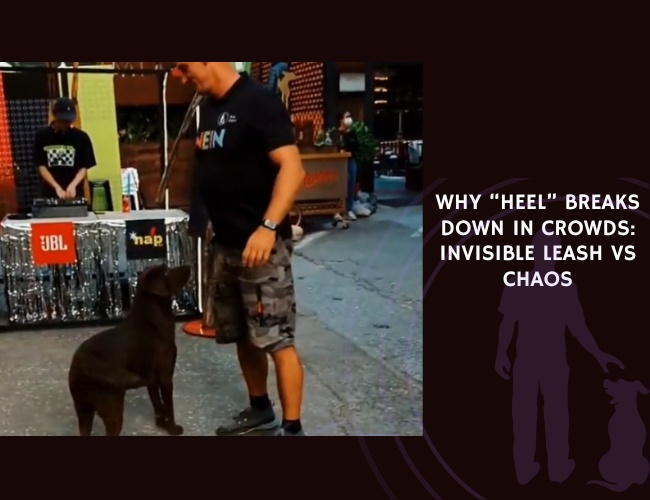
Introduction: When Training Meets Reality
Picture this: Your dog performs a perfect heel in your backyard, maintaining position with precision that would make any trainer proud. Yet the moment you step into a bustling farmer’s market or crowded street, that same well-trained companion seems to forget everything they’ve learned. Sound familiar? You’re not alone in this frustration, and more importantly, your dog isn’t being stubborn or defiant.
The breakdown of heel position in crowded environments reveals a fascinating interplay between cognitive processing, emotional regulation, and the limits of traditional training approaches. Let us guide you through the neuroscience behind this common challenge and explore how understanding your dog’s mental processes can transform your approach to real-world obedience. This journey will take us from the overwhelmed canine brain processing a thousand competing signals to innovative training paradigms that might just revolutionize how we think about heel work altogether.
The Cognitive Storm: What Happens in Your Dog’s Mind
Understanding Sensory Overload
When you and your furry friend enter a crowded space, their brain immediately begins processing an avalanche of information that would challenge even the most focused human mind. Visual stimuli bombard their system – moving legs at eye level, swaying bags, fluttering clothing, other dogs, children darting unpredictably. Each of these visual elements carries what researchers call “salience” – a measure of how much something grabs attention.
The brightness factor plays a crucial role here. Research into visual working memory shows that brighter, more saturated visual elements naturally capture attention more effectively than muted ones. In a crowd, this means that colorful shopping bags, reflective surfaces, and vibrant clothing all compete for your dog’s attentional resources. Your heel cue, delivered through voice or hand signal, suddenly becomes just one input among hundreds.
Depth perception adds another layer of complexity. Your dog’s brain must constantly calculate distances to moving obstacles while maintaining awareness of your position. This three-dimensional processing challenge intensifies as crowd density increases, creating what cognitive scientists call “attentional saturation” – the point where the brain simply cannot process all incoming information effectively.
Working Memory: The Invisible Bottleneck
Working memory functions like your dog’s mental clipboard, temporarily holding information needed for immediate tasks. During heel work, your dog uses working memory to:
- Track your position and speed
- Remember the heel command
- Monitor their own body position
- Process environmental navigation
In calm environments, this mental juggling act is manageable. But crowds introduce what researchers term “cognitive load” – the total amount of mental effort being used. When cognitive load exceeds working memory capacity, something has to give. Unfortunately, that “something” is often the heel position you’ve worked so hard to train.
The local versus global processing challenge reveals itself dramatically in crowds. Your dog’s brain must simultaneously process local cues (individual people nearby, specific obstacles) and global patterns (overall crowd flow, general direction of movement). Studies show that dogs struggle with this type of dual processing, particularly when both local and global cues demand immediate attention. This explains why your normally attentive companion might suddenly veer toward an interesting smell or person – their overwhelmed working memory simply dropped the “maintain heel” instruction to process more immediate environmental information.
Attention & Distraction Load: The Competition for Focus
The Hierarchy of Attention
Your dog’s attention operates on a priority system, and understanding this hierarchy helps explain heel breakdowns. At the top of this hierarchy sits survival-relevant information – sudden movements, unfamiliar dogs, loud noises. These stimuli trigger what neuroscientists call “attentional capture” – an automatic redirection of focus that bypasses conscious control.
Handler cues typically rank lower in this natural hierarchy, especially when competing with novel or potentially threatening stimuli. This isn’t a training failure; it’s evolutionary programming that kept your dog’s ancestors alive. In a crowd, every moving person represents potential threat or opportunity, triggering ancient assessment circuits that override recently learned behaviors.
The salience competition becomes particularly intense when multiple high-priority stimuli appear simultaneously. Imagine your dog trying to maintain heel while processing: a child running directly toward them, another dog barking nearby, food smells from a vendor, and your “heel” command. Each stimulus demands cognitive resources, and your training cue – no matter how well-practiced – might simply lose this neurological bidding war for attention.
Selective Attention and Its Limits
Selective attention allows your dog to filter relevant from irrelevant information, but this filtering system has limitations. The cocktail party effect – our ability to focus on one conversation in a noisy room – requires significant cognitive resources. Dogs face similar challenges in crowds, trying to “tune in” to their handler while filtering out environmental noise.
Visual salience can hijack selective attention before conscious processing occurs. A squirrel darting past, a dropped piece of food, or another dog’s sudden movement can trigger automatic orienting responses that momentarily break heel position. These aren’t choices your dog makes; they’re reflexive responses governed by subcortical brain structures that react faster than the cortical areas responsible for trained behaviors.
The depth of processing required for heel maintenance often exceeds what selective attention can sustain in chaos. Your dog must continuously update their position relative to yours while navigating obstacles and monitoring threats. This multitasking eventually exhausts attentional resources, leading to those frustrating moments when heel position deteriorates despite your best efforts.
Stress and Emotional Regulation: The Hidden Saboteur
The Neurochemical Cascade
When your dog enters a crowded environment, their body initiates a complex stress response that profoundly impacts behavior. Cortisol levels begin rising within minutes of entering a challenging environment, affecting memory consolidation and recall. This stress hormone can actually impair your dog’s ability to remember and execute trained behaviors, including heel position.
The arousal curve follows Yerkes-Dodson law, which states that performance increases with arousal up to a point, then rapidly declines. In crowds, many dogs quickly exceed their optimal arousal level, entering a state where cognitive performance deteriorates. You might notice your dog panting excessively, pulling harder, or seeming “disconnected” from you – all signs of arousal exceeding the functional threshold.
Adrenaline floods the system, preparing your dog for potential flight or fight responses. This sympathetic nervous system activation redirects blood flow from the prefrontal cortex (responsible for impulse control and trained behaviors) to more primitive brain structures focused on survival. The heel command, processed in higher brain centers, literally receives less neurological support when stress hormones dominate.
Social Density and Reactivity Amplification
Crowds create unique social pressures that can amplify your dog’s natural reactivity. Personal space invasion occurs constantly as strangers pass within your dog’s comfort zone. Each invasion triggers a micro-stress response, cumulatively building tension that eventually erupts as pulling, lunging, or complete heel breakdown.
The emotional contagion effect means your dog picks up on the collective energy of the crowd. Human stress, excitement, or anxiety transmits through subtle cues – elevated heart rates, quickened breathing, tense body language. Your dog’s mirror neurons fire in response, essentially “catching” the crowd’s emotional state and adding to their own arousal burden.
Frustration builds when natural behaviors are repeatedly blocked. Your dog wants to investigate interesting smells, greet other dogs, or move at their preferred pace. The heel position prevents these natural expressions, creating internal conflict that intensifies with each denied opportunity. This frustration compounds existing stress, creating a negative feedback loop that makes heel maintenance increasingly difficult.
Fear, Frustration, and Overstimulation: The Emotional Triad
Different dogs experience crowds through different emotional lenses, but three primary states commonly emerge:
Fear-based responses manifest in dogs who find crowds threatening. These dogs might maintain heel initially through freezing or inhibition, but as fear builds, they eventually hit a breaking point where flight responses override trained behaviors. You might notice tucked tails, lowered body posture, or attempts to hide behind you – all incompatible with proper heel position.
Frustration-driven behaviors appear in confident, social dogs prevented from engaging with their environment. These dogs pull toward people, dogs, or interesting smells, their frustration mounting with each restriction. The heel position becomes a source of conflict rather than cooperation, leading to increasingly forceful attempts to break position.
Overstimulation presents as hypervigilance and inability to settle. These dogs try to process everything simultaneously, their heads swiveling constantly, bodies tense with excitement or anxiety. They might maintain physical proximity to you but lose the relaxed, attentive quality that characterizes good heel work. Their minds race faster than their bodies can follow, resulting in erratic movement patterns and position breaks.

Training Paradigm Revolution: From Commands to Connection
Traditional Cue-Based Heeling: Strengths and Limitations
Traditional heel training relies on clear cues, consistent reinforcement, and gradual distraction-proofing. This approach builds strong stimulus-response connections in controlled environments. Your dog learns that “heel” means assuming and maintaining a specific position relative to you, usually reinforced through treats, praise, or play.
The fundamental limitation emerges in cognitive overload situations. Traditional training creates what behaviorists call “stimulus control” – reliable responses to specific cues under specific conditions. But crowds present conditions far outside typical training parameters. The cue-response pathway, no matter how well-rehearsed, competes with numerous other neural pathways activated by environmental stimuli.
Context-dependency poses another challenge. Dogs trained traditionally often struggle to generalize behaviors across vastly different environments. The heel learned in your living room differs neurologically from the heel required in a crowded market. Each context creates distinct neural activation patterns, and without specific crowd training, your dog lacks the neural pathways needed for crowd-specific heel maintenance.
The Invisible Leash Paradigm: Relational Synchrony
The Invisible Leash approach represents a fundamental shift from command-based to relationship-based training. Rather than teaching specific positions, this method develops attentional habits and emotional attunement. Your dog learns to maintain awareness of and synchrony with you, regardless of environmental conditions.
Relational synchrony operates below conscious thought, engaging subcortical bonding circuits rather than cortical command-processing areas. This deeper neurological engagement proves more resistant to interference from environmental stimuli. When your dog’s brain becomes overwhelmed, these primitive bonding circuits continue functioning while higher-order command processing fails.
The co-regulation component addresses emotional overwhelm directly. Instead of expecting your dog to manage their emotional state independently while maintaining position, the Invisible Leash framework emphasizes shared emotional regulation. You become your dog’s emotional anchor, providing stability that transcends specific commands or positions. This emotional foundation maintains even when cognitive resources are exhausted.
Building NeuroBond Connections
The NeuroBond framework takes relational training further, deliberately strengthening specific neural pathways that support handler focus. This approach recognizes that attention is finite but emotional connection is expansive. By building training on emotional rather than purely cognitive foundations, dogs maintain handler orientation even under extreme distraction.
Neuroplasticity principles guide the training process. Rather than teaching behaviors, you’re literally rewiring your dog’s brain to prioritize handler awareness. This involves:
- Meditation-like focus exercises that strengthen sustained attention
- Movement synchronization drills that build proprioceptive awareness
- Emotional regulation practices that develop stress resilience
The generalization occurs naturally because you’re training underlying capacities rather than specific behaviors. A dog with strong handler-bonding circuits maintains connection across contexts, from empty parks to crowded festivals. The “invisible leash” isn’t a behavior – it’s a neurological state of sustained interspecies awareness.
Breed, Temperament & Individual Differences: One Size Never Fits All
Genetic Predispositions and Breed-Specific Challenges
Your dog’s breed heritage significantly influences their crowd response patterns. Herding breeds face unique challenges as their genetic programming compels them to monitor and control movement. In crowds, every person becomes potential “livestock” to manage, creating overwhelming cognitive demands that make heel maintenance nearly impossible.
Hunting breeds battle different demons. Their heightened sensory awareness and prey drive mean every flutter, scurry, or sudden movement triggers deep-seated chase instincts. These dogs might maintain perfect heel until a pigeon flies past or a squirrel appears, at which point millions of years of evolution override months of training.
Guardian breeds process crowds as potential threats, maintaining hypervigilance that exhausts cognitive resources. They position themselves strategically for protection rather than heel position, their ancient programming prioritizing security over obedience. You might notice these dogs constantly scanning, muscles tensed, ready to intervene if danger appears.
The Anxious versus Confident Spectrum
Anxious dogs experience crowds as overwhelming threat matrices. Their amygdala hypersensitivity means every stimulus triggers threat assessment, flooding their system with stress hormones. These dogs might maintain heel through frozen compliance initially, but this isn’t true training success – it’s fear-based inhibition that eventually collapses into panic or shutdown.
Confident dogs face different challenges related to frustrated exploration and social desires. Their emotional regulation remains stable, but their motivation to maintain heel weakens when exciting opportunities present themselves. These dogs need different strategies focusing on engagement and choice rather than anxiety management.
The sweet spot exists in the middle – dogs with moderate confidence and appropriate caution. These dogs possess sufficient emotional stability to handle stress while maintaining enough handler focus to remember their training. Understanding where your dog falls on this spectrum helps tailor your approach to their specific needs.
Early Life Experiences: The Critical Window
Puppies exposed to crowds during their critical socialization period (3-14 weeks) develop more robust neural pathways for processing complex environments. These early experiences create what neuroscientists call “stress inoculation” – the ability to maintain function despite environmental challenges.
Lack of early crowd exposure creates lasting deficits. Dogs who first encounter crowds as adolescents or adults must build entirely new neural pathways while simultaneously managing fear or overexcitement. This double challenge makes heel training in crowds exponentially more difficult.
The quality of early experiences matters enormously. Positive, controlled crowd exposure during puppyhood builds confidence and processing capacity. Traumatic crowd experiences, conversely, can create lasting negative associations that require extensive counterconditioning to overcome. Your dog’s crowd behavior today often reflects experiences from their earliest months.
Crowded. Chaotic. Overloaded.
Precision collapses when the mind is saturated. What looks like disobedience is often cognitive overload, where your dog’s brain cannot process the flood of competing signals. In this storm of sights, sounds, and scents, the heel command becomes just one more input lost in the noise.
Working memory breaks under pressure. Heel requires constant tracking of position, pace, and command, but crowds demand simultaneous navigation of countless moving obstacles. When cognitive load exceeds capacity, instinct prioritises survival cues over trained behaviours.
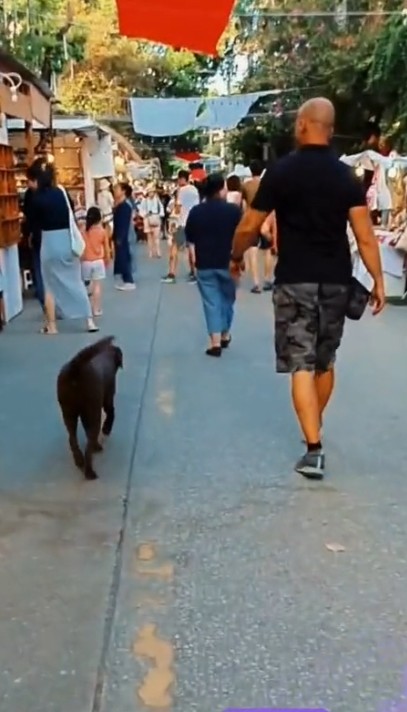


Attention follows ancient rules of survival. Sudden movements, loud noises, and unfamiliar figures automatically outrank your signals. In these moments, your dog isn’t ignoring you—they are wired to react. Connection is rebuilt not through correction, but by reshaping training to respect this hierarchy of attention.
Performance & Activities: Real-World Applications
Urban Navigation Strategies
Navigating city environments with your dog requires strategic planning that goes beyond basic heel training. Time of day dramatically impacts difficulty – rush hour presents maximum challenge while early morning offers gentler introduction opportunities. Start your crowd training during off-peak hours, gradually building your dog’s processing capacity.
Route selection can make or break success. Choose paths with escape options – wide sidewalks, parks, or quiet side streets where you can retreat if overwhelmed. Avoid bottlenecks like narrow passages or construction zones where crowd density intensifies suddenly. Your dog needs to know retreat remains possible, reducing anxiety and maintaining cognitive function.
The checkpoint system proves invaluable for urban heel work. Rather than expecting continuous heel through entire walks, establish specific heel zones (crosswalks, busy intersections) alternating with relaxation zones where your dog can process and decompress. This interval approach prevents cognitive exhaustion while maintaining safety when it matters most.
Crowd Training Progressions
Systematic desensitization remains the gold standard for building crowd competence. Begin with distant crowd observation, rewarding calm attention to you while crowds pass at comfortable distances. Gradually decrease distance while monitoring your dog’s stress signals – panting, whining, pulling, or disconnection indicate you’ve progressed too quickly.
The “crowd simulation” technique allows controlled practice without overwhelming real-world exposure. Recruit friends or training partners to create artificial crowds, starting with two or three people and gradually increasing density. This controlled environment lets you manage variables while building your dog’s confidence and processing capacity.
Integration exercises bridge the gap between training and reality. Practice heel work near (but not in) crowds initially – the edges of farmer’s markets, outside busy stores, or adjacent to playgrounds. Your dog learns to maintain focus despite nearby chaos, building the neural strength needed for eventual crowd immersion.
Competition versus Real-World Heeling
Competition heeling emphasizes precision in controlled environments where judges evaluate exact positioning, focal attention, and synchronized movement. This refined skill requires intense concentration but occurs in predictable settings with minimal unexpected variables.
Real-world heeling prioritizes safety and general compliance over perfect position. Success means your dog remains close enough to avoid danger, responsive enough to follow directional changes, and calm enough to navigate challenges. This functional heeling requires different neural pathways – those supporting flexible attention rather than rigid focus.
The two styles can complement each other when trained appropriately. Competition heeling builds focus capacity and handler awareness that transfers to real-world situations. Conversely, real-world training develops adaptability and stress resilience that enhances competition performance. The key lies in recognizing these as related but distinct skill sets requiring separate development.
Health Considerations: When Biology Meets Behavior
Sensory Health and Heel Performance
Vision problems significantly impact crowd navigation. Dogs with declining eyesight struggle to process rapidly moving visual stimuli, creating anxiety that disrupts heel position. Regular eye examinations become crucial as your dog ages, with early intervention preventing heel work deterioration.
Hearing changes affect command processing in noisy environments. Dogs with partial hearing loss might maintain perfect heel in quiet settings but fail completely when ambient noise masks your cues. Consider adding visual or tactile cues to supplement verbal commands in challenging acoustic environments.
Pain or discomfort derails concentration faster than any distraction. Hip dysplasia, arthritis, or even minor muscle strains make maintaining heel position physically uncomfortable. Your dog might break position not from disobedience but from attempting to find less painful positioning. Regular veterinary assessments ensure physical comfort supports behavioral success.
Neurological Factors in Training Response
Age-related cognitive changes affect learning capacity and stress resilience. Senior dogs might struggle with heel maintenance not from stubbornness but from genuine cognitive decline affecting working memory and processing speed. Adjusting expectations and simplifying requirements maintains quality of life while acknowledging biological limitations.
Certain medications impact cognitive function and training responsiveness. Anti-anxiety medications might reduce stress but also diminish learning capacity. Pain medications can cause drowsiness affecting attention. Work with your veterinarian to balance medical needs with training goals, adjusting protocols as needed.
Nutritional status influences brain function more than many realize. Omega-3 fatty acids support cognitive health, while B-vitamins affect neurotransmitter production. Dogs on restricted or imbalanced diets might lack the neurological resources for complex cognitive tasks like crowd heel work. Optimal nutrition provides the biological foundation for behavioral success.
Lifestyle Integration: Making It Work in Your World
Daily Practice Opportunities
Transform routine activities into training moments without adding time to your schedule. Your morning coffee run becomes heel practice through increasing pedestrian traffic. Afternoon school pickup provides controlled crowd exposure with predictable timing. Evening walks through busy neighborhoods offer graduated challenge levels.
The micro-training approach proves highly effective for busy handlers. Rather than dedicating hour-long training sessions, incorporate thirty-second heel practices throughout your day. These brief, frequent repetitions build neural pathways more effectively than sporadic intensive sessions.
Environmental variety prevents context-dependency while maintaining reasonable challenge levels. Rotate between different crowd types – shopping areas, parks, transit stations – ensuring your dog generalizes heel behavior across settings. This variety also prevents boredom while building comprehensive crowd competence.
Building Handler Confidence
Your emotional state directly impacts your dog’s performance. Crowds that make you anxious transmit tension through the leash, elevating your dog’s stress and impairing their cognitive function. Developing your own crowd confidence improves your dog’s heel maintenance more than any training technique.
Body language speaks louder than commands in overwhelming environments. Relaxed shoulders, steady breathing, and confident stride communicate safety to your dog when their cognitive processing fails. Practice maintaining calm body language even when internally stressed – your dog relies on these signals when overwhelmed.
The leadership mindset shifts responsibility from your dog to you. Instead of expecting your dog to maintain heel independently, you actively guide them through challenging environments. This subtle shift from passive expectation to active partnership reduces pressure on your dog while strengthening your bond.
Creating Success Patterns
Set your dog up for victory by managing variables within your control. Feed before (but not immediately before) crowd exposure to optimize cognitive function. Ensure adequate exercise beforehand to reduce excess energy without causing fatigue. Choose weather conditions that support comfort – avoiding extreme heat, cold, or precipitation that adds stress.
The success spiral builds momentum through carefully orchestrated positive experiences. Each successful crowd navigation, however brief, strengthens neural pathways and builds confidence. Conversely, repeated failures create negative associations requiring extensive rehabilitation. Prioritize quality over quantity, ending sessions on positive notes even if that means cutting them short.
Recovery time matters as much as training time. Dogs need processing periods to consolidate learning and restore cognitive resources. Schedule rest days between intensive crowd work, allowing your dog’s brain to strengthen new neural connections. This isn’t laziness – it’s strategic neuroscience supporting long-term success. 🧠
Advanced Strategies: Beyond Basic Heel
The Dynamic Positioning System
Rather than maintaining rigid heel position, dynamic positioning allows flexible response to environmental demands. Your dog learns to adjust their position based on crowd density, obstacle placement, and movement patterns while maintaining general proximity and responsiveness. This adaptive approach reduces cognitive load while preserving safety.
Zone training replaces position training in this framework. Instead of one specific heel position, your dog learns three zones: close (crowded/dangerous), medium (normal walking), and loose (safe/open areas). Transitions between zones occur smoothly based on environmental cues rather than explicit commands, reducing processing demands.
The orbit concept allows your dog to move within defined parameters while maintaining handler awareness. Like a planet orbiting the sun, your dog can shift position while remaining energetically connected to you. This freedom reduces frustration while preserving the essential handler-dog connection needed for crowd safety.
Emotional Regulation Techniques
Breathing synchronization creates powerful co-regulation between you and your dog. Practice synchronized breathing during calm moments, establishing a rhythm your dog associates with safety. In crowds, deliberately slowing your breathing can trigger your dog’s parasympathetic nervous system, countering stress responses that impair heel maintenance.
The “touch and release” protocol provides periodic grounding without constant physical connection. Brief, intentional touches remind your dog of your presence while allowing independent processing between contacts. This intermittent reinforcement maintains awareness without creating dependency or restricting natural movement.
Calming signals replace corrective cues when heel position deteriorates. Rather than repeatedly commanding “heel” (adding to cognitive load), use established calming signals – soft eye contact, gentle voice tones, or specific touch patterns. These signals activate bonding circuits rather than command-processing pathways, maintaining connection when cognitive resources are depleted.
Technology Integration
GPS trackers provide objective data about your dog’s movement patterns in crowds, revealing stress indicators invisible to human observation. Sudden position changes, erratic movement, or increasing distance from handler all suggest overwhelming cognitive load requiring intervention.
Heart rate monitors reveal physiological stress before behavioral symptoms appear. Elevated heart rate in crowds indicates sympathetic nervous system activation, warning you to reduce challenge levels before heel breakdown occurs. This physiological feedback enables proactive rather than reactive training adjustments.
Video analysis uncovers subtle pattern changes in your dog’s heel performance across environments. Recording training sessions reveals gradual deterioration patterns, attention shifts, or stress signals you might miss in real-time. This objective feedback guides training modifications targeting specific breakdown points.
The Welfare Perspective: Ethics and Wellbeing
Recognizing Overwhelm Signs
Physical indicators appear before behavioral breakdown. Watch for dilated pupils, excessive panting, trembling, or rigid body posture. These signs indicate your dog is approaching or exceeding their processing capacity. Continuing to demand heel maintenance when these signs appear risks both training regression and welfare compromise.
Behavioral changes signal emotional distress requiring immediate intervention. Sudden aggression, shutdown, or panic indicates your dog has exceeded their coping capacity. These aren’t training failures but welfare emergencies requiring immediate removal from the overwhelming environment.
Recovery indicators tell you when to resume training. After overwhelming experiences, monitor your dog’s return to baseline. Full body shakes, deep sighs, or seeking play indicate stress discharge and readiness to continue. Persistent stress signals – continued panting, inability to settle, or avoidance behaviors – suggest your dog needs extended recovery before attempting crowds again.
Ethical Training Progressions
The consent principle respects your dog’s emotional capacity and choice. Rather than forcing compliance through corrections or restrictions, observe whether your dog voluntarily maintains proximity despite distractions. This voluntary engagement indicates genuine learning rather than suppressed behavior.
Stress inoculation versus flooding represents a critical ethical distinction. Gradual exposure building resilience (inoculation) supports welfare and learning. Overwhelming exposure hoping for eventual habituation (flooding) risks trauma and permanent negative associations. The difference lies in your dog’s ability to recover between exposures.
The partnership model recognizes heel work as collaborative rather than dominance-based. You’re not commanding obedience but inviting cooperation. This philosophical shift changes everything from training methods to success metrics, prioritizing relationship quality over position precision. 🐾
Long-term Welfare Considerations
Chronic stress from repeated crowd exposure without adequate support can impact your dog’s overall health. Sustained cortisol elevation affects immune function, digestion, and cognitive health. Monitor for signs of chronic stress – weight changes, digestive issues, or behavioral regression in other areas.
Quality of life must supersede training goals. Some dogs, due to temperament, history, or neurology, may never comfortable navigate crowds. Accepting these limitations and finding alternative solutions (different walking routes, timing, or management strategies) prioritizes welfare over arbitrary training standards.
The relationship cost of forced compliance often exceeds any practical benefit. Repeatedly forcing your dog through overwhelming experiences damages trust and communication. Sometimes the most ethical choice involves accepting your dog’s limitations and working within them rather than against them.
Senior Dogs: Special Considerations
Cognitive Changes with Age
Senior dogs experience decreased processing speed that affects heel maintenance in complex environments. What once took milliseconds to process now requires full seconds, creating dangerous delays in crowded situations. Adjust your expectations to match your dog’s current cognitive capacity rather than their younger performance.
Working memory decline means your senior dog might genuinely forget heel position more frequently. This isn’t defiance or regression but normal age-related change. Increase reminder frequency while decreasing duration expectations, maintaining success through modified goals rather than original standards.
Sensory decline compounds cognitive challenges. Decreased vision and hearing mean your senior dog receives incomplete environmental information, creating anxiety that further impairs cognitive function. Consider whether heel work in crowds remains appropriate or whether management strategies better serve your senior companion’s welfare.
Adaptation Strategies for Older Dogs
The “senior-safe” zones approach identifies specific areas where your older dog can successfully maintain modified heel position. These might include quiet morning walks, familiar routes, or specific low-traffic areas. Focus success in achievable contexts rather than struggling in overwhelming ones.
Assistive equipment can support senior heel work. Properly fitted harnesses provide security without restriction. Shorter leashes allow closer management without demanding perfect position. Consider whether mobility aids might help your dog maintain proximity despite physical limitations.
Modified cues accommodate sensory changes. Replace verbal commands with clear hand signals for dogs with hearing loss. Add verbal markers for dogs with vision decline. Use touch cues for dogs with both sensory impairments. These adaptations maintain communication when primary channels fail.
Practical Solutions: Your Action Plan
Assessment and Baseline
Start with honest evaluation of your dog’s current crowd capacity. Can they maintain focus in mildly busy environments? Do they show stress signs immediately or after prolonged exposure? Understanding your starting point prevents overwhelming jumps in difficulty.
Document baseline behaviors through video or written notes. Record how long your dog maintains heel before breakdown, what triggers position breaks, and recovery time needed. This objective data guides training progressions and reveals subtle improvements you might otherwise miss.
Identify your specific goals rather than pursuing abstract “perfect heel.” Do you need crowd navigation for urban living? Brief heel maintenance for street crossings? Or complete crowd avoidance with management strategies? Clear goals guide training investments and success metrics.
Implementation Timeline
Weeks 1-2: Foundation Building
- Practice relaxation exercises in increasingly stimulating environments
- Establish clear communication signals for different scenarios
- Build handler focus through engagement games
- Document stress signals and recovery patterns
Weeks 3-4: Controlled Exposure
- Begin distance work near crowds
- Practice brief heel segments with immediate release
- Introduce the three-zone system (close/medium/loose)
- Monitor physiological stress indicators
Weeks 5-8: Gradual Integration
- Increase crowd proximity while decreasing duration
- Practice dynamic positioning adjustments
- Implement recovery protocols between exposures
- Build duration only after achieving calm proximity
Weeks 9-12: Real-World Application
- Navigate actual crowds for brief periods
- Practice emergency protocols for overwhelming situations
- Generalize skills across different crowd types
- Establish sustainable long-term practices
Troubleshooting Common Challenges
“My dog maintains heel briefly then explodes” suggests cognitive resource depletion. Reduce duration requirements dramatically – even 10 seconds of quality heel work beats 60 seconds ending in breakdown. Build duration only after achieving consistent calm performance.
“They heel perfectly until they see another dog” indicates specific trigger overwhelming general training. Address dog reactivity separately from heel work initially, then gradually integrate the two skills. Expecting simultaneous performance of both exceeds most dogs’ cognitive capacity.
“Heel is perfect going somewhere, terrible returning” reveals motivation and arousal differences. Outbound journeys carry anticipation and novelty that maintains focus. Return journeys lack this motivation while accumulated stress impairs performance. Consider different routes home or breaking return journeys into segments with play or rest breaks.
Conclusion: Is Perfect Crowd Heel Worth Pursuing?
After exploring the cognitive complexities, emotional challenges, and neurological limitations affecting heel work in crowds, we return to a fundamental question: What really matters for you and your dog?
Perfect competition-style heeling in crowds may be neurologically impossible for many dogs without causing significant stress. The cognitive demands simply exceed what canine brains evolved to handle. But functional proximity, responsive connection, and mutual awareness? These remain achievable goals that serve real-world needs while respecting your dog’s welfare.
The journey toward better crowd navigation teaches us about relationship, not just position. Through understanding your dog’s cognitive processes, emotional needs, and individual limitations, you build connection transcending specific behaviors. This deeper understanding enriches your entire relationship, extending far beyond heel work.
Did you know that dogs trained with relational approaches show lower cortisol levels in challenging environments than those trained with traditional methods? This suggests that how we train matters as much as what we train. The invisible leash connecting you to your dog might be built from understanding, patience, and mutual trust rather than commands and positions.
Moving forward, consider whether your goal involves perfect heel position or functional partnership. Both have value, but only one acknowledges the full complexity of your dog’s experience in our overwhelming human world. Your choice shapes not just training outcomes but the very nature of your relationship with your faithful companion.
Remember: Every dog has limits, and respecting those limits shows wisdom, not weakness. Some dogs will never comfortably navigate Times Square at rush hour, and that’s okay. Success means finding what works for your unique dog, in your specific situation, supporting both safety and welfare.
The crowd may challenge the heel, but it doesn’t have to break your bond. In fact, navigating these challenges together, with patience and understanding, might just strengthen the invisible leash that truly connects you. After all, the best heel position is one where both ends of the leash feel secure, confident, and connected – regardless of what chaos swirls around you. 🧡










