
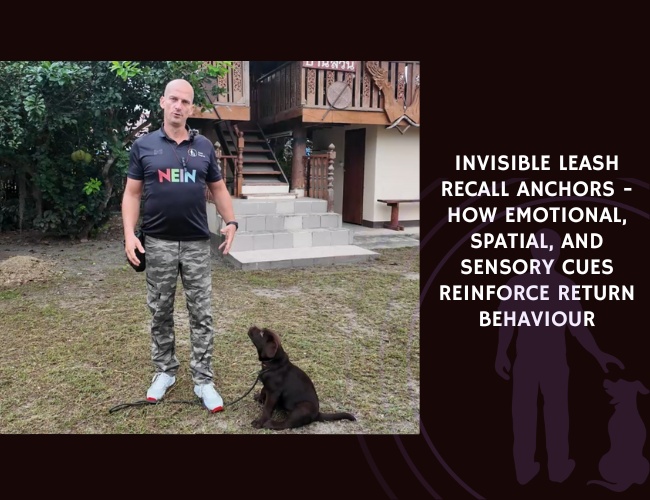
Have you ever wondered why some dogs return instantly to their handler, while others hesitate or ignore the call entirely? The answer lies not in obedience alone, but in something far more profound—the emotional anchors that connect your dog to you. Let us guide you through the fascinating science of recall anchors, where neuroscience meets the deep bond you share with your furry friend.
Recall anchors are the stable emotional and sensory associations that drive consistent return behaviour, even when your dog faces distractions. These anchors work like invisible threads, woven from trust, memory, and positive experience. Understanding how these anchors form—and how to strengthen them—can transform your relationship with your dog from simple command compliance to genuine, joyful connection.
Understanding the Foundation: What Are Recall Anchors?
Before we explore the complex mechanisms behind recall behaviour, you need to understand what makes an anchor truly effective. A recall anchor is not simply a command your dog has learned to obey. It represents a multi-layered association between specific cues and deeply positive emotional states—particularly the feeling of safety and connection with you.
The Three Pillars of Recall Anchors:
- Emotional resonance – Your dog associates returning with feelings of safety, comfort, and joy rather than fear or mechanical obligation
- Sensory consistency – Specific sounds, sights, scents, and physical sensations become reliable predictors of positive outcomes
- Neural pathways – Repeated positive experiences literally reshape your dog’s brain, creating automatic response patterns that transcend conscious thought
Through the NeuroBond approach, these pillars work together to create recall that emerges from genuine desire rather than trained compliance. This distinction matters profoundly when your dog faces real-world challenges—a squirrel darting across the path, another dog approaching, or unfamiliar territory calling for exploration.
The Cognitive Architecture of Recall Memory
How Your Dog’s Brain Encodes the “Come Home” Signal
When you call your dog, their brain performs a remarkable feat of information processing. The recall cue—whether verbal, visual, or both—triggers a cascade of neural activity across multiple brain regions. The hippocampus, your dog’s memory center, immediately searches for stored associations with that specific cue. Meanwhile, the amygdala evaluates the emotional significance, asking: “Is this safe? Is this rewarding?”
Research reveals that emotional state during cue delivery profoundly impacts memory consolidation. If your dog experiences stress or anxiety when hearing a recall command, their brain may encode that cue poorly or associate it with negative emotions. This creates a fragmented memory—like trying to recall a moment from a stressful day where details blur together.
Key Insight: Your dog’s emotional state when learning recall cues determines how reliably those cues will work later. A calm, positive training environment creates strong neural connections, while high-arousal situations can actually disrupt memory formation. 🧠
The Dual Nature of Memory Storage
Your dog’s brain stores recall experiences through two parallel systems. The explicit memory system processes the conscious understanding: “When my human makes this sound and gesture, I should return.” The implicit emotional memory system operates beneath awareness: “Returning feels safe and rewarding.”
This dual representation becomes crucial when distractions arise. While your dog’s conscious mind might be captivated by an exciting scent, the deeper emotional memory can still pull them back toward you—provided that emotional anchor is strong enough. The difference between dogs who return reliably and those who don’t often lies not in training frequency, but in the strength of these emotional associations.
Studies on memory encoding show that fragmented, trauma-based memories lack the broader conceptual organization that makes recall smooth and automatic. When you build recall through positive, emotionally coherent experiences, you create unified memories that your dog can access easily, even under pressure.
Emotional Anchoring: Beyond Food Rewards
Why Connection Outperforms Treats
You might notice that some dogs will ignore even their favorite treats when distracted, yet return instantly to certain handlers. This phenomenon reveals something essential about motivation: the feeling of safety and connection can outweigh tangible rewards.
Traditional operant conditioning focuses on consequences—give a treat, get compliance. While effective for teaching basic behaviours, this approach overlooks the deeper motivational systems in your dog’s brain. Emotional anchoring works differently. By consistently pairing the recall cue with feelings of safety, joy, and secure connection, you tap into your dog’s fundamental need for social bonding.
Emotional Anchoring Creates:
- Intrinsic motivation – Your dog wants to return because it feels inherently rewarding, not just for external benefits
- Stress resilience – When pressure or distractions arise, the emotional anchor remains stable while food motivation may falter
- Generalization – Emotional safety transcends specific environments, helping recall work in novel settings
- Lasting reliability – Neural pathways strengthened by positive emotion become increasingly automatic over time
The Invisible Leash reminds us that awareness, not tension, guides the path. When your dog feels emotionally anchored to you, they carry an internal compass that points home, regardless of external temptations.
The Role of Oxytocin in Building Trust-Based Recall
Oxytocin, often called the “bonding hormone,” plays a leading role in social behaviour across mammals. When you engage in positive, calm interactions with your dog—gentle touch, eye contact, playful engagement—both your brains release oxytocin. This neurochemical doesn’t just make the moment feel good; it literally strengthens the neural pathways associated with your relationship.
Every successful recall followed by genuine, warm connection floods your dog’s system with oxytocin. Over time, the recall cue itself becomes associated with this neurochemical reward. Your dog begins to anticipate the positive feelings that accompany returning, creating a self-reinforcing cycle. This biological mechanism explains why some handlers seem to have an almost magnetic pull on their dogs—they’ve built powerful oxytocin-driven bonds that transcend simple training.
The Neurobiology of Recall: Inside Your Dog’s Brain
Neural Pathways That Make Recall Possible
The brain regions responsible for recall form an intricate network. Ventral hippocampal neurons project simultaneously to both the medial prefrontal cortex and the amygdala, creating what researchers call “double-projecting” neurons. These specialized cells efficiently convey contextual information—where your dog is, what’s happening around them—while simultaneously processing the emotional significance.
When your dog hears your recall cue, these double-projecting neurons activate, sending signals that essentially ask: “What does this context mean emotionally?” If previous experiences have established that returning leads to safety and reward, the amygdala signals approach behaviour. The prefrontal cortex then coordinates the executive function needed to actually execute the return, even if distractions compete for attention.
The Recall Processing Sequence:
- Sensory input (sound, sight, scent) enters primary processing areas
- Hippocampus retrieves stored memories associated with these cues
- Amygdala evaluates emotional significance and safety
- Prefrontal cortex weighs competing motivations and initiates decision
- Motor cortex executes the physical return behaviour
Understanding this sequence helps you appreciate why recall sometimes fails. If any step in this chain weakens—poor memory encoding, negative emotional associations, overwhelming competing motivations—the system breaks down. Strengthening each link requires attention to both cognitive and emotional factors.
Olfactory Memory: The Power of Scent
Your dog experiences the world primarily through scent, and olfactory memories form some of the strongest neural connections in their brain. Research demonstrates that odors create particularly robust associations with emotionally salient memories. The olfactory system connects directly to the amygdala and hippocampus, bypassing some of the cognitive processing required for visual or auditory information.
This neurological architecture offers profound implications for recall training. Your unique scent—consistent and unchanging—can become one of the most powerful recall anchors available. When your dog associates your scent with safety, comfort, and positive experiences, that olfactory cue can trigger return behaviour even when visual or auditory signals fail to penetrate distractions.
The posterior piriform cortex and specific amygdala subnuclei show increased neural activity when processing emotionally significant scents. By ensuring your presence and scent consistently accompany positive experiences, you essentially program your dog’s olfactory memory system to treat your scent as a “home base” signal—a sensory beacon calling them back to safety. 🧡

Physiological Markers: Reading Your Dog’s Emotional State
Heart Rate Variability as a Trust Indicator
Heart rate variability (HRV) measures the subtle changes in time intervals between heartbeats. High HRV typically indicates parasympathetic nervous system dominance—the “rest and digest” state associated with calm, confident behaviour. Low HRV suggests sympathetic activation—the stress response that drives fight, flight, or freeze behaviours.
When building recall anchors, you can use HRV patterns to gauge your dog’s emotional state. A dog with healthy HRV during recall training is processing the experience through their social engagement system, building positive associations. A dog with reduced HRV may be experiencing the training as stressful, potentially encoding negative associations that will undermine recall reliability later.
Signs of Healthy Emotional State During Training:
- Relaxed body posture with soft, natural movements
- Variable attention—switching between you and environment without fixation
- Playful engagement rather than frantic energy
- Soft eye contact and responsive facial expressions
- Willingness to disengage from distractions and re-orient to you
Tracking these physiological and behavioural markers helps you adjust training intensity. The goal is building recall anchors while maintaining your dog in a state of calm confidence rather than high arousal or stress.
Cortisol: The Stress Hormone That Blocks Learning
Cortisol, released during stress responses, has profound effects on memory formation. Moderate cortisol levels actually enhance memory consolidation for emotional events—this is why significant experiences become memorable. However, chronically elevated or extremely high cortisol levels disrupt the hippocampus’s ability to form and retrieve memories effectively.
If your dog experiences persistently high cortisol during recall training—perhaps due to punishment-based methods, environmental overwhelm, or handler frustration—their brain cannot effectively encode the positive associations you’re trying to build. Worse, elevated cortisol during recall attempts can impair your dog’s ability to access previously learned behaviours, explaining why “trained” dogs sometimes seem to forget everything in stressful situations.
The shift from stress-driven avoidance to trust-driven return shows itself in cortisol patterns. As emotional anchors strengthen, your dog’s cortisol response to recall scenarios should decrease. They begin to perceive recall situations through their social engagement system rather than their threat-detection system, fundamentally changing the neurobiological context of the behaviour.
Context and Consistency: Building Resilient Anchors
The Challenge of Environmental Shifts
Context-dependent memory means that recall trained exclusively in one environment may not generalize automatically to different settings. Your dog’s brain encodes the training location, time of day, environmental sounds, and countless other contextual details alongside the recall behaviour itself. When these contextual cues change dramatically, retrieval becomes more difficult.
However, research suggests that memory consolidation over time can reduce context dependency. Remote memories become more flexible than recent ones, allowing for broader generalization. This finding has practical implications: patient, consistent recall training over months creates more robust anchors than intensive training over days or weeks.
Strategies for Building Context-Independent Recall:
- Practice in progressively varied environments, not random locations
- Maintain core emotional consistency across all contexts
- Use consistent multisensory cues (voice tone, hand signal, body language) regardless of setting
- Allow adequate time between environmental shifts for memory consolidation
- Return to easier contexts periodically to reinforce foundation
Moments of Soul Recall reveal how memory and emotion intertwine in behaviour. When your dog returns to you across different environments, they’re accessing not just trained commands but deeply embedded emotional memories of safety and connection that transcend specific locations.
Generalization Across Multiple Handlers
Can your dog develop reliable recall with multiple family members without confusion? The answer depends on consistency of emotional tone and cue structure. Dogs can absolutely learn to respond to different handlers, provided each person maintains clear, consistent associations between their specific cues and positive outcomes.
The challenge arises when handlers use conflicting approaches—one person demands compliance while another remains permissive, or cue signals vary dramatically in tone and delivery. These inconsistencies create what researchers might call “emotional confusion,” where the dog cannot form stable predictions about what return behaviour will produce.
For families building shared recall anchors, establish these consistency principles:
Core consistency requirements:
- Similar emotional energy—calm, positive, welcoming
- Consistent consequence patterns—all handlers provide meaningful positive reinforcement
- Aligned physical cues—agree on hand signals, body language, approach distance
- Unified emotional safety—no handler should create stress or fear around recall
Different vocal tones and verbal cues can work across handlers if the underlying emotional message remains consistent. Your dog reads intention and emotional state more accurately than they parse specific words. This flexibility allows each family member to develop their own recall “voice” while maintaining the emotional anchoring that makes the behaviour reliable.
Anchor. Align. Return.
Emotion guides direction. A dog doesn’t run to words—they run to safety. When recall feels like coming home, instinct outpaces distraction.
Memory weaves through feeling. Each cue binds sound to trust, sight to comfort, and space to belonging. The Invisible Leash tightens through connection, not control.


Consistency shapes instinct. Calm repetition forges pathways stronger than impulse. When every call carries warmth, return becomes reflex—love guiding motion.
Sensory Integration: Creating Multisensory Anchors
The Hierarchy of Sensory Effectiveness
When building recall anchors, certain sensory modalities prove more effective than others, particularly under high-arousal conditions or at distance. Understanding this hierarchy helps you design optimal training protocols.
Sensory Effectiveness for Recall (Most to Least Reliable Under Distraction):
- Olfactory (scent) – Most primal and emotionally connected; works at distance when wind carries scent
- Auditory (sound) – Effective at moderate distances; tone and emotional quality matter more than specific words
- Visual (sight) – Limited by line of sight and distance; easily blocked by environmental obstacles
- Tactile (touch) – Only available at close range but powerful for reinforcing connection
The most resilient recall anchors integrate multiple sensory channels simultaneously. When your dog learns that your scent, voice tone, and body language all converge to signal “safety and reward,” they develop redundant pathways for accessing the recall response. If one sensory channel becomes unavailable—visual blocked by terrain, auditory drowned by environmental noise—others remain functional.
Consistent Environmental Markers as Grounding Points
Your body posture, hand signals, and vocal melody become powerful environmental markers when used consistently. These signals don’t just communicate commands; they create a predictable sensory landscape that your dog associates with specific emotional outcomes.
Consider your recall whistle or verbal cue as having three components:
The acoustic component – The actual sound waves and their physical properties The emotional component – The feeling-tone you project through vocal quality The contextual component – The behavioural and environmental patterns that accompany the sound
All three must align to create a grounding anchor. A recall cue delivered with frustration or anxiety—even if acoustically identical to one delivered with warmth—carries different emotional information. Your dog perceives this difference through subtle variations in pitch, rhythm, and intensity that reflect your internal state.
The Invisible Leash operates through these subtle signals. When your emotional state remains calm and confident, your dog reads that steadiness across all sensory channels. This coherent message creates what researchers describe as a “unified perception of safety”—a multisensory experience that becomes synonymous with returning to you. 🐾
🧠 Invisible Leash Recall Anchors 🐾
The Science of Trust-Based Return Behavior Through Emotional & Sensory Cues
🧩 The Foundation: What Are Recall Anchors?
Three Pillars of Emotional Anchoring:
• Emotional Resonance – Your dog associates returning with safety, comfort, and joy rather than fear or obligation
• Sensory Consistency – Specific sounds, sights, scents become reliable predictors of positive outcomes
• Neural Pathways – Repeated positive experiences reshape your dog’s brain, creating automatic responses
Recall anchors are stable emotional and sensory associations that drive consistent return behavior, even amidst distractions. Through the NeuroBond approach, these anchors work like invisible threads woven from trust, memory, and positive experience.
🎯 The Neurobiology: How Your Dog’s Brain Processes Recall
The Neural Pathway Sequence:
• Hippocampus retrieves stored memories associated with your recall cue
• Amygdala evaluates emotional significance and safety levels
• Prefrontal Cortex weighs competing motivations and initiates decision
• Motor Cortex executes the physical return behavior
Ventral hippocampal “double-projecting” neurons simultaneously convey contextual information to both the prefrontal cortex and amygdala. This efficient pathway integrates emotional significance with environmental context, determining whether your dog approaches or avoids.
✨ Building Multisensory Anchors: Practical Training Steps
Sensory Effectiveness Hierarchy (Most to Least Reliable):
• Olfactory (scent) – Most primal and emotionally connected; works at distance
• Auditory (sound) – Effective at moderate distances; tone matters more than words
• Visual (sight) – Limited by line of sight and environmental obstacles
• Tactile (touch) – Only close-range but powerful for reinforcing connection
The most resilient recall anchors integrate multiple sensory channels simultaneously. When your scent, voice tone, and body language converge to signal “safety and reward,” your dog develops redundant pathways for accessing the recall response.
⚠️ Critical Factor: Why Emotional State Matters More Than Repetition
Cortisol & Stress Block Memory Formation:
• High arousal or fear during cue delivery disrupts hippocampal encoding
• Elevated cortisol impairs your dog’s ability to access learned behaviors
• Chronic stress creates fragmented memories rather than reliable anchors
• Handler anxiety transfers to dogs, undermining the safety signal
Your emotional state during training determines memory quality. A calm, positive environment creates strong neural connections, while stress-based training disrupts the very foundations you’re trying to build. Prioritize how training feels over how frequently you practice.
⚡ Quick Reference: The Recall Anchor Formula
Emotional Safety (oxytocin release) + Consistent Multisensory Cues (scent, sound, sight) + Positive Reinforcement (intrinsic joy, not just treats) + Progressive Distraction Training (building resilience) = Reliable Trust-Based Recall
Remember: HRV and cortisol tracking can objectively measure the shift from stress-driven avoidance to trust-driven return. Monitor physiological signals to ensure training stays within your dog’s emotional capacity.
🧡 The Invisible Leash Philosophy
The Invisible Leash reminds us that awareness, not tension, guides the path. When you build recall through emotional co-regulation and the NeuroBond approach, your presence becomes your dog’s safe harbor. Moments of Soul Recall reveal how memory and emotion intertwine—creating return behavior that emerges from genuine desire rather than trained compliance.
True recall isn’t about commands and corrections. It’s about becoming the source of safety, calm, and joy in your dog’s world. When neural synchrony strengthens your bond, returning to you isn’t obedience—it’s coming home.
© Zoeta Dogsoul – Where neuroscience meets soul in dog training
Building the Unified Safety Signal
Integrating multiple sensory inputs into a single, powerful recall anchor requires systematic practice. Begin with environments where sensory competition is low, allowing your dog’s brain to clearly encode the associations between your cues and positive outcomes. As these neural pathways strengthen, gradually introduce complexity.
Progressive Integration Protocol:
- Week 1-2: Establish verbal cue alone in quiet, familiar environment with high emotional positivity
- Week 3-4: Add consistent hand signal while maintaining verbal cue and positive emotional state
- Week 5-6: Introduce unique physical approach pattern (your movement toward dog, not away)
- Week 7-8: Practice in varied environments while maintaining all cue elements
- Week 9+: Add controlled distractions while ensuring cue consistency and emotional safety
Throughout this progression, your emotional state remains the foundation. The verbal cue, hand signal, and movement patterns are simply vehicles for conveying the deeper message: “I am your safe harbor. Coming to me means security, joy, and connection.”
Over time, your dog’s brain forges what neuroscientists call “associative networks”—neural structures where activation of one element (hearing your voice) automatically activates associated elements (the feeling of safety, the expectation of positive interaction, the motor program for returning). These networks become so robust that recall transforms from a trained behaviour into an automatic response, resilient even under significant environmental pressure.
The NeuroBond Approach: Emotional Co-Regulation for Stronger Recall
What Is Emotional Co-Regulation?
Emotional co-regulation occurs when two beings influence each other’s physiological and emotional states through their interaction. You’ve experienced this phenomenon: a calm, confident person can help you feel more settled during stress, while an anxious person can elevate your own worry.
Dogs are remarkably attuned to human emotional states. They read micro-expressions, body tension, breathing patterns, and vocal qualities to assess our internal condition. When you consciously maintain a calm, confident emotional state during recall training, your dog’s nervous system tends to mirror that steadiness. This synchronization creates optimal conditions for learning and memory consolidation.
Through the NeuroBond approach, emotional co-regulation becomes a training tool. Instead of focusing solely on mechanical cue delivery and treat timing, you attend to the emotional field you create through your presence. This shift in focus produces profound changes in training outcomes.
Co-Regulation Practices for Recall Training:
- Monitor your own breathing—slow, deep breaths signal safety to your dog
- Maintain soft body language—avoid rigid posture or abrupt movements
- Use warm, melodic voice tones—harsh or sharp sounds trigger stress responses
- Practice patience—rushing creates tension that undermines emotional anchoring
- Celebrate small successes—genuine joy reinforces positive associations
When you approach recall training as a dance of emotional synchronization rather than a mechanical training exercise, you access deeper learning systems in your dog’s brain. The social engagement circuits activated by calm co-regulation create stronger, more resilient neural pathways than those formed through stress-based compliance.
Creating Neural Anchors Through Synchrony
Neural synchrony refers to the alignment of brain activity patterns between individuals during positive social interaction. Research on human bonding shows that synchronized neural activity strengthens relationship bonds and facilitates learning. While direct measurement of neural synchrony in dogs requires specialized equipment, behavioural and physiological indicators suggest similar processes occur in dog-human dyads.
When you and your dog engage in calm, mutually enjoyable interaction—gentle play, synchronized walking, affectionate contact—your breathing rates, heart rates, and movement patterns often synchronize. This physical alignment reflects and reinforces neural alignment, creating what we might call “neural anchors” for the recall response.
Building Synchrony:
- Shared attention exercises – Practice focusing on the same object or direction together
- Mirrored movement – Walk, sit, and stand in coordinated patterns
- Breath awareness – Notice when your breathing patterns naturally align
- Touch connection – Use gentle physical contact during calm moments
- Play synchronization – Engage in games that require coordination and mutual attention
These exercises don’t look like traditional recall training, yet they build the relational foundation that makes recall reliable. When your dog experiences regular neural synchrony with you, the feeling of that connection becomes a powerful motivator. Recall isn’t just obedience—it’s a return to that synchronized state, a reunion with the being whose presence creates calm and joy.
Practical Applications: From Theory to Real-World Training
Rebuilding Recall in Trauma-Affected Dogs
Perhaps you’ve adopted a dog with a difficult past, or your own dog has experienced a frightening event that compromised their recall. Trauma creates fragmented, emotionally charged memories that can override trained behaviours. The dual representation account of traumatic memory suggests these experiences encode as disconnected sensory details rather than coherent narratives.
For trauma-affected dogs, traditional recall training may actually reinforce avoidance. If the recall cue becomes associated with the handler’s frustration or the dog’s failure to comply, it adds another negative layer to already compromised neural pathways. The emotional anchoring approach offers a gentler, more effective alternative.
Trauma-Sensitive Recall Rebuilding:
- Start at absolute zero – If necessary, choose an entirely new recall cue without negative associations
- Prioritize safety over distance – Practice exclusively at ranges where your dog feels secure
- Remove all pressure – No expectations, corrections, or disappointment in your emotional energy
- Build positive density – Create hundreds of positive recall experiences in safe contexts before progressing
- Read physiological signals – Watch for stress indicators (panting, lip-licking, whale eye, tucked tail)
- Proceed at your dog’s pace – Let their comfort level dictate progression speed
Remember that for traumatized dogs, the goal isn’t mechanical compliance but rebuilding the felt sense of safety that makes approach behaviour possible. Polyvagal theory tells us that perception of safety allows for social engagement and approach rather than avoidance. Your patience in creating that safety foundation determines long-term success. 🧡
Progressive Distraction Training
Once foundational emotional anchors are solid, you can systematically introduce distractions while maintaining recall reliability. The key lies in managing arousal levels—keeping challenges within your dog’s capacity to maintain emotional regulation.
Distraction Hierarchy (Least to Most Challenging):
- Familiar environment, familiar people, low novelty
- Familiar environment, new visual elements (objects, decorations)
- New quiet environment, no other animals or people
- Familiar environment, other calm dogs at distance
- New environment with moderate activity level
- Familiar environment, high-value resources (toys, food) present
- New environment with other animals at medium distance
- High-activity environment (park, event) with controlled exposure
- Environment with running animals or unpredictable movement
- Full real-world scenarios with multiple competing motivations
Progress through this hierarchy only when your dog demonstrates consistent, confident recall at each level. Rushing creates stress responses that undermine emotional anchoring. If recall deteriorates, return to an easier level rather than pushing through.
Training Session Structure:
- Begin each session with easy, successful recalls to activate positive neural pathways
- Introduce new challenges mid-session when your dog is warmed up but not tired
- End each session with easy successes to consolidate positive memory
- Keep sessions short (5-10 minutes) to maintain high-quality emotional states
- Practice multiple short sessions rather than fewer long ones
This progressive approach respects your dog’s neurobiological capacity for learning while steadily building resilience. Each successful recall under slightly increased challenge strengthens the neural pathways that make the behaviour automatic.
Environment-Specific Anchoring Techniques
Different environments present unique challenges and opportunities for recall anchoring. Adapting your approach to environmental characteristics increases training effectiveness.
Indoor Environments: Lower sensory complexity allows focus on emotional quality and precise cue delivery. Use indoor training to establish crystalline clarity in your recall signal and the positive emotions that accompany it. The controlled setting lets you refine timing, reward delivery, and emotional energy without environmental interference.
Outdoor Familiar Territory: Your yard or regular walking route offers moderate challenge. Environmental familiarity provides some security while outdoor sensory richness creates realistic training conditions. Practice emotional grounding here—your calm confidence must remain stable even as environmental inputs increase.
Novel Outdoor Environments: New locations trigger heightened alertness in your dog’s brain. The hippocampus actively encodes new spatial information, which can either enhance or impair recall depending on emotional context. Make first recalls in novel environments especially rewarding to create positive associations with novelty itself.
High-Distraction Environments: Parks, trails, and social settings provide the ultimate test. Here, competing motivations are strongest. Success depends on the strength of emotional anchors built in easier environments. Your own emotional steadiness becomes paramount—if you project anxiety about your dog’s recall, you undermine the safety signal that drives return behaviour.
That balance between science and soul—that’s the essence of Zoeta Dogsoul. When you understand the neurobiology while honouring the emotional bond, you create recall that emerges from genuine connection rather than mere training.
Measuring Progress: Beyond Command Compliance
Qualitative Indicators of Strong Emotional Anchoring
Effective recall anchoring reveals itself not just in compliance but in the quality of your dog’s return behaviour. Observing these qualitative factors tells you whether you’re building genuine emotional connection or merely mechanical compliance.
Signs of Emotionally Anchored Recall:
- Your dog’s ears remain forward and relaxed during approach
- Tail position shows confidence—either neutral or happily elevated
- Approach speed increases as they near you, showing anticipation
- Eye contact is soft and frequent rather than hard or avoidant
- Body language remains loose and fluid throughout the return
- Your dog engages with you upon arrival rather than seeking immediate release
- Recall works even when you’re not holding visible treats or toys
- Recovery time from distractions decreases over training progression
These indicators reveal whether your dog experiences recall as inherently rewarding or merely as something they must do to access rewards. Emotionally anchored recall feels good to your dog—the return itself provides intrinsic satisfaction because it reconnects them with their safe base.
Quantitative Measures for Training Assessment
While emotional quality matters most, tracking quantitative metrics helps you identify patterns and adjust training approaches systematically.
Key Metrics to Monitor:
- Response latency – Time between cue delivery and start of return movement (should decrease)
- Completion rate – Percentage of recalls fully completed without redirection (should increase)
- Distance reliability – Maximum distance at which recall remains reliable (should increase)
- Distraction threshold – Level of environmental challenge where recall remains effective (should increase)
- Generalization range – Number of different environments where recall is reliable (should increase)
Create a simple training log noting these metrics across sessions. Patterns will emerge showing which variables most affect your dog’s recall performance, allowing targeted refinement of your approach.
The Role of Handler Emotion in Long-Term Success
Your emotional state during recall practice may be the single most important variable determining long-term outcomes. Dogs with identical training histories can develop dramatically different recall reliability based solely on handler emotional patterns.
Handler States That Undermine Recall:
- Frustration when your dog is slow to respond
- Anxiety about whether recall will work
- Disappointment when your dog chooses distraction over return
- Anger at non-compliance
- Embarrassment in front of other people or dogs
These emotional states communicate the opposite of safety. Your dog perceives your dysregulation and associates the recall situation with unpredictable or negative emotional experiences. This undermines the very foundation you’re trying to build.
Handler States That Strengthen Recall:
- Calm confidence in your dog’s eventual return
- Genuine joy when your dog chooses you over distractions
- Patience with the learning process
- Pride in small improvements
- Playful engagement during and after recall
By consciously cultivating these states, you leverage the co-regulation mechanisms that create strong neural anchors. Your emotional steadiness becomes a beacon your dog can feel and orient toward, even in challenging circumstances. 🐾
Advanced Concepts: The Future of Recall Training
Integration of Biofeedback Technology
Emerging technologies allow real-time monitoring of both handler and dog physiological states during training. Heart rate monitors, HRV sensors, and even cortisol-tracking devices are becoming increasingly accessible. These tools could revolutionize recall training by providing objective feedback about emotional states.
Imagine receiving alerts when your dog’s HRV pattern suggests rising stress during training, prompting you to adjust approach before negative associations form. Or tracking your own HRV to ensure you maintain the calm presence that facilitates emotional anchoring. This objective data removes guesswork, allowing precise calibration of training intensity to optimal learning zones.
Scent-Based Recall Enhancement
Given the powerful connection between olfactory input and emotional memory, deliberately engineering scent anchors represents an untapped frontier. Some trainers experiment with unique scents (specific essential oils, handler clothing items) consistently paired with recall training and positive experiences.
The goal is creating a scent signature so strongly associated with safety and reward that its presence alone can facilitate recall even in highly distracting environments. While research specifically on intentional scent anchoring in dogs remains limited, the neurobiological foundations suggest significant potential.
Cross-Species Applications
The principles of emotional anchoring and trust-based recall aren’t unique to dogs. Research on African wild dogs shows that scent-based interventions influence ranging behaviour. Horse trainers describe similar connection-based recall. Even in human contexts—parents calling children, therapists supporting clients—the neurobiology of trust and safety shapes approach behaviour.
Understanding recall through this broader lens highlights its fundamental nature: it’s about creating conditions where an individual feels safer with you than anywhere else. That universal principle transcends training methodologies and species boundaries, pointing toward deeper truths about relationship and connection.
Common Challenges and Solutions
The “Selective Hearing” Phenomenon
You might feel frustrated when your dog appears to have perfect recall at home but completely ignores you at the park. This isn’t defiance or selective hearing—it’s predictable based on arousal, competing motivations, and the context-dependency of memory.
Solution: Rather than increasing pressure (louder voice, angry tone, threats of punishment), focus on bridging the gap between easy and difficult contexts more gradually. Practice recall at progressively higher arousal levels in controlled environments. Use long lines for safety while allowing your dog to make choices—including initially choosing distraction over return—without negative consequences. As emotional anchors strengthen, the motivation to return will outweigh even highly appealing alternatives.
Recall Degradation After Initial Success
Some dogs show excellent recall early in training, then gradually become less reliable. This pattern often indicates that the behaviour was built primarily on novelty or food motivation rather than deep emotional anchoring. As novelty wears off and food becomes less salient, compliance fades.
Solution: Return to foundation work, but this time focus intensely on emotional quality over mechanical frequency. Reduce the number of recalls you practice but increase the richness of connection surrounding each one. Ensure every return leads to genuinely positive interaction, not just treat delivery. Rebuild the behaviour from emotional foundations rather than operant principles alone.
Handler Anxiety Transfer
If you feel anxious about your dog’s recall—worrying they’ll ignore you, run away, get injured—your dog perceives and responds to that anxiety. They may avoid returning because your emotional state signals something is wrong rather than safe.
Solution: Work on your own emotional regulation separate from training sessions. Practice visualization where you imagine successful recall with genuine calm and joy. Use breathing exercises before recall practice. Consider whether your anxiety stems from past negative experiences that need processing. Sometimes the handler’s emotional healing is prerequisite to the dog’s behavioural success.
Conclusion: Is Emotionally Anchored Recall Right for You?
Building recall through emotional anchoring and trust-based connection requires patience, self-awareness, and willingness to prioritize relationship over quick results. This approach asks you to examine your own emotional patterns, remain present during training, and trust that safety and connection will ultimately prove more powerful than mechanical compliance.
You’re an ideal candidate for this approach if you:
- Value your dog’s emotional wellbeing as much as their obedience
- Can remain patient through gradual progression rather than expecting rapid results
- Are willing to examine and regulate your own emotional states during training
- Understand that true reliability comes from desire to return, not fear of consequences
- Want recall that strengthens your relationship rather than existing as isolated behaviour
Consider alternative approaches if you:
- Need reliable recall immediately for safety reasons (use long lines until trust-based recall develops)
- Prefer structured, mechanical training with clear benchmarks and protocols
- Find emotional attunement and co-regulation concepts uncomfortable or unclear
- Work with a dog whose history makes safety-based approaches initially inaccessible
The science is clear: emotional anchoring creates recall resilience that purely operant approaches cannot match. Dogs motivated by genuine connection to their handlers show more reliable return behaviour across contexts, greater stress resilience, and longer retention than dogs trained through mechanical compliance alone.
Your journey toward invisible leash recall begins not with commands and corrections, but with building the emotional foundation that makes your presence your dog’s safe harbor in an uncertain world. When you become the source of safety, calm, and joy, returning to you isn’t compliance—it’s coming home.
Next, we’ll explore how these same principles of emotional anchoring and trust-based connection extend to every aspect of your relationship with your dog, from daily walks to complex training challenges. The skills you build in recall work become the foundation for lifelong harmony and mutual understanding. 🧡
Ready to begin? Start with the simplest environment, the calmest emotional state you can access, and the genuine intention to create safety and connection. That’s where all lasting change begins—not in perfect technique, but in authentic relationship. That balance between science and soul—that’s the essence of Zoeta Dogsoul.










